Resort Spotlight
Alpe d’Huez: The Essential Buyer’s Guide to the Island in the Sun — 2026 Property & Resort Insights
France’s sun-drenched high-altitude resort at 1,860m — 300 days of sunshine a year, 250km of pistes, and a property market that still offers value at the top of the Isère.
15 Dec 2023
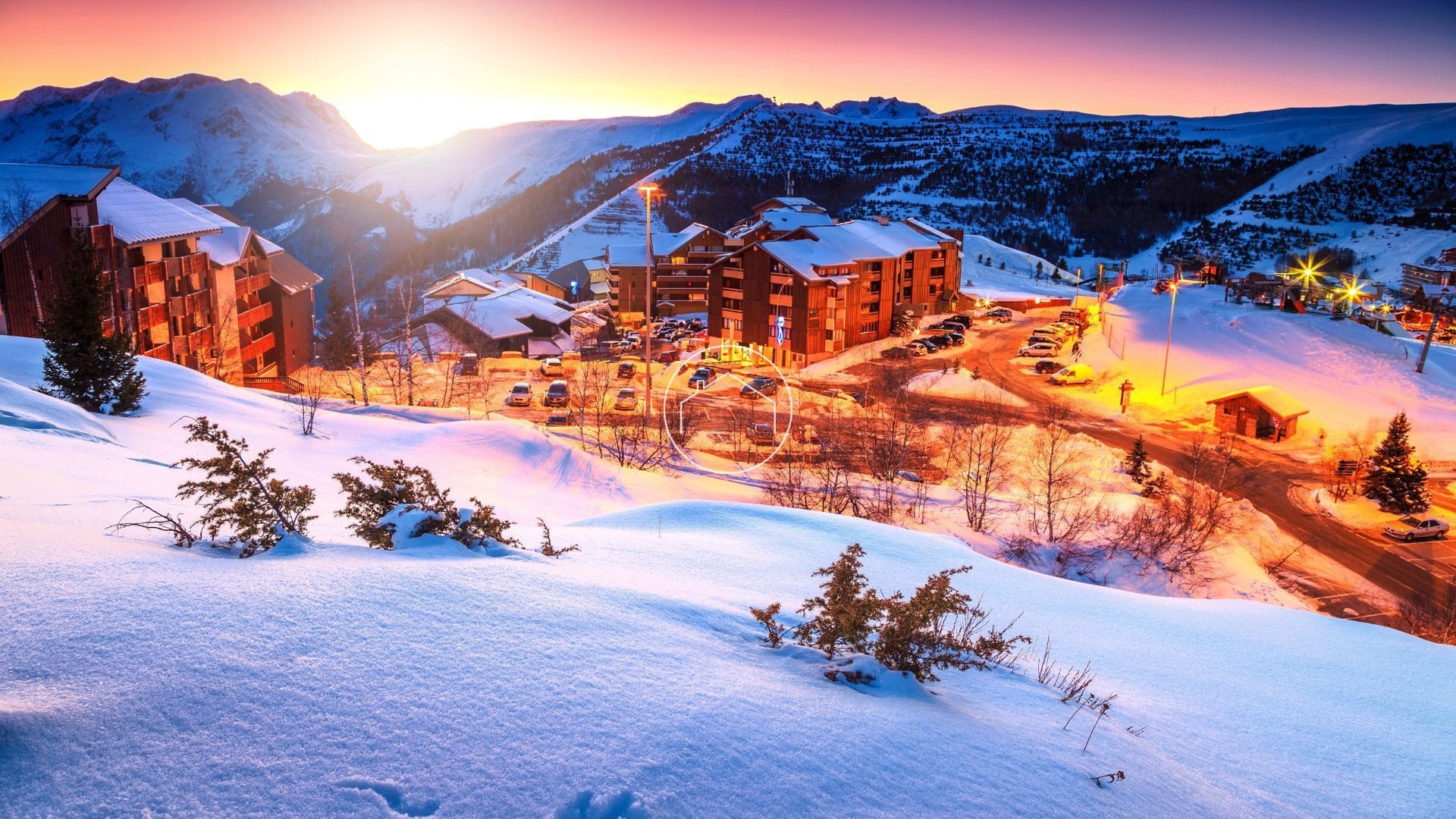
At 1,860m on the Isère side of the French Alps, Alpe d’Huez is one of the few major French ski resorts that can credibly claim 300 days of sunshine a year. The locals call it L’Île au Soleil — the Island in the Sun — and for very good reason: the south-facing plateau sits high above the Romanche valley, and the combination of altitude, aspect and microclimate delivers some of the most reliable good-weather skiing in the entire French Alps. For buyers, that matters enormously. A property you can genuinely use in January sunshine without sinking into grey valley fog is a very different proposition from a lower-altitude alternative.
Alpe d’Huez is also the anchor of the Grand Domaine Ski, a 250km linked network covering Alpe d’Huez itself, Auris, Oz-en-Oisans, Vaujany and Villard-Reculas. The area rises to 3,330m at the top of the Pic Blanc — one of the highest lift-served skiable points in France — and descends to 1,100m in the valley, delivering a vertical drop and piste length that rivals the 3 Vallées giants. Buyers can pick from several micro-markets: the resort-centre Alpe d’Huez village, the quiet Vaujany valley, the small family sectors of Auris and Oz, or the historic village of Villard-Reculas. Each tells a different buyer story.
This guide walks through what the resort is actually like to ski, the 2026 property market, the rental yield reality, and the practical mechanics of buying as a non-resident. We’ll also cover the infrastructure upgrades shaping values over the next decade, and the reasons Alpe d’Huez is one of the strongest value-luxury propositions in the Isère side of the French Alps. If after reading you’d like live inventory, our Alpe d’Huez property page lists current stock across the Grand Domaine.
Location & Character
The Island in the Sun: What Makes Alpe d’Huez Different
Alpe d’Huez sits on a wide, south-facing plateau at 1,860m, reached from Grenoble via the famous 21-hairpin climb made iconic by the Tour de France. The plateau itself is large enough to accommodate the resort village, a small aerodrome (the altiport has occasional fixed-wing traffic and regular helicopter services), golf course, ice rink and a walkable village centre — something genuinely rare at this altitude. Unlike the narrower, concrete-stacked Tarentaise resorts, Alpe d’Huez feels open and spacious, with long views south to the Écrins massif and east to the Maurienne peaks.
The climate is the resort’s secret weapon. The south-facing aspect and the altitude combine to deliver an average of around 300 sunny days per year, with dry cold rather than damp fog, and reliable snow cover from December to late April despite the warm aspect. Snow-making coverage has been expanded meaningfully over the past decade, and the high-altitude Glacier de Sarenne terrain stays open well into the spring. For buyers prioritising usable winter weather — days when you genuinely want to be on the mountain rather than retreating to the apartment — Alpe d’Huez consistently delivers more of them than any other major French resort.
The resort is also practically accessible. Grenoble-Isère Airport is 63km away (1h15 by road), Lyon Saint-Exupéry is 160km (2h), and the Eurostar ski train to Bourg-Saint-Maurice is not far off Grenoble-line access in travel terms for UK buyers willing to use direct TGV via Lyon. For British buyers based on the south coast and the southwest, Alpe d’Huez is one of the fastest drives from the Channel Tunnel of any major French resort. Our buying process guide covers transit logistics in more detail.
300 days
Approximate annual sunshine on the Alpe d’Huez plateau — the highest of any major French ski resort
€7,500–11,000
Typical 2026 new-build price per m² in central Alpe d’Huez — below Megève and the 3 Vallées
3,330m
Top altitude at the Pic Blanc — one of the highest lift-served skiable points in France
3–4% net
Realistic rental yield range for well-positioned Alpe d’Huez new-builds
Skiing
The Skiing: 250km, Pic Blanc and the Sarenne Descent
The Grand Domaine Ski covers 250km of linked pistes across Alpe d’Huez, Auris, Oz-en-Oisans, Vaujany and Villard-Reculas, with 84 lifts serving 133 runs. The top of the network is the Pic Blanc at 3,330m, accessed by the Pic Blanc cable car from the top of the Grandes Rousses gondola. From the Pic Blanc you can ski the La Sarenne run — at 16km it’s one of the longest black pistes in Europe and a genuine bucket-list descent, dropping 2,000m of vertical through progressively gentler terrain down to the village of Le Freney-d’Oisans.
Beyond Sarenne, the network is unusually well balanced for all abilities. Beginners get the long wide Couloir and Signal sectors directly above the village, with free lift access at dedicated learning zones. Intermediates spend their week working across the Signal de l’Homme side, the DMC sector, and the Auris linkage. Advanced skiers and off-piste specialists head for the Pic Blanc’s couloirs, the Gorges de Sarenne, and the extensive off-piste available on the north side of the Massif des Grandes Rousses when conditions allow.
The high-altitude ski experience is what differentiates Alpe d’Huez from the mid-altitude Haute-Savoie resorts. Top-station temperatures stay cold into the spring, the snow quality at altitude is consistently excellent, and the reliability is genuinely better than any resort below 1,800m. For a buyer choosing between Alpe d’Huez and a lower-altitude Portes du Soleil option, that climate resilience is one of the main arguments for paying the Alpe d’Huez price premium — and the reason the resort has been much less affected by thin snow years than the broader French Alpine average.
Grand Domaine Ski: Alpe d’Huez Sector Pricing 2026
Central Alpe d’Huez
Ski-in/ski-out premium
Vaujany
Oz-en-Oisans
Auris-en-Oisans
Villard-Reculas
Market Data
2026 Property Prices: What You Actually Pay in Alpe d’Huez
In 2026, new-build apartments in central Alpe d’Huez trade in the €7,500–11,000 per square metre band, with the best ski-in/ski-out stock near the Grandes Rousses gondola reaching €12,500/m². Entry-level new-build one-beds start from around €320,000, two-beds from €480,000, three-beds from €720,000. That is meaningfully below the headline prices of the Tarentaise giants (Courchevel, Méribel, Val Thorens all €14,000–35,000/m²) and below Haute-Savoie leaders like Megève — making Alpe d’Huez one of the strongest value-luxury propositions in the French Alps.
Resale apartments trade in a slightly lower range, typically €5,500–8,500/m² depending on vintage and renovation status. Renovated central properties with direct ski access can narrow the gap to new-build pricing, particularly for unique view apartments or pre-2000 chalets with authentic character. Detached chalets are scarce in the resort centre itself but available in the satellite villages — Vaujany, Oz-en-Oisans and Villard-Reculas all offer traditional chalet stock in the €800,000–2.5M range with full Grand Domaine lift access.
The new-build VAT reclaim applies exactly as in higher-profile resorts: VEFA purchases entered into a classified managed rental scheme qualify for 20% VAT recovery on the gross price, with a minimum 9-year commitment through an approved operator. On a €600,000 apartment that represents €100,000 effective reduction in acquisition cost. Notaire fees on new-build run 2–3% versus 7–8% on resale — another material cost advantage for buyers willing to work with the VEFA process. Our new-build ski apartments page lists current Alpe d’Huez inventory.
“Alpe d’Huez is where serious Alpine altitude meets Mediterranean sunshine — 3,330m skiing, 300 days of sun, and property prices that still make investment sense in a world of compressed 3 Vallées yields.”
Micro-Markets
The Four Micro-Markets: Centre, Vaujany, Auris & Oz
The Alpe d’Huez centre is the commercial heart — wide streets, restaurants, bars, shops, direct access to the Grandes Rousses lift and the Signal beginners’ zone. This is where most new-build projects launch and where rental demand is strongest, so it carries a price premium but also the best yield numbers. For a buyer prioritising investor-use and high occupancy, central Alpe d’Huez is typically the right answer.
Vaujany is the quieter alternative — a traditional Isère village on the other side of the Grand Domaine, connected by a fast gondola. It is notably cheaper per square metre (typically €5,500–8,500/m² for new-build) and has a strong rental proposition of its own driven by French domestic families who value the authentic village atmosphere. Vaujany suits buyers who want Grand Domaine access without resort-centre density or prices.
Auris-en-Oisans and Oz-en-Oisans are the two smaller satellite villages. Auris is family-focused, quiet and tree-lined, with its own independent ski sector and connection to the main network. Oz sits at 1,350m and has meaningful new-build development in recent years, plus direct lift access to the DMC gondola that climbs towards Alpe d’Huez and the Pic Blanc. Both are value picks for buyers with moderate budgets who want a credible Grand Domaine address without central resort prices.
| Property Type | 2026 Price Range | Best For | Rental Yield |
|---|---|---|---|
| 1-bed apartment (new-build) | From €320,000 | Couples, investors | Strong (3–3.5% net) |
| 2-bed apartment (new-build) | From €480,000 | Small families | Strong (3–4% net) |
| 3-bed apartment (new-build) | From €720,000 | Families, group rental | Strong (3–4% net) |
| 4-bed duplex / penthouse | From €1.1M | Luxury multi-gen | Strong (3.5–4.5% net) |
| Vaujany chalet (resale) | €800k–€2.5M | Traditional chalet lovers | Moderate (2.5–3.5% net) |
| Oz/Auris new-build apt | From €280,000 | Value buyers | Moderate (2.5–3.5% net) |
Infrastructure
Lift Upgrades and Infrastructure Investment
The Grand Domaine Ski has been one of the most actively investing French resort networks of the past five years. Major capital projects have included the replacement of several older chairlifts with high-speed detachables, new snowmaking coverage along the Signal de l’Homme sector, and expanded beginner facilities around the central resort. The resort authorities have publicly committed to further uplift modernisation through 2028, with specific projects planned to reduce queues at the Grandes Rousses and the DMC gondolas at peak weekends.
For property buyers, these investments matter directly. Lift modernisation shortens queues, improves the guest experience, and drives sustained rental demand — which in turn supports property values across the network. The pattern has played out in every major French resort over the past 20 years: the resorts that invest consistently in infrastructure maintain their pricing advantage, while those that defer upgrades see their headline prices erode over time. Alpe d’Huez’s pipeline is clearly in the first category.
The resort is also investing in year-round infrastructure — the summer MTB network has been expanded, the 18-hole altitude golf course (one of the highest in Europe) has been updated, and the road access from Grenoble and Lyon has been kept in good condition despite the demanding climb. For a buyer seeking a credible year-round base with high personal-use intensity, these investments meaningfully improve the usability case versus winter-only resort alternatives.
1936
First ski lift installed
The original drag lift transforms the Alpe d’Huez plateau from a summer pasture into one of the pioneering French ski resorts.
1968
Grenoble Winter Olympics
Alpe d’Huez hosts Olympic events, cementing the resort’s international profile and triggering sustained infrastructure investment.
1990s
Grand Domaine formed
The linkage of Alpe d’Huez with Auris, Oz, Vaujany and Villard-Reculas creates the 250km ski area that defines the modern resort.
2003
Pic Blanc cable car renewed
Major uplift upgrade at 3,330m reinforces Alpe d’Huez as one of the highest-altitude ski experiences in France.
2020s
Infrastructure modernisation wave
Systematic replacement of older chairlifts with high-speed detachables across the Grand Domaine materially improves the guest experience and supports property values.
2026
Continued lift investment
Published resort capital programmes target further queue reduction at Grandes Rousses and the DMC gondolas through 2028.
Rental & Tax
Rental Yields, Non-Resident Mortgages & Tax
Realistic net rental yields for well-positioned Alpe d’Huez new-builds run 3–4% for investor-only use, or 2–3% net if you take one or two high-season weeks for personal use. The best central addresses with professional management and strong summer bookings can reach 4.5% net in strong seasons. These numbers are materially better than the top-tier Tarentaise giants (Courchevel, Megève typically compress to 1.5–2.5%) and on par with the best Haute-Savoie family resorts — a direct consequence of Alpe d’Huez’s value-luxury pricing.
On the financing side, 2026 non-resident French mortgages remain accessible. Typical LTVs run 70–80% for prime British profiles, 70% for non-EU citizens, and fixed rates currently sit at 3.3–4.4% on 20-year terms. Because ECB policy has eased over 2024 and 2025, rates are meaningfully below the 2023 peaks — making 2026 a more attractive window for leveraged buyers than at any point in the past three years. Our French mortgage calculator models current scenarios.
Tax-wise, the LMNP furnished rental regime is the default wrapper for investor-users. LMNP lets you depreciate the building component of the property over 25–40 years and the furniture over 7 years, typically shielding the first 10–15 years of rental income from French income tax entirely. Combined with the 20% VEFA VAT reclaim, the after-tax return on a well-structured Alpe d’Huez new-build compares favourably with most Northern European buy-to-let alternatives — and the UK/France double-tax treaty protects UK buyers from being taxed twice.
The Verdict
Who Alpe d’Huez Is Right For
Alpe d’Huez is an exceptional fit for buyers who prioritise high-altitude snow reliability, sun-drenched winter weather, a major 250km linked ski area, and a credible value-luxury price point below Courchevel, Megève or Val d’Isère. It works particularly well for British buyers based in the south and southwest of England who value the faster Channel Tunnel/Lyon drive compared to the Tarentaise, for families with mixed abilities, and for investor-users building a credible rental case with strong summer usability.
It’s probably not the right fit for buyers who specifically want the Portes du Soleil or the 3 Vallées lift pass (obvious, but worth stating), who want a traditional Haute-Savoie village character (look at Megève, Les Gets or Montriond instead), or who need trophy-address prestige for its own sake (Courchevel 1850 remains the default for that). But for the large majority of buyers who want genuine ski-first Alpine quality at a reasonable price, with year-round usability and reliable weather, Alpe d’Huez is one of the strongest value-luxury propositions in the entire French Alps. Our Alpe d’Huez property page lists live inventory and the Domosno team can walk you through specific buildings.
Common Questions
Frequently Asked Questions
How reliable is snow cover at Alpe d’Huez compared to lower-altitude resorts?
Very reliable. The resort sits at 1,860m and the Grand Domaine rises to 3,330m at Pic Blanc, with an extensive snowmaking network covering the south-facing main slopes. Winter snow cover from December to April is consistent in normal seasons, and the Glacier de Sarenne stays open well into spring — meaningfully more reliable than Megève, Morzine or Les Gets.
Is Alpe d’Huez suitable for families with young children?
Excellent for families. The plateau is wide and walkable, the Signal and Couloir beginner zones are genuinely large and well-staffed, and the ski schools offer English instruction. The resort centre has everything families need — restaurants, supermarkets, ice rink, indoor pool and evening activities — without the hairpin access road of more remote resorts.
What’s the best value area of Alpe d’Huez for buyers?
For investor-users with a €400k–€800k budget, central Alpe d’Huez new-builds deliver the strongest yield and the easiest rental management. For lifestyle buyers who prioritise traditional village character over resort density, Vaujany is the strongest alternative at €5,500–8,500/m², typically 25–35% below central prices for equivalent specs.
How does Alpe d’Huez compare to the 3 Vallées resorts?
Alpe d’Huez has a smaller ski area (250km vs 600km) but meaningfully better altitude, sunshine and climate resilience. Property prices are typically 30–60% below the 3 Vallées giants, and rental yields are consequently stronger. For buyers choosing between them, the trade-off is sheer ski-area scale versus sunshine and pricing.
Can non-residents get a French mortgage for Alpe d’Huez?
Yes. Non-residents typically access 70–80% LTV in 2026, with prime British profiles reaching up to 85%. Non-EU citizens usually cap at 70%. Fixed rates for non-residents run 3.3–4.4% on 20-year terms. Our French mortgage calculator models both scenarios with realistic current rates.
Does a new-build in Alpe d’Huez qualify for the 20% VAT reclaim?
Yes — VEFA new-builds entered into a classified managed rental programme qualify for 20% VAT recovery on the gross purchase price. The commitment is typically 9 years with an approved operator. On a €600,000 apartment that represents roughly €100,000 recovered, materially improving the investment maths.
What’s the best access route from the UK?
Either fly into Grenoble-Isère (63km, 1h15 by road), Lyon Saint-Exupéry (160km, 2h) or drive from the Channel Tunnel via the French motorway network (around 9 hours). For buyers based in southern England, the drive is one of the faster French Alpine options, since Alpe d’Huez sits further west than the Tarentaise giants.
Is Alpe d’Huez a good year-round investment?
Increasingly so. The summer economy has been meaningfully strengthened over the past decade with the MTB network, altitude golf course and hiking infrastructure. Year-round rental bookings can reasonably target net yields of 3.5–4%, compared to 2.5–3% for winter-only resorts. The Tour de France associations provide an additional summer visibility boost in July each year.
Featured Properties
Popular Ski Resorts
Morzine
Megève
Chamonix
Les Gets
Alpe d’Huez
Les Deux Alpes
Les Arcs
La Plagne
Courchevel
Méribel
Saint-Martin-de-Belleville
Val Thorens
Val d’Isère
Tignes
Thollon-les-Mémises
Quick Links
All New-Build Ski Properties
All Ski Apartments
All Ski Chalets
New-Build Ski Apartments
New-Build Ski Chalets
Resale Ski Apartments
Resale Ski Chalets