PISTE ROBOTICS
Autonomous Snow Groomers Arrive in the French Alps: How Self-Driving Piste Machines Are Reshaping Ski Resort Operations in 2026
A quiet robotic revolution is unfolding every night on French Alpine pistes — and the economics, snow quality and carbon footprint of ski property is changing with it.
18 Apr 2026
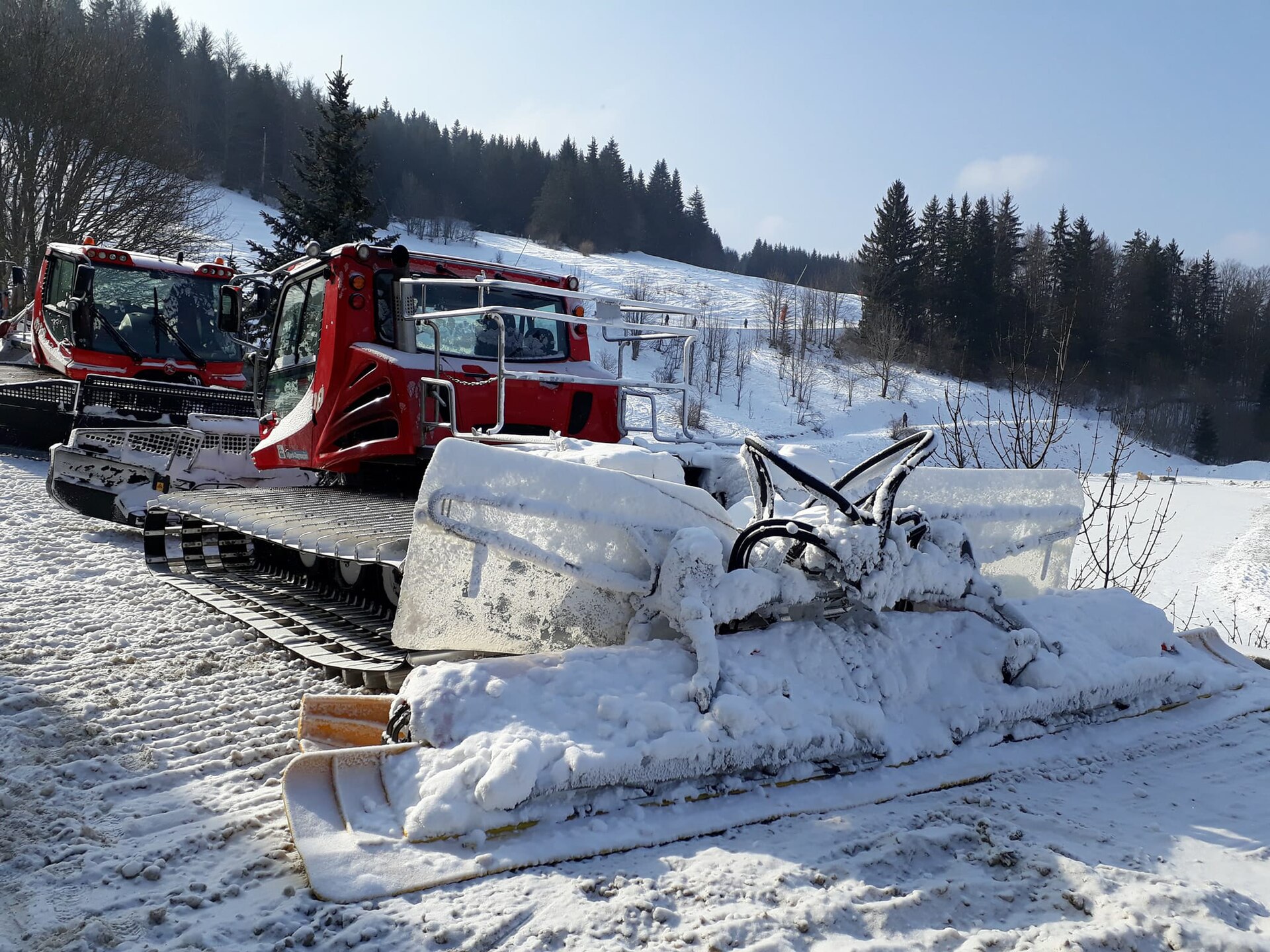
Every night, long after the last chairlift has stopped and the bar terraces have emptied, a fleet of 40-tonne tracked machines fans out across French Alpine ski resorts. For sixty years the dameuse — the piste basher, known internationally as a snowcat or snow groomer — has been the most under-appreciated piece of equipment in skiing. Each resort runs between five and thirty of them, each machine costs around €400,000, each one burns roughly 20 litres of diesel per hour, and collectively they account for a surprisingly large slice of a resort’s operating budget and carbon footprint.
Something is now changing. Through 2025 and into 2026, French resorts have begun serious trials of autonomous and semi-autonomous snow groomers — machines that can groom a piste with minimal driver input, optimise their own fuel consumption, measure snow depth in real time, and coordinate with the rest of the fleet. The technology is not yet universal, but the trajectory is clear: the dameuse is going the same way as the tractor and the mining truck, and the operational economics of ski resorts will follow. For anyone who owns — or is considering buying — a French Alps ski property, this quiet revolution is worth understanding.
The Starting Point
Why Piste Grooming Is the Unsung Core of Any Ski Resort
Piste preparation is the invisible infrastructure of skiing. A 2024 analysis by France Montagnes, the umbrella body for French ski resorts, estimated that grooming costs the French ski industry around €180 million per season. In the Trois Vallées alone, between 70 and 90 machines operate every night across the combined domain, running two shifts from roughly 5pm to 9am and resurfacing around 600 km of marked pistes before the first skier loads onto a chairlift.
The reason this matters commercially is simple: snow quality is the single biggest determinant of guest satisfaction in a ski resort. Guest surveys conducted by Atout France and ski-resort operators consistently rank piste condition above lift speed, food, accommodation and even weather. A badly groomed morning costs reputation; a consistently perfectly groomed one builds it. That is why, despite their cost and carbon impact, no serious resort has ever considered grooming less.
The status quo, though, has limits. Night grooming is lonely, skilled work with a significant safety component — avalanche exposure, winch cables with enormous forces, steep gradients. Driver retention is a growing problem across the Alps, and wage costs have climbed meaningfully over the past three seasons. The industry has been looking for technical answers, and Kässbohrer (maker of the PistenBully) and Prinoth (maker of the Leitwolf) have been delivering them.
€180M
Estimated annual cost of piste grooming across French ski resorts (France Montagnes, 2024)
-12–18%
Projected reduction in grooming operating cost from full smart-grooming adoption (Mountain Planet trade show, 2024)
€400k
Typical purchase price of a modern high-end snow groomer (PistenBully / Leitwolf range)
30–40%
Share of a French ski resort’s direct emissions attributable to piste grooming
The Technology
What ‘Autonomous’ Actually Means in 2026
A modern dameuse is already a data-rich machine. Since the late 2010s, both major manufacturers have equipped their flagship vehicles with GPS-linked snow-depth radar (SNOWsat from Kässbohrer, ARENA from Prinoth). These systems measure snow depth under the tracks in real time, display a heat map of the snowpack to the driver, and allow a resort to push snow precisely from deep areas to thin ones. For a resort using artificial snowmaking, that feedback loop alone has been shown to cut water and energy use by 10–15% compared to a blind grooming strategy.
The 2025–2026 step change is from assisted to semi-autonomous. Prinoth’s Leitwolf h² is already commercially available as a hydrogen-powered (zero tailpipe CO2) groomer, and the company has demonstrated a remotely supervised unmanned prototype (Husky eMotion) on closed test slopes. Kässbohrer’s PistenBully line has added steer-assist, track-limit warnings, automatic blade height control, and winch path planning. In practice, today’s fleet is closer to Level 2–3 autonomy (driver-supervised) than full Level 5 (no driver), but the operational model is already shifting — one driver per machine is becoming one driver supervising two or three.
The enabler beneath all of this is precise positioning and mapping. Every marked piste in a modern resort is surveyed to centimetre accuracy with RTK-GPS; every run of every machine is logged; snow-depth data is accumulated into multi-season datasets. This is what makes full autonomy plausible in the first place: the machine operates inside a well-mapped, largely closed environment at night with no skiers present — structurally a much easier autonomy problem than a self-driving car in traffic.
Autonomous Grooming Adoption Across French Alps (2026)
Val Thorens / 3 Vallées
Tignes / Val d’Isère
La Plagne / Les Arcs (Paradiski)
Alpe d’Huez / Les 2 Alpes
Portes du Soleil / Grand Massif
Family / village resorts
French Alps Adoption
Which Resorts Are Leading the Robotic Shift
Not every French resort is moving at the same speed. A useful rule of thumb: the larger the domain and the deeper the operator’s pockets, the further along it is. The Compagnie des Alpes, which operates flagship resorts including Tignes, Les Arcs, La Plagne and parts of the Trois Vallées, has been the most public about investment in smart grooming. Val Thorens was an early adopter of SNOWsat across its full fleet and has been publicly trialling Leitwolf h² hydrogen units. Méribel and Courchevel have integrated snow-depth mapping into daily grooming decisions for several seasons.
In the Portes du Soleil and Grand Massif, independent-minded operators like SERMA (Avoriaz), Morzine’s SAEM and Les Gets have followed with similar technology at a slightly slower pace. Val d’Isère and Tignes (Espace Killy) are testing semi-autonomous grooming on lower-risk pistes. Alpe d’Huez and Les Deux Alpes have invested in fleet data systems. Smaller family resorts — think Saint-Martin-de-Belleville, Valmorel, Thollon-les-Mémises — are mostly running standard modern machines without full autonomy yet, but they benefit from supplier-wide software updates that make even a non-autonomous machine operate more efficiently.
The broader picture: by the end of the 2026/27 season we expect every major French ski domain to operate at least partial semi-autonomous grooming, and several Compagnie des Alpes resorts to be running closed-circuit fully autonomous night shifts on selected pistes. That is a remarkable adoption curve for a heavy-equipment category that barely changed between 1980 and 2015.
“The dameuse is going the same way as the mining truck and the container-port crane — and the resorts that adopt early are buying themselves a durable cost, quality and carbon advantage.”
The Economics
What This Does to Resort Operating Costs
Follow the money and the picture becomes clearer. Industry case studies presented at the Mountain Planet trade show in Grenoble in 2024 suggested that a full rollout of smart-grooming technology across a large French domain could reduce annual grooming operating cost by 12–18%, through a combination of lower fuel use, reduced overtime, less artificial-snow consumption, and fewer machine-hours burned resurfacing already-sufficient pistes. At Trois Vallées scale, that translates to meaningful millions per season.
For resort operators, the return is not just lower cost — it is the ability to hold piste quality steady while staff retention and wage inflation make it harder to maintain headcount. Autonomy here is a defensive investment, not just an efficiency play. For property investors in resorts owned by listed groups (Compagnie des Alpes is publicly traded) this matters directly: grooming is a meaningful cost line, lift-pass prices are under pressure, and technology that holds margins keeps resorts financially healthy — which in turn keeps them investing in the lifts, beds and snowmaking that drive property values.
There is also a decarbonisation angle. Grooming accounts for roughly 30–40% of a typical French ski resort’s direct emissions. Hydrogen-powered groomers, electric shuttle versions, and the broader fuel-efficiency gains from smart software add up to a resort-level carbon story that increasingly matters for the environmental certifications (Flocon Vert, ISO 14001) that ski buyers now consciously look for.
| Grooming Generation | Representative Model | Capability | French Alps Status |
|---|---|---|---|
| Legacy (pre-2010) | Kässbohrer 200-series | Manual operation, no data capture | Largely phased out |
| Data-enabled (2010–2018) | PistenBully 600 / Leitwolf | GPS tracking, basic telematics | Standard fleet today |
| Smart (2018–2024) | PistenBully 600 SCR SNOWsat | Snow-depth radar, fleet coordination | Widely deployed in large resorts |
| Semi-autonomous (2024–2026) | Leitwolf h² / Husky eMotion | Steer-assist, remote supervision, hydrogen | Early deployment, CdA resorts leading |
| Fully autonomous (2026+) | Next-gen unmanned prototypes | Unmanned night shifts on mapped pistes | Closed-circuit trials only |
Property Implications
What This Means for Ski Property Buyers
For French Alps property buyers the link is indirect but real. Snow quality, operational reliability and resort carbon performance are all inputs into long-term property value. Resorts that maintain perfectly groomed pistes through marginal snow seasons defend their visitor numbers; resorts that don’t, lose market share to higher-altitude rivals. Autonomous grooming is a defensive moat against climate variability, because it allows resorts to manage thin snow zones with surgical precision rather than blanket machine passes.
Rental yield is also affected. A resort with consistently good piste condition in shoulder weeks (late November, early April) can extend its commercial season by 7–14 days. That is directly additive to rental income on investment properties, because shoulder weeks are exactly the margin where rentals either book or fail to book. Data from our rental management partners suggests that a two-week season extension lifts annual gross yield on a typical new-build ski apartment by 3–5%.
At the other end of the spectrum, ultra-prime buyers are increasingly asking about resort sustainability credentials as part of due diligence. The question is no longer just “is this property well-built?” but “is the resort operating in a way that preserves value over 20 years?” A resort investing heavily in autonomous, low-carbon grooming is signalling a long-term commitment that matters to buyers writing €5M–€20M cheques for chalets in the 3 Vallées and Val d’Isère.
1962
First commercial snow groomer (Tucker Sno-Cat)
The Tucker Sno-Cat brings mechanised grooming to North American ski resorts, kicking off an industry.
1969
Kässbohrer launches PistenBully
The German-built PistenBully becomes the European standard and arrives in France shortly after.
2014
SNOWsat and ARENA snow-depth systems go mainstream
GPS-linked radar snow-depth systems transform grooming from art to data-driven operation.
2022
First hydrogen groomer demonstrated
Prinoth demonstrates the Leitwolf h² hydrogen-powered groomer at Mountain Planet Grenoble.
2024
Hydrogen groomer reaches French commercial operation
Val Thorens and other resorts begin integrating hydrogen-compatible machines into production fleets.
2026
Semi-autonomous night shifts begin
Multiple French resorts begin supervised semi-autonomous operation on lower-risk pistes at scale.
Wider Robotics
Grooming Is Just the Beginning
The autonomous dameuse is the most visible example of a much broader trend. Across French ski resorts in 2026 you will find automated snowmaking networks that respond to wet-bulb temperature, drone-based piste inspection, AI-powered avalanche forecasting (which we covered in our earlier article on AI and snowmaking), predictive maintenance on lifts, autonomous shuttles in resort car parks, and robotic cleaning of gondola cabins. Nothing here is replacing the fundamental experience of skiing — people still want to ski with people — but everything operational behind the scenes is being rebuilt.
The next five years will also see more progress on the hardware side. Prinoth’s Leitwolf h² hydrogen groomer is already operating commercially, and several French resorts are in active procurement discussions. Fully electric groomers are harder because of battery weight and cold performance, but small autonomous skidder-size machines for narrow sections and back-country connections are in prototype. The likely 2030 picture is a mixed fleet: hydrogen-powered autonomous heavy units on the main pistes, small electric autonomous units on feeder trails, human-operated specialist units for winch work and difficult terrain.
From an investor standpoint, the important observation is that this is a classic technology adoption curve happening inside an industry most people still think of as romantically analogue. The resorts that invest early buy themselves a durable cost and quality advantage. The resorts that don’t, will feel the gap widen. Over a 10–20 year property holding period, which resort is on which side of that curve starts to matter.
Safety & Driver Role
What Happens to the Dameurs?
A reasonable question, especially in French resorts where the role of the dameur is both highly skilled and culturally embedded. The short answer is that their role changes rather than disappears. In every large-scale equipment autonomy transition we have precedent for — mining trucks, container ports, warehouse forklifts — the human role moves from direct driver to supervisor, planner and exception-handler. Winch grooming on steep terrain, avalanche-risk management, new-snow clearing after heavy falls, and tight-terrain work will remain human-led for the foreseeable future.
For French resorts there is a practical reason for gradual transition. The dameur role is unionised, the equipment investment cycle runs 8–12 years per machine, and semi-autonomy delivers most of the cost and safety benefits of full autonomy with much less change-management friction. Our reading is that full unmanned grooming on live ski domains is unlikely before 2030–2033 even in the most advanced French resorts, and that the principal gain between now and then will come from one driver managing two or three machines simultaneously on the flatter, well-mapped parts of the domain.
What buyers should take from this is that the underlying infrastructure is getting better, more reliable and more data-rich every season — and that the resorts leading the charge are also typically the ones with the strongest long-term property fundamentals. Technology adoption in grooming is, in effect, a proxy for operational seriousness.
Buyer Takeaway
How to Factor Robotic Grooming Into a Property Decision
When we help clients evaluate French Alps ski property at Domosno, resort operational quality is a standard part of the due diligence. Autonomous grooming now sits alongside snowmaking coverage, lift capital investment, and altitude profile on the checklist. Our practical advice for buyers reading this through a property lens: first, ask about the size and age of the grooming fleet — a newer, larger fleet is a positive signal. Second, check whether the resort operator publishes any sustainability or technology reports. Third, consider the ownership structure — Compagnie des Alpes resorts tend to move faster than independent family-run domains, though the latter can offer the best value.
Fourth, do not overweight the story. Piste grooming is one input among many. Altitude remains the single most important climate-resilience factor, and no grooming technology will save a low-altitude resort with a failing snowpack. Autonomous grooming extends the life and quality of well-sited resorts, not badly sited ones. The Chamonix Valley, Tignes, Val Thorens, the upper Trois Vallées and the head of the Espace Killy are structurally advantaged regardless; technology compounds that advantage rather than creating it.
Finally, think about this as a tailwind rather than a decision driver. Ski property in the French Alps is a long-duration asset, and the quieter, cleaner, more efficient resort operations of 2030 are part of the value you are buying into when you sign a preliminary sale contract in 2026. The dameuses rolling out now will still be operating — smarter, cleaner and more autonomous — when your children inherit the chalet.
Common Questions
Frequently Asked Questions
Will autonomous groomers replace human drivers in French Alps resorts?
Not fully, and not soon. Full unmanned grooming on live domains is unlikely before 2030–2033 even in the most technology-forward French resorts. The practical near-term change is one driver supervising two or three machines simultaneously, and humans retaining control of winch work, steep terrain, avalanche-risk zones and post-storm clearing.
How does smart grooming affect ski property values?
Indirectly but measurably. Resorts with smart grooming maintain better piste quality in marginal snow conditions, extend their shoulder seasons, and run lower operating costs — all of which support long-term visitor numbers and therefore ski property values. The Three Vallées, Espace Killy and upper Paradiski resorts are leading the adoption curve and are also the resorts seeing the strongest recent price growth.
Are hydrogen-powered snow groomers commercially available?
Yes. Prinoth’s Leitwolf h² hydrogen groomer is in commercial operation as of 2024, with Val Thorens among the earliest adopters in the French Alps. Hydrogen groomers deliver zero tailpipe CO2 and are part of French resorts’ broader decarbonisation strategies, which matters increasingly to property buyers seeking long-term asset durability.
Which French ski resorts have the most advanced grooming operations?
The Trois Vallées (particularly Val Thorens, Méribel and Courchevel), Tignes and Val d’Isère in the Espace Killy, and Compagnie des Alpes resorts including Les Arcs and La Plagne are the most technology-forward. Independent larger domains like Avoriaz in the Portes du Soleil and Les Gets in the Grand Massif follow at a slightly slower pace but are also investing actively.
Does autonomous grooming reduce a resort’s carbon footprint?
Yes, through three routes: lower diesel consumption per hour through smarter driving patterns; fewer redundant machine passes thanks to snow-depth mapping; and substitution of hydrogen or electric drivetrains. Industry analysis suggests combined reductions of 15–25% in grooming-related emissions are achievable, and grooming accounts for 30–40% of total resort direct emissions.
How does this technology connect to ski property buying decisions?
Resort operational quality is a key input to long-term ski property value. At Domosno we include resort technology investment, snowmaking coverage and altitude profile in our standard due diligence on any new-build development. Our property search can help you focus on resorts that are advancing operationally, not just aesthetically.
Are smaller or family-run resorts at a disadvantage?
They are slightly behind on autonomy but not structurally disadvantaged. Most smaller resorts run modern fleets with telematics and GPS snow-depth mapping even when they haven’t adopted semi-autonomous units. For buyers focused on value, family-run resorts like Saint-Martin-de-Belleville, Valmorel or Thollon-les-Mémises remain excellent investment propositions despite slower adoption.
Can autonomous grooming help resorts cope with climate change?
Yes, as a defensive tool. Smart grooming allows resorts to manage marginal snow conditions with precision — pushing snow from deep areas to thin ones, timing grooming passes to conserve snow, and operating more efficient snowmaking. It doesn’t solve the underlying climate problem but it extends the operational window of well-sited, high-altitude resorts meaningfully, which matters for long-term property value.
Featured Properties
Popular Ski Resorts
Morzine
Megève
Chamonix
Les Gets
Alpe d’Huez
Les Deux Alpes
Les Arcs
La Plagne
Courchevel
Méribel
Saint-Martin-de-Belleville
Val Thorens
Val d’Isère
Tignes
Thollon-les-Mémises
Quick Links
All New-Build Ski Properties
All Ski Apartments
All Ski Chalets
New-Build Ski Apartments
New-Build Ski Chalets
Resale Ski Apartments
Resale Ski Chalets