New-Build Spotlight
Chalet L’Agate, Vaujany: New Alpine Living in the Family-Friendly Heart of Alpe d’Huez
A comprehensive look at the €165,000–€763,000 new-build apartment development in Vaujany, completion Q3 2026 — positioning, pricing, ski access, specification, and investment case for family and beginner-focused buyers.
3 Feb 2024

Vaujany is not Alpe d’Huez — and that is precisely its strength. Nestled on the opposite side of the valley from the main Alpe d’Huez resort, this charming mountain village of around 350 residents retains a genuine alpine character that many larger ski stations have lost. At 1,250 metres altitude, Vaujany sits within the 250-kilometre Alpe d’Huez Grand Domaine ski area but maintains its own identity: a ‘Famille Plus Montagne’ certified village with strong infrastructure for families, beginners and intermediate skiers. Chalet L’Agate, completing in Q3 2026, represents a rare opportunity to buy into this understated yet strategically positioned location at a price point — averaging €6,965 per square metre — that undercuts premium resorts like Méribel and Courchevel by 30 per cent or more. The development offers studios through four-bedroom apartments priced from €165,000 to €763,000, with direct access to the village’s famous escalator system and the Vaujany gondola that connects to the broader Alpe d’Huez Grand Domaine.
The investment case for Chalet L’Agate rests on three pillars: location economics, rental demand, and development quality. Location economics are compelling: Vaujany is roughly one hour’s drive from Grenoble and two hours from Lyon airport, making it highly accessible for international buyers seeking a second home in the French Alps without the premium-resort price tag. Rental demand is robust, sustained by the ‘Famille Plus’ certification and proven family appeal: gross rental yields in the 4.5–6 per cent range are achievable for furnished apartments in Vaujany, particularly during school holidays and the February half-term. Development quality is evident in the specification — the building is clad in natural wood and stone, with balconies on most units, heated ski lockers, private cellars, basement parking, and a full wellness suite including sauna, steam room, jacuzzi and massage room, plus a dedicated children’s playroom and concierge service.
Chalet L’Agate is built under the French VEFA (Vente en l’État Futur d’Achèvement) framework, which allows buyers to benefit from the 20 per cent VAT reclaim mechanism available on furnished rental properties. The development timeline is well-defined: stage payments are structured across the build phases through to completion, with the notaire role ensuring legal protection at each step. This article walks through Vaujany’s positioning within Alpe d’Huez, the development’s design and specification, ski access logistics, the broader investment case, and the practical steps to purchase via VEFA, as well as the village’s broader lifestyle offering for families and leisure-focused buyers.
Village Positioning
Vaujany: The Understated Village on the Valley Floor
Vaujany sits at 1,250 metres on the opposite side of the valley from Alpe d’Huez town, connected by the DMC (Téléphérique de la Maison de la Culture) lift, a two-way cable car that runs year-round. The valley geography is itself a feature: looking up the opposite slope toward Alpe d’Huez’s higher elevations and the Pic Blanc (at 3,330 metres), you get a profound sense of altitude without Vaujany itself feeling remote or car-dependent. The village has roughly 350 permanent residents and a core of reliable local infrastructure: a modern leisure centre with swimming pool and ice rink, a primary school, a pharmacy, a post office, grocery shops, several restaurants and bars, and free covered parking throughout the village. The modern escalators — built in the 1980s as part of the village’s lift infrastructure — are iconic and make the connection between the lower village and the upper lift stations seamless and accessible even for families with young children or elderly visitors.
The ‘Famille Plus Montagne’ label, awarded by the French government to family-friendly mountain resorts that meet strict criteria for childcare, family facilities, and beginner skiing infrastructure, is a tangible competitive advantage for Vaujany. This certification drives bookings from families in the UK, France, the Benelux, and Germany, particularly during school holiday periods. The village’s beginner skiing area at Montfrais — a gentle bowl of blue and green runs just above the village — is purpose-designed for young learners and nervous intermediates. The Montfrais area is accessible via the Vaujany gondola (the Remontée Mécanique de Vaujany), a free lift that takes eight minutes to ascend to the main ski area. The free lift infrastructure is historically funded by royalties from the EDF Grande Maison hydroelectric dam, which sits on the other side of the valley — a fascinating piece of Alpine infrastructure history that gives Vaujany a long-term subsidy for ski access that few other villages enjoy.
Vaujany’s position within the broader Alpe d’Huez Grand Domaine (250 kilometres of linked ski terrain accessed from seven different villages and entry points) means that while the village itself is small, the skiing is not. From Montfrais, intermediate and advanced skiers can access the full Grand Domaine network via the main Vaujany gondola. Iconic runs include the DMC piste down from Pic Blanc and the Sarenne run, one of the longest black runs in the Alps at over 16 kilometres, which descends all the way to the village of Villard-Reculas before linking back to the main ski area. The practical upshot: Vaujany offers genuine family-friendly skiing in a small, charming village setting without sacrificing access to world-class intermediate and advanced terrain.
€6,965/sqm
Average price per square metre at Chalet L’Agate — 30–35% cheaper than Méribel or Courchevel new-build apartments.
4.5–6%
Gross annual rental yields achievable for furnished apartments in Vaujany with professional rental management and occupancy management.
8 minutes
Gondola time from Vaujany village to the main Alpe d’Huez ski area at Montfrais, with free lift infrastructure funded by historic hydroelectric royalties.
250 km
Linked ski terrain across the Alpe d’Huez Grand Domaine, accessible from Vaujany via the main gondola and lift system.
The Development
Chalet L’Agate: Layout, Specification and Pricing
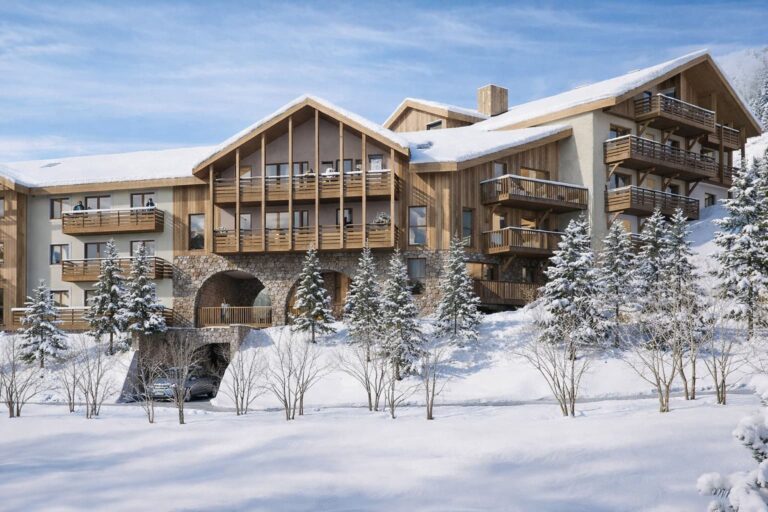
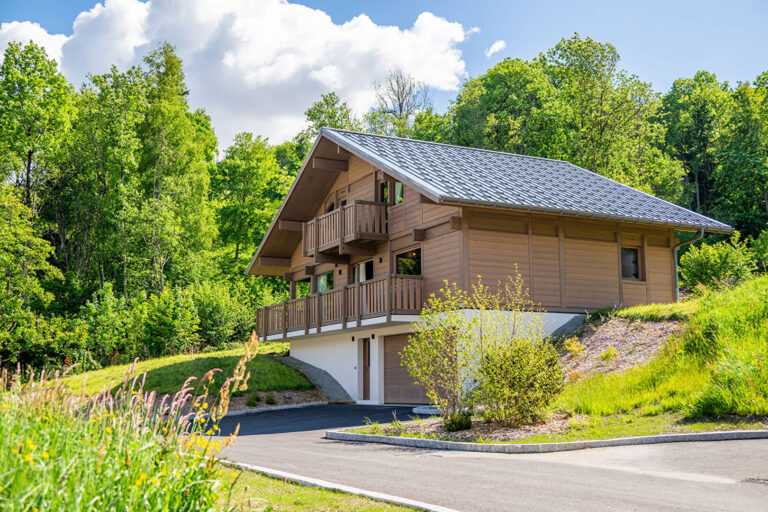
Chalet L’Agate is positioned at the upper edge of Vaujany village, with immediate access to the free escalators and the Vaujany gondola. The building comprises multiple apartment blocks arranged around shared courtyards and designed to blend into the Alpine landscape with traditional materials: wood cladding and natural stone facades echo the vernacular architecture of the wider region. The development houses studios, one-bedroom, two-bedroom, three-bedroom and four-bedroom apartments, priced from €165,000 (studios) to €763,000 (top-of-range four-bedroom units). The average price per square metre across the range is €6,965, which is dramatically cheaper than premium new-build developments in Méribel (€11,000–€13,000 per square metre) or Courchevel (€12,000–€15,000 per square metre), yet higher quality in specification than many older or less well-positioned Alpe d’Huez properties.
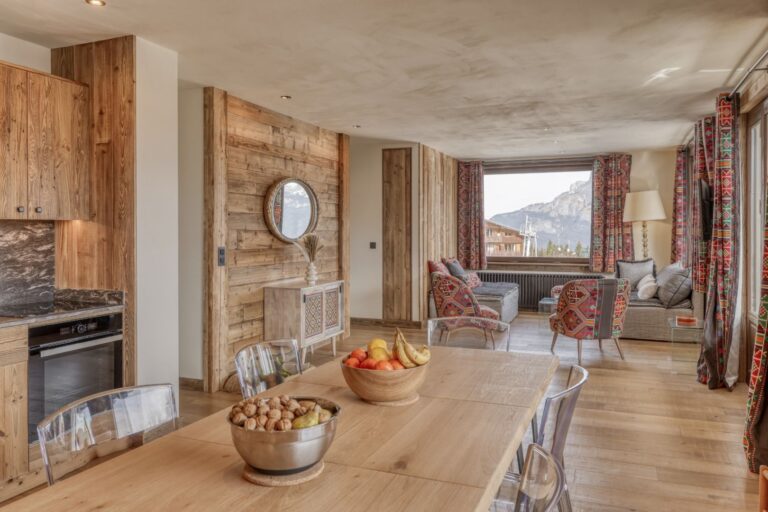
The specification is comprehensive: each apartment includes heated ski lockers on the ground floor (a necessity for rental properties, where guest turnover is constant and drying facilities are critical), individual cellars for storage, basement parking, and balconies on most units with views toward the valley or the Grandes Rousses massif. The building includes a full wellness facility in the basement with sauna, steam room, jacuzzi and massage room — a amenity particularly attractive to families seeking post-ski relaxation and to older buyers concerned with wellness. There is a dedicated children’s playroom, a lounge with fireplace, and a reception and concierge service available to residents. The building has been designed to BBCA (Bâtiment Basse Consommation d’Énergie) standard, meaning excellent insulation and lower operating costs compared to older Alpine properties.
The purchasing structure is VEFA (Vente en l’État Futur d’Achèvement), which in France means the buyer receives delivery of an ‘as yet uncompleted’ property at a future date. VEFA purchases include statutory buyer protections — a 10 per cent deposit held in escrow, stage payments aligned to the construction progress (typically 15 per cent at foundation, 40 per cent at roof, 20 per cent at windows and doors, and final settlement at completion), and a two-year defect guarantee provided by the builder’s insurance. The notaire’s role is to safeguard the buyer’s funds and ensure all legal formalities are completed. Completion is targeted for Q3 2026, with stage payments expected through 2025 and into early 2026.
Typical Chalet L’Agate apartment pricing and monthly gross rental potential
Studio (25–30 sqm)
1-bed (40–50 sqm)
2-bed (65–75 sqm)
3-bed (100–115 sqm)
4-bed (130–150 sqm)
Average rent (2-bed annual)
Ski Access
Connection to the Alpe d’Huez Grand Domaine: Montfrais and Beyond
The Vaujany gondola (Remontée Mécanique de Vaujany) is a free eight-minute lift from the village to the main ski area at approximately 1,800 metres. This connectivity is the single most important feature of Vaujany skiing: families staying in the village can be on the slopes within 10 minutes of leaving their apartment. The gondola runs from roughly 8:30 a.m. to 5:00 p.m. daily during the ski season (typically mid-December to late March), with extended hours on peak school holiday weekends. The escalators through the village mean that young children, elderly visitors, and those with mobility challenges can reach the gondola without navigating steep slopes or difficult terrain — this is a profound advantage for multi-generational family groups and accessibility-conscious buyers.
From the top of the Vaujany gondola, beginner and intermediate skiers are immediately on the Montfrais plateau, a gentle bowl of blue and green runs designed specifically for learning. Montfrais includes the Montfrais area with the nursery slopes and confidence-building intermediate runs. Advanced skiers can take the DMC lift from Montfrais to Pic Blanc at 3,330 metres, where the full Alpe d’Huez Grand Domaine terrain opens up. The descent from Pic Blanc via the DMC piste is one of the most iconic runs in the region, with views across the valley and down toward Villard-Reculas. Intermediate skiers looking for more challenge beyond Montfrais can access the broader network of blue and red runs throughout the Alpe d’Huez area.
The Sarenne run — over 16 kilometres of linked pistes descending from Pic Blanc to Villard-Reculas at 780 metres — is one of the longest black runs in the Alps and a genuine draw for advanced skiers. The run is often opened mid-morning (depending on snow conditions) and requires the Pic Blanc connection. From Villard-Reculas, skiers can re-access the main Alpe d’Huez area via lifts or can return to Vaujany via the Villard-Reculas connection. Off-piste opportunities are substantial in the Alpe d’Huez area, though this requires a guide. Mountain biking is equally prominent in summer, with 250 kilometres of marked trails accessible from the same lift infrastructure.
“Vaujany offers genuine Alpine family skiing without the premium price tag — and Chalet L’Agate delivers contemporary specification at 30% below Méribel and Courchevel new-build rates.”
Interior Specification
Materials, Finishes, Amenities and Rental Features
The exterior cladding combines timber and natural stone, designed to harmonise with the Alpine vernacular. This is not merely aesthetic: the materials are functional. Wood cladding provides weathering protection and thermal performance, while natural stone base courses and window surrounds add thermal mass and visual grounding. Balconies are south or west-facing where possible, maximising sun exposure and views. The roofline is pitched to shed snow effectively, and gutters and downpipes are proportioned for Alpine rainfall and snowmelt volumes. The level of detail suggests the developer understands Alpine building rather than simply applying a standard template.
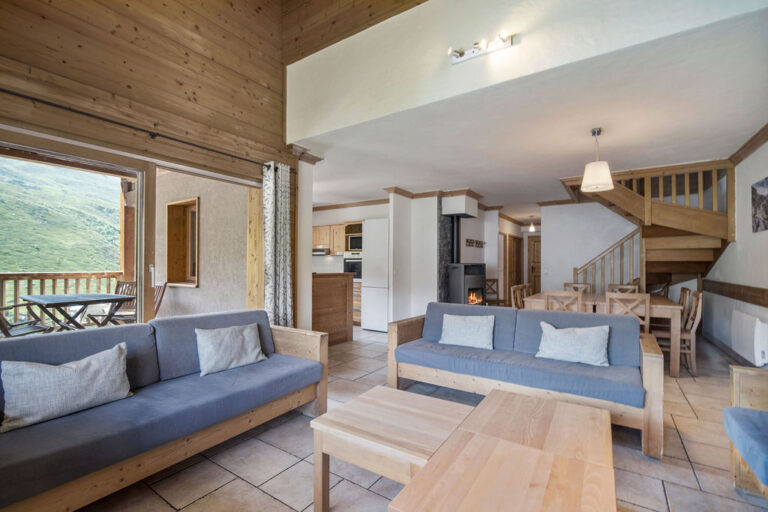
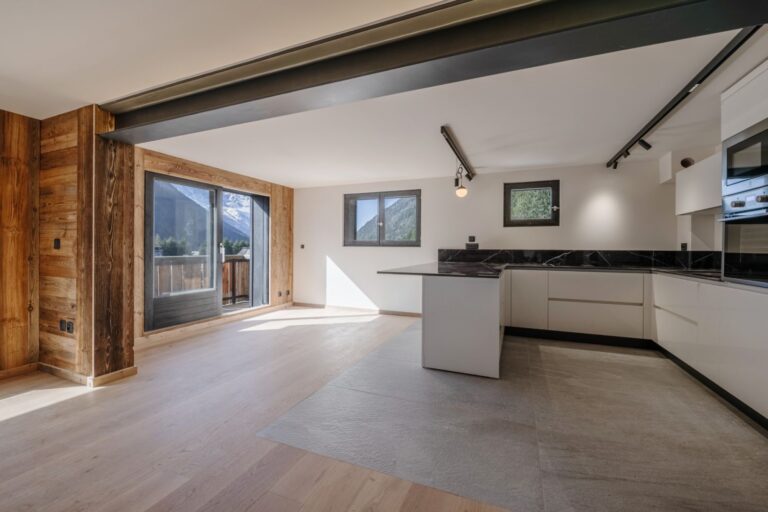
Interior finishes are contemporary but restrained: kitchens are fitted with modern appliances (induction hob, oven, extraction, integrated dishwasher and fridge-freezer), bathrooms include shower enclosures and heated towel rails, and flooring is typically solid wooden boards in main living areas with tile in wet zones. Heating is via an individual heat pump or boiler serving each apartment (not a shared plant), which allows occupants to manage their own consumption and gives rental operators control over winter heating costs. All apartments are wired for high-speed broadband, a necessity for working-from-home guests and year-round residents. Laundry facilities are either in-apartment (larger units) or available in a shared facility.
The heated ski lockers are a critical rental feature: these are maintained at approximately 15 degrees Celsius (significantly warmer than outdoor storage or unheated basements), allowing ski boots and bindings to dry properly between days, preventing rust and equipment degradation, and making the return to skiing the following day comfortable. The lockers are sized for two sets of adult skis or four pairs of boards and the corresponding boots. Private cellars offer secure storage for personal effects, off-season clothing, and sometimes secondary equipment. Basement parking is enclosed and lit, with dedicated numbered spaces allocated to each apartment. The wellness suite with sauna and jacuzzi is available on a timed booking basis to all residents.
| Aspect | Chalet L’Agate | Comparable Méribel | Comparable Courchevel | Key Advantage |
|---|---|---|---|---|
| Average price per sqm | €6,965 | €11,500 | €13,500 | 30–35% price savings |
| 2-bed apartment (70 sqm) | €488,000 | €805,000 | €945,000 | €317,000–457,000 cheaper |
| Gross rental yield (furnished) | 4.5–6% | 3–4% | 2.5–3.5% | Higher occupancy, family demand |
| Ski access time | 8 minutes (free gondola) | 15 minutes (paid lift) | 20 minutes (paid lift) | Free lift, fastest access |
| Village size and atmosphere | 350 residents, charming | 2,000+ residents, busier | 2,500+ residents, premium feel | Authentic, quiet, accessible |
| VAT reclaim (furnished rental) | 20% available | 20% available | 20% available | Structured into rental package |
Investment Case
Pricing Economics, Rental Yields and VAT Reclaim Potential
Chalet L’Agate is priced at an average of €6,965 per square metre across all apartment sizes and unit types. This compares very favourably to new-build developments in competing Alpe d’Huez area locations: similar new-build properties in central Alpe d’Huez town are typically €8,000–€9,500 per square metre, while new-build in Méribel averages €11,000–€13,000 per square metre and Courchevel €12,000–€15,000 per square metre. The price advantage is genuine and material. A typical two-bedroom apartment at Chalet L’Agate might be 65–75 square metres, pricing at approximately €450,000–€520,000, whereas an equivalent unit in Méribel would run €700,000–€1,000,000.
The rental yield case rests on family demand during peak periods (school holidays, February half-term, Easter) and steady mid-season lettings. Furnished apartments in Vaujany achieve average daily rates of €120–€180 per night for one-bedroom units and €180–€260 per night for two-bedroom units, depending on season and occupancy management. A typical two-bedroom apartment generating 150 nights of bookings per annum at €200 per night yields €30,000 gross rental income. Operating costs (management fee to an agent, insurance, utilities, maintenance reserve, council tax) typically consume 30–40 per cent of gross income, leaving net yields of 4.5–6 per cent on the purchase price — highly competitive by Alpine standards and comparable to established rental properties in Chamonix or Val d’Isère.
The VAT reclaim mechanism is particularly attractive: in France, furnished rental properties (meublés touristiques) managed under a professional rental agreement (including staged cleaning, linen changes, and guest liaison services) qualify for 20 per cent VAT reclaim on the purchase price. For a €500,000 property, this represents €100,000 of reclaimed VAT, which can be returned to the buyer via the notaire or offset against other French VAT liabilities. The reclaim is not automatic — it requires proof of professional rental management and proof of intended furnished rental status — but when structured correctly, it is a powerful capital boost to the investment case. Buyers purchasing with the full rental management package (which Chalet L’Agate developers are offering in conjunction with a professional rental agent) should expect to secure the full reclaim.
Q1 2025
Completion of Avant-contrat and first stage payment
Buyer signs preliminary agreement, deposits 10% in escrow, begins 10-day reflection period. Legal commitment becomes binding after reflection period.
Q2 2025
Foundations and first progress stage
Construction begins, foundations reach completion, surveyor verifies progress. Second stage payment (15%) released from escrow on verification.
Q3 2025
Roof installation and major structural work
Building envelope substantially complete, roof installed. Third stage payment (40%) released on surveyor verification of roof and weatherproofing.
Q4 2025
Windows, doors, and internal divisions
External envelope closed, windows and doors installed, internal partitions in place. Fourth stage payment (20%) released on verification.
Q1–Q2 2026
Finishes, fittings and final defect inspection
Kitchens, bathrooms, flooring, heating systems installed. Final defect walkthrough with independent surveyor before completion.
Q3 2026
Completion and notaire settlement
Final payment (15%) released, deed (acte authentique) signed with notaire, property transferred to buyer. VAT reclaim processed through notaire.
Buying Process
VEFA Timeline, Stage Payments, Notaire Role and Completion
The purchase of a VEFA property in France follows a legally mandated structure. The buyer first signs a non-binding Information Document (Formulaire d’Information Précontractuelle) and a preliminary agreement (Avant-contrat), which establishes the sale price, unit specifications, and expected completion date. At this stage, the buyer deposits approximately 5 per cent of the purchase price, held in escrow by the developer’s notaire. This deposit is fully refundable if the developer fails to complete by the deadline or if material contract terms are breached.
Once the Avant-contrat is signed, the buyer has 10 days to withdraw without penalty (the statutory reflection period). After this 10-day period, the commitment becomes binding. The developer then exchanges the Avant-contrat for the formal VEFA Contract (Contrat de Vente), which itemises the apartment specification, payment schedule, completion timeline, and defect remedies. Stage payments are typically structured as follows: 10 per cent at exchange (already deposited), 15 per cent when foundations are completed, 40 per cent when the roof is on, 20 per cent when windows and external doors are installed, and the final 15 per cent at completion. Each stage payment is verified by an independent surveyor before funds are released from escrow.
The notaire’s role is fundamental: the buyer’s notaire (who is typically appointed by the buyer or jointly with the developer) ensures that all stage payment conditions are met, that the developer’s insurance is valid, and that the final deed (acte authentique) is properly registered with the French land registry. The notaire also calculates the VAT reclaim position and guides the buyer through the process of claiming the 20 per cent refund if the property qualifies. Completion is expected in Q3 2026, with stage payments scheduled across 2025 and early 2026. The final settlement includes the balance of the purchase price plus applicable taxes and notaire fees, typically totalling 7–8 per cent of the purchase price.
Life in Vaujany
Village Amenities, Dining, Leisure and Year-Round Lifestyle
Vaujany is not a resort town in the sense of Méribel or Courchevel — there is no casino, no Michelin-starred restaurant, and no nightlife equivalent to a large ski centre. What Vaujany offers instead is authentic Alpine village life with modern conveniences. The leisure centre (Centre de Loisirs) includes a heated swimming pool, ice rink, fitness gym, and activity classes, making it central to family holidays and winter weekends. The ice rink hosts both public skating and hockey matches. The swimming pool is indispensable during the warmer months and for families with young children in winter. The village primary school, Ecole de Vaujany, serves local families and takes visiting children during school holiday periods with activities programmes. There is a qualified doctor’s surgery in the village, a pharmacy, a post office, and several small grocery shops covering the basics — while serious provisioning is easier from Grenoble (an hour’s drive), everyday items are locally available.
Dining options are limited but solid. The Hotel V de Vaujany is a comfortable three-star hotel and restaurant with traditional Savoyard cuisine, often full during peak seasons with tourists and visitors. La Bergerie, a simple mountain restaurant near the Montfrais area, serves casual lunches during ski season. Le Comptoir, located in the neighbouring village of Villard-Reculas (about 20 minutes by car or ski link), is a popular casual spot with good pizza and simple French fare. For more extensive dining, Grenoble offers everything from casual bistros to Michelin restaurants, a one-hour drive away. Local food culture is rooted in traditional Alpine ingredients: cheese (especially Bleu du Vercors and Reblochon from the broader region), cured meats, and hearty stews.
Year-round lifestyle in Vaujany includes summer mountain biking on the same trails used by skiers in winter, hiking in the surrounding Écrins National Park, fishing in local mountain streams, and paragliding from the higher altitude points. The village hosts an annual Fête Nationale (July 14) with fireworks and a village fête, and a winter carnival in February. The mountain biking season runs from June through September, with the same 250-kilometre trail network as the winter ski area. For non-sporty visitors, the village offers a gentler pace than busier resorts: walks through the village, afternoon coffee at a local café, and the simple pleasure of mountain views. The accessibility by car (one hour from Grenoble, two hours from Lyon airport) makes Vaujany realistic for regular long-weekend visits and for semi-retired couples seeking a part-time Alpine base.
Common Questions
Frequently Asked Questions
Why is Vaujany cheaper than Méribel or Courchevel if it’s in the same ski area?
Vaujany is genuinely separate in character from the main Alpe d’Huez resort. It is a small village with limited infrastructure, lower brand recognition, and a more local feel rather than a cosmopolitan resort. Prices reflect this — the village is not competing for luxury retail, Michelin dining or celebrity clientele. However, the skiing is equivalent (same Grand Domaine access), and family appeal is actually stronger due to Famille Plus certification and beginner-friendly Montfrais area.
Is the gondola really free?
Yes, the Vaujany gondola (Remontée Mécanique de Vaujany) is free to residents and visitors. This funding model has been in place since the 1980s and is supported by historic royalties from the EDF Grande Maison hydroelectric dam on the opposite side of the valley. This is a genuine structural advantage: buyers do not incur daily or seasonal lift pass charges for the main connection to the ski area, which meaningfully reduces the cost of living in the village.
What are the rental yields really achievable?
Professional rental management in Vaujany typically delivers gross yields of 4.5–6% on purchase price, depending on occupancy and daily rates. A two-bedroom apartment at €500,000 generating 150 nights at €200 per night yields €30,000 gross income and approximately €18,000–21,000 net after management fees and operating costs. This is materially higher than yields in premium resorts but assumes consistent occupancy management and family-season focus. Summer and peak winter periods are strongest; November and April are significantly weaker.
Can I really claim back 20% VAT?
Yes, provided the property is purchased under the furnished rental (meublé touristique) structure and is managed professionally as a rental. The VAT reclaim is not automatic — the buyer must execute a rental management agreement with a professional agent and provide evidence of intended rental use. Chalet L’Agate developers are offering integrated rental management packages specifically to facilitate this reclaim. Your notaire will calculate the exact VAT reclaim position and guide the formal process.
What is the VEFA process and why should I care?
VEFA (Vente en l’État Futur d’Achèvement) means you are buying an apartment not yet completed. The legal framework provides strong buyer protections: deposits are held in escrow, stage payments are tied to verified construction progress, and the developer must provide two years of defect cover via builder’s insurance. This is actually safer than buying off-plan in many jurisdictions because the French legal and insurance framework is specifically designed to protect VEFA buyers.
How much is the notaire fee and what else do I need to budget for?
Notaire fees for a French property purchase are typically 7–8% of the purchase price and are regulated by law. For a €500,000 property, expect €35,000–40,000 in notaire fees, plus €1,500–3,000 in mortgage registration fees if financing. VAT on the purchase price is included in the sale price (already quoted at VAT-inclusive prices), so you are not paying VAT on top. Currency conversion costs (if buying from outside the euro zone) should be budgeted separately.
What is the reality of living in a small village like Vaujany?
Vaujany is not a resort town. There is no nightlife, no high-end shopping, and limited restaurant options. What it offers instead is quiet, authentic Alpine living with excellent family skiing and modern amenities (leisure centre, school, medical facilities). The village is realistic for families, retired couples, and part-time occupants seeking a weekend or holiday base. For buyers requiring year-round entertainment and dining, proximity to Grenoble (one hour) is essential.
Can I get a French mortgage to buy Chalet L’Agate?
Yes, non-resident mortgages are available for French property purchases through French banks and brokers. Typical loan-to-value limits are 70–80% for EU/UK residents, at fixed rates around 3.8–4.4% for 20-year terms in 2026. The 33% debt-service affordability rule is strictly applied, so buyers should confirm their borrowing capacity early. French mortgages require life insurance covering the loan balance and typically take 8–12 weeks to arrange. Specialist non-resident mortgage brokers can guide the process.
Featured Properties
Popular Ski Resorts
Morzine
Megève
Chamonix
Les Gets
Alpe d’Huez
Les Deux Alpes
Les Arcs
La Plagne
Courchevel
Méribel
Saint-Martin-de-Belleville
Val Thorens
Val d’Isère
Tignes
Thollon-les-Mémises
Quick Links
All New-Build Ski Properties
All Ski Apartments
All Ski Chalets
New-Build Ski Apartments
New-Build Ski Chalets
Resale Ski Apartments
Resale Ski Chalets