Ski Industry News
How AI Is Revolutionising Snowmaking: The Technology Keeping Ski Resorts Alive
From Super-Besse in Auvergne to Mountain Creek in New Jersey, AI-driven snowmaking is letting resorts produce snow in warmer conditions, slash energy use and extend viable seasons — here is how the technology actually works, and what it means for Alpine property owners.
15 Jan 2026
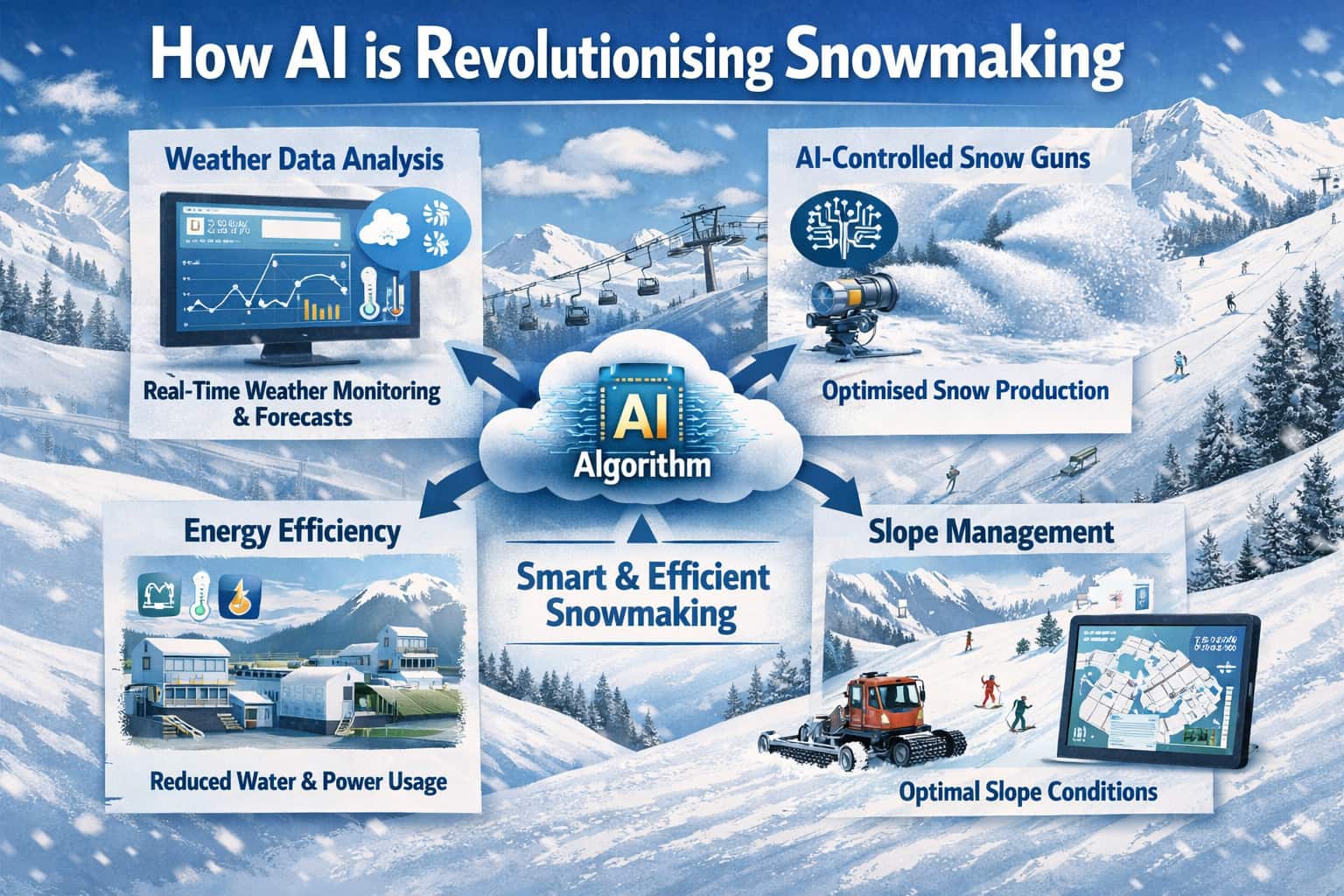
The idea that a ski resort can manufacture snow in conditions once considered marginal sounds, at first hearing, like an engineering fantasy. But at Super-Besse in the Auvergne region of central France, exactly that is happening in 2026 — AI-powered snowmaking systems analyse weather data in real time to identify brief optimal production windows, preparing pistes with a thirty-metre-wide snow layer even when the ambient air temperature suggests the conditions should be impossible. Across the Atlantic at Mountain Creek in New Jersey, operators have slashed energy consumption by around 70% while simultaneously doubling snow output — a resort that now runs roughly 15% of its snowmaking system for the same energy cost it once took to operate just 1% of the old manual setup.
These are not marketing numbers. They are the documented operational results of a quiet technology revolution that has transformed ski resort snowmaking from an energy-intensive gamble into a precise, predictive science. The core breakthrough is the combination of wet-bulb temperature monitoring, machine-learning forecasts, networks of atmospheric sensors and automated snow-gun control — a stack that lets a resort continuously find and exploit the tiny windows of cold that used to be missed by manual operators. The result is more snow, better quality, lower energy use, and a materially improved ability to survive warm winters that would previously have wrecked the commercial season.
This article walks through how AI snowmaking actually works, which resorts are leading adoption in France and elsewhere, what the efficiency numbers really mean, and why property buyers should care about it. Snowmaking reliability is one of the most important underlying operational quality signals in the modern French Alpine property market, and AI-driven systems are rapidly becoming the baseline expectation at any well-operated ski destination. Understanding the technology is increasingly part of doing proper due diligence on a resort’s long-term prospects.
The Science
Why -3°C Wet-Bulb Temperature Is the Magic Number
The physics of snowmaking rest on a single critical threshold: the wet-bulb temperature, a measurement that combines air temperature with relative humidity into a single metric determining whether water droplets can freeze into snow crystals before hitting the ground. The rough practical rule is that at around -3°C wet-bulb, traditional snowmaking becomes viable, and below that figure, efficiency improves sharply. Above it, energy use balloons and the snow quality deteriorates. Understanding this number is the foundation of every AI snowmaking system.
Traditional snowmakers relied on experience and manual checks. An operator would walk outside, look at the thermometer, feel the humidity, and make a judgement call. Good operators became genuine craftspeople over years of night shifts, but even the best of them missed production windows — particularly short ones. A two-hour wet-bulb dip in the middle of the night, when the operator was at the other end of the resort dealing with a different gun, might go entirely unexploited. Over a season those missed windows added up to thousands of cubic metres of potential snow that never got made.
Today’s AI platforms monitor wet-bulb temperature continuously, sometimes updating every few minutes, with data pulled from networks of weather sensors tracking air temperature, relative humidity, barometric pressure, wind speed and direction, solar radiation and precipitation. The AI models use that input to identify snowmaking opportunities as brief as a few hours in advance, and in many cases to predict inversions before they happen. At Levi Ski Resort in Finland, 335 automated snow guns equipped with weather sensors continuously adjust water pressure and flow rates based on real-time conditions, producing significantly more snow for the same input of water and energy.
The deeper change is that the system moves from reactive to predictive. Instead of reacting to cold conditions once they arrive, modern snowmaking schedules production around a seven-day forecast, deploys guns automatically when the models identify a high-value window, and adjusts production parameters on the fly as the actual conditions evolve. For large resort networks with hundreds or thousands of snow guns, this is a genuinely transformational efficiency improvement — one that was simply impossible under manual operation.
-3°C
Approximate wet-bulb temperature threshold below which traditional snowmaking becomes viable and AI systems excel
70%
Energy consumption reduction documented at Mountain Creek after full AI snowmaking deployment
335
Number of automated, AI-networked snow guns at Levi Ski Resort in Finland — a benchmark European deployment
€5-10M
Typical annual snowmaking operating cost at a major French resort, where 20% AI-driven efficiency gains translate to €1-2M/year saved
The Case Studies
Super-Besse, Mountain Creek and the Efficiency Frontier
Super-Besse in the Auvergne is the most striking French example of AI snowmaking in challenging conditions. The resort sits at a relatively modest altitude by Alpine standards and has historically faced meaningful climate risk on its lower commercial pistes. Its AI-driven snowmaking has let it exploit short production windows aggressively — the resort reports being able to lay down a thirty-metre-wide snow layer across its key pistes even when the ambient air temperature seems too warm, by finding and fully using every two-to-four-hour cold window the forecast identifies.
Mountain Creek in New Jersey is the benchmark for energy-efficiency gains. The resort’s operators have documented a roughly 70% reduction in energy consumption and roughly doubled snow output versus their pre-AI baselines. In practical terms, the resort is producing significantly more snow while running a fraction of the power-intensive compressors and pumps it once needed. The economic consequence is substantial: what once took 100% of the system to make a given volume of snow now takes 15% of the system, freeing compressors and pumps for longer production runs, deferred maintenance and lower peak-power bills.
Levi in Finland is the European benchmark for fully-automated fleet deployment. With 335 snow guns all on an AI control network, Levi is able to run 24/7 across the entire production-capable period of the season with minimal human intervention. The operators can focus on grooming, maintenance and quality-control audits rather than the minute-by-minute judgement calls that used to dominate their working day. That is a cultural as well as a technical shift for the industry — the job of snowmaker is changing from craftsperson to systems engineer.
Several French resorts are now at or close to this level of deployment. Serre Chevalier has completed a full ATASSpro rollout with TechnoAlpin’s latest AI platform, Le Grand Bornand has invested heavily in automated fan guns integrated with AI control, the Espace Killy resorts of Tignes and Val d’Isère operate automated networks across more than 65km of pistes, and the Trois Vallées has comprehensive AI coverage on its main commercial routes. The Portes du Soleil resorts, Paradiski, Grand Massif and most of the other major Alpine destinations are somewhere along the same curve.
AI Snowmaking: Efficiency and Operational Gains
Energy use reduction (European norm)
Energy use reduction (Mountain Creek)
Snow output per unit input
Water consumption reduction
Production window capture
Operational labour requirement
The Economics
What the Energy and Water Savings Actually Mean
The headline figure that matters most is energy consumption. AI-driven snowmaking systems consistently deliver 15-30% reductions in energy use at European resorts, with outlier cases like Mountain Creek reporting 70% reductions where the baseline was particularly inefficient. For a major French resort spending €5-10 million annually on snowmaking operations, a 20% efficiency gain is €1-2 million of recurring cost savings per season, which compounds over a decade into a genuinely material contribution to resort profitability and reinvestment capacity.
The water savings are equally important and perhaps more politically valuable. French ski resorts are increasingly scrutinised by environmental NGOs and regulators on their water consumption, and resorts that can show quantitative improvements of 20-30% in water efficiency via AI automation are in a far stronger position when negotiating water allocations with local and regional authorities than resorts that continue running inefficient manual systems. The ability to expand snowmaking coverage while reducing absolute water draw is one of the industry’s most important defensive narratives against regulatory pressure, and AI is the operational tool that makes the narrative credible.
Beyond energy and water, there is a third efficiency dimension that is less discussed but increasingly important: labour. A modern AI-driven network can be supervised by a small team of engineers working standard day shifts, where a manual system required around-the-clock attendance during production windows. The change frees up labour for other operational priorities and improves retention of experienced staff because the job is no longer defined by cold midnight shifts spent walking between remote snow guns. Operational resilience improves as a result, and the whole snowmaking function becomes easier to plan, audit and improve.
The aggregate economic effect of all these shifts is that AI snowmaking is quietly becoming one of the largest operational improvements in ski resort history. Resorts that have adopted it early have widened their operational quality gap versus laggards, and the gap is showing up in property markets that give weight to operational resilience and climate adaptation. The signal is not loud — you will not see a resort billboard advertising its wet-bulb sensor network — but it shows up in the underlying numbers on lift utilisation, piste availability, customer satisfaction and repeat-visit rates.
“AI snowmaking is no longer a competitive differentiator — it is baseline infrastructure at any well-run ski resort, and the resorts that have not invested in it are the ones showing up on the wrong side of the climate-risk ledger.”
The Climate Angle
Why AI Snowmaking Matters for Climate-Resilient Resorts
The climate adaptation story is the single most important reason AI snowmaking has become essential industry infrastructure. Warmer winters are compressing the natural window of cold conditions, and resorts that cannot efficiently exploit short cold spells are the most exposed to climate risk. AI systems directly address this by maximising production during every available window, stretching the viable operational calendar at both ends of the season and protecting commercially critical village-connection pistes even during marginal conditions.
A lower-altitude French resort — say, something at 1,200-1,500 metres — that has invested in AI snowmaking is typically able to guarantee opening dates a week or two earlier and stay open a week or two later than the same resort running manual systems. Over a 20-week ski season, that is a meaningful stretch that feeds directly into lift-pass revenue, rental yields for property owners, and the overall commercial health of the resort. Over multiple seasons of compounding, it is the difference between a resort that remains viable through the next decade of warming and one that struggles.
There is also a defensive angle against environmental criticism. The argument that ski resorts are profligate water and energy users is sometimes deployed by environmental groups pushing for operational constraints on the industry. AI snowmaking is the industry’s strongest counterpoint, because it allows resorts to demonstrate concrete efficiency improvements, absolute reductions in water and energy consumption per unit of snow output, and quantitative monitoring of environmental KPIs. Resorts with mature AI deployments have data to put on the table; resorts without them do not.
For the Alpine property market, the practical consequence is that operational quality and climate resilience are now quantifiable variables that thoughtful buyers should factor into their resort selection. The worst place to own a chalet over the next decade is at a low-altitude resort with weak operational investment and no AI snowmaking — that combination creates meaningful downside risk to rental yields, occupancy and capital values. The best place to own is at a well-invested resort with mature automation, strong altitude protection, and deep commercial management. The spread between those two endpoints is widening year by year.
| Resort | Country | Key AI Deployment | Reported Impact |
|---|---|---|---|
| Super-Besse | France (Auvergne) | AI + wet-bulb sensor network | Snow even in marginal warm windows |
| Mountain Creek | USA (New Jersey) | Full automated AI stack | ~70% energy reduction, output roughly doubled |
| Levi | Finland | 335 AI-networked snow guns | 24/7 automated production across fleet |
| Serre Chevalier | France | Full TechnoAlpin ATASSpro rollout | Efficiency and coverage gains across domain |
| Le Grand Bornand | France | New machine room + 135 AI fan guns and lances | Expanded reliable coverage |
| Trois Vallées | France | AI control on main commercial pistes | Consistent performance across domain |
Technology Partners
The Equipment Makers Behind the Revolution
TechnoAlpin, headquartered in Bolzano, is the largest supplier of AI-driven snowmaking systems worldwide and the dominant platform at most major French resorts. Its ATASSpro platform is the reference AI snowmaking control system and has been deployed at Serre Chevalier, in the Trois Vallées, at Portes du Soleil resorts and at multiple Paradiski operations. ATASSpro bundles wet-bulb monitoring, weather forecast ingestion, gun scheduling, real-time production control and post-season analytics into a single operational platform.
Demac Lenko, based in Italy, is the closest competitor and specialises in automated fan guns and integrated control systems. Its equipment is deployed widely across the Tarentaise and Haute-Savoie, and the company has been particularly aggressive on energy-efficiency improvements in its latest snow-gun models. Sufag, a Swiss specialist, is the premium supplier for resorts that prioritise very precise snow quality control, and its equipment is common at the high-altitude luxury resorts of Switzerland and western Austria.
Beyond the major equipment makers, a secondary layer of weather-data and machine-learning specialists has emerged to provide the forecast models that feed the AI control systems. These firms ingest data from national meteorological agencies, private weather networks and resort-installed sensors, and deliver hyper-local wet-bulb forecasts that drive scheduling decisions. The combination of hardware from TechnoAlpin or competitors and software from the specialist forecasting firms is what makes modern AI snowmaking possible at the efficiency levels quoted earlier.
The competitive market means that the technology is broadly available to any resort with the capital to deploy it. The constraint is not technical any more; it is capital, operational management and organisational willingness to change. Resorts with strong operators and capital discipline are moving rapidly; resorts with weaker management are lagging, and the gap is showing up in their seasonal performance numbers.
1989
First French snowmaking at scale
French resorts begin deploying snowmaking at commercial scale, initially as a supplemental tool for marginal early-season operations.
2000s
Infrastructure wave
French resorts invest heavily in expanding snowmaking coverage, taking the share of French piste under snowmaking from around 5% to approximately 20% by 2009.
2010-2015
Automation begins
Early-generation automated control systems from TechnoAlpin, Demac Lenko and Sufag arrive at major Alpine resorts, initially focused on remote gun operation rather than predictive scheduling.
2018-2022
AI layer matures
Machine-learning forecast and control systems mature and reach commercial deployment, with ATASSpro and competing platforms becoming the new industry standard.
2024-2025
Flagship rollouts
Serre Chevalier, Le Grand Bornand, Tignes, Val d’Isère and other major French resorts complete full AI snowmaking deployments on their main commercial networks.
2026
Baseline infrastructure
AI-driven snowmaking becomes a baseline expectation at all major French resorts, with the main differentiation now about coverage depth, hybrid production modes and integration with wider resort management platforms.
Property Implications
What AI Snowmaking Means for Alpine Property Buyers
For property buyers, the practical effect of AI snowmaking is that it meaningfully improves the operational reliability of the resorts that have deployed it, which feeds directly into rental yields and long-term value preservation. A resort that can reliably guarantee opening dates, protect key commercial pistes and stretch operational seasons at both ends of the calendar is a resort that will typically outperform similar resorts without that operational investment over the course of a 10-year ownership horizon.
The effect is most pronounced for mid-altitude resorts where climate risk is a real factor. Buying a chalet at 1,300-1,500m in a resort with weak snowmaking and no AI investment is a fundamentally different proposition from buying at the same altitude in a resort with a full AI-driven automated network. The first is exposed to meaningful downside risk on rental yield and capital value; the second is substantially insulated from it. Thoughtful buyers should ask pointed questions about operational investment when shortlisting resorts, and should weigh AI snowmaking alongside lift modernisation, summer revenue diversification and broader climate adaptation signals.
The Domosno team tracks operational investment across French resorts as part of our ongoing market coverage, and we can walk buyers through the full picture on specific resorts on their shortlist — including AI snowmaking coverage, climate resilience, lift modernisation and broader operational quality signals. Our new-build ski apartments page lists inventory across the full French Alpine market, and the Domosno team is happy to discuss how these factors apply to specific buildings and resorts.
The broader message for buyers is simple: snowmaking is no longer a background operational detail, it is a core part of a resort’s long-term viability story, and AI is now the defining technology that separates well-run resorts from weak ones. Buyers who treat it as a serious variable in their selection process will typically end up at better resorts with stronger long-term value performance than buyers who ignore it.
Looking Forward
Where AI Snowmaking Is Heading Next
The direction of development over the next 3-5 years is toward tighter integration with broader resort management platforms. AI snowmaking is becoming part of a wider operational data fabric that also includes lift control, grooming optimisation, guest flow management and energy management. The next generation of systems will coordinate snow production with grooming cycles, align snowmaking with guest-flow predictions and optimise the entire commercial operation rather than just the snow guns individually. Expect to see resort-wide operational dashboards become standard over the next few years.
Hybrid snowmaking networks are the second major direction. AI control systems are being extended to manage mixed production networks combining traditional snow guns, SnowFactory weather-independent snow units and groomer-mounted snow distribution. That allows resorts to optimise across multiple production modalities based on weather, commercial priorities and operational cost — a meaningful step beyond current single-modality systems, and especially valuable at marginal altitudes where traditional snowmaking alone cannot guarantee coverage.
Environmental reporting is the third direction. Resorts face increasing regulatory and public pressure to publish environmental KPIs, and AI-driven operations are the tool that makes credible reporting possible. Expect to see French resorts publishing annual water and energy consumption numbers, snow-production-per-cubic-metre-water ratios, and carbon-intensity figures over the next few years — and expect buyers to start weighing those numbers when comparing resorts, just as home buyers weigh energy performance certificates.
For buyers, the direction of travel is consistent improvement in French resort operational quality over the next decade, with AI snowmaking as one of the central enabling technologies. Buyers whose resort selection gives weight to operational investment and technology adoption will typically end up in resorts that compound both reliability and property value more strongly than buyers who ignore this dimension entirely. The Domosno team is happy to discuss how this applies to specific resorts on a client’s shortlist.
Common Questions
Frequently Asked Questions
How warm can an AI snowmaking system actually operate?
The practical floor remains around -3°C wet-bulb temperature, but AI systems are much better at identifying short windows where the wet-bulb briefly dips low enough for production — even if the ambient air temperature never looks obviously cold. At Super-Besse, AI scheduling has allowed useful production during weather that traditional manual operators would have dismissed as hopeless, by exploiting brief overnight inversions and humidity dips.
Is the snow from AI systems different from manually-made snow?
Skiers generally notice no difference at point of use, but the quality is actually slightly better on average because AI systems produce snow at optimal wet-bulb windows where the crystal structure is most durable. This translates into longer-lasting snow on the piste surface and less total volume required to maintain quality, which compounds the water and energy savings without reducing the skiing experience.
Which French resorts are furthest along in adoption?
Serre Chevalier has been the flagship public deployment of TechnoAlpin ATASSpro. Le Grand Bornand has invested heavily over the past three years. The Espace Killy resorts of Tignes and Val d’Isère operate automated networks across 65km+ of pistes. The Trois Vallées, Paradiski and Portes du Soleil resorts have progressively deployed AI control across their main commercial pistes. Most major French resorts at 1,500m+ now have substantial AI snowmaking coverage in 2026.
How big are the water savings in practice?
Typically 15-30% less water per unit of snow output compared to manual baselines, with outlier cases showing larger gains at especially inefficient legacy systems. For a resort drawing 500,000 m³ of water per season, a 20% improvement represents 100,000 m³ saved — a meaningful contribution to local water sustainability and regulatory negotiation leverage.
Does AI snowmaking reduce the carbon footprint of skiing?
Yes, meaningfully. The combination of lower energy consumption per unit of snow and the low-carbon French electricity grid means AI-driven French snowmaking has a materially lower carbon intensity than legacy systems. It does not eliminate the footprint of artificial snow production, but it represents a substantial forward step and is one of the strongest tools the industry has for defending itself against environmental criticism.
Is the technology genuinely AI or just better automation?
It is both. Simple automation would open valves on a schedule. Modern systems add machine-learning forecasts trained on years of historical production and weather data, real-time adjustment of production parameters, and continuously-improving models that refine themselves from every season’s operational data. That predictive intelligence is what delivers the largest efficiency gains and what distinguishes modern systems from earlier-generation automation.
Should this change which resorts I look at for property?
Yes, as one of several operational quality signals in your resort selection. AI snowmaking coverage correlates with broader operational quality — resorts that have invested in it are typically also investing in lift modernisation, summer revenue diversification and climate adaptation. Combined with altitude and brand strength, it shapes the shortlist in favour of resorts with better long-term value preservation characteristics.
Where can I see how specific resorts compare?
The Domosno team tracks operational investment across French resorts as part of our ongoing market coverage and is happy to walk buyers through the full picture on specific resorts on their shortlist. Our resort guides cover the operational profile of each major French Alpine market, and our new-build and resale inventory pages list current opportunities across the resorts best positioned for long-term value compounding.
Featured Properties
Popular Ski Resorts
Morzine
Megève
Chamonix
Les Gets
Alpe d’Huez
Les Deux Alpes
Les Arcs
La Plagne
Courchevel
Méribel
Saint-Martin-de-Belleville
Val Thorens
Val d’Isère
Tignes
Thollon-les-Mémises
Quick Links
All New-Build Ski Properties
All Ski Apartments
All Ski Chalets
New-Build Ski Apartments
New-Build Ski Chalets
Resale Ski Apartments
Resale Ski Chalets