Construction Technology
How Robotics and AI Could Transform Alpine Ski Property Construction
Autonomous equipment, 3D-printed foundations and robotic assembly could finally fix the cost, speed and safety problems of building at 1,800m — and reshape new-build inventory.
13 Feb 2026
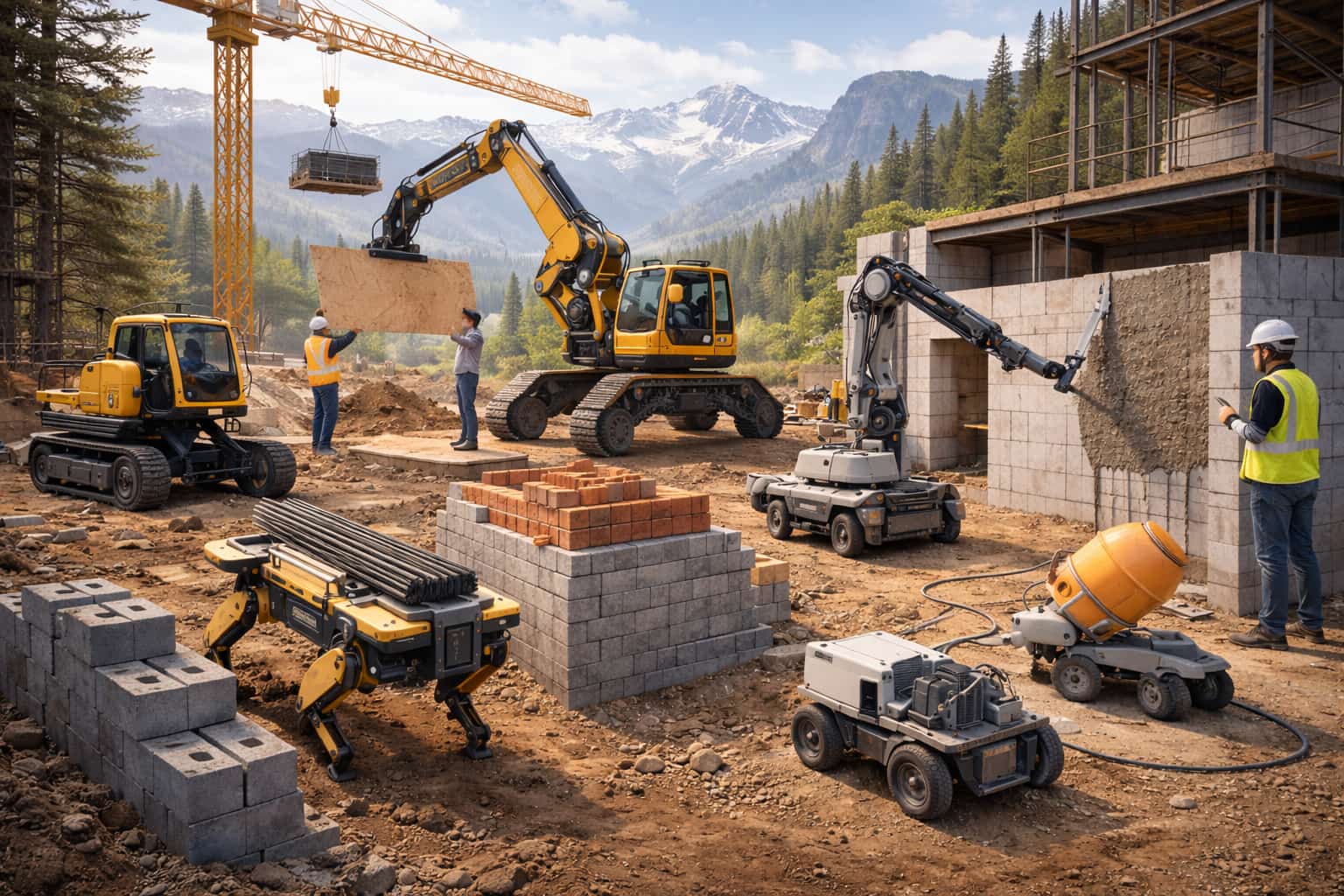
Anyone who has ever watched a French alpine construction site knows that building at altitude is genuinely hard. Short summer weather windows, steep terrain, helicopter-only access for some materials, freezing temperatures that degrade concrete, and a shrinking pool of specialist mountain construction labour all combine to make a straightforward €5,000/m² coastal build feel like a €8,000/m² mountain one. These cost and time penalties are not abstract — they are the reason why new-build ski property in desirable resorts comes to market slowly, and why waiting lists for the best projects stretch into years.
Robotics and AI are on a plausible trajectory to materially reduce these penalties over the next decade. Autonomous earthwork machines designed specifically for steep terrain, robotic masonry and timber-frame assembly, AI-driven planning tools that optimise around weather windows, 3D-printed foundations and retaining walls, and drone-based site supervision are all moving from research-lab curiosity to real construction deployment. None of this will replace skilled alpine builders entirely, and it will not suddenly make chalet construction cheap — but it could compress build times, improve safety, and expand the range of sites that are economically viable to develop.
This guide looks at each of the emerging technologies in detail, the specific bottlenecks they target, a realistic timeline for deployment, and — crucially for property buyers — what the implications are for new-build supply, pricing and quality over the next decade. If you are weighing a VEFA (off-plan) new-build ski property purchase now versus waiting, the technology trajectory is directly relevant to your timing decision.
The Constraints Today
Why Building at 1,800m Is Uniquely Hard
Alpine construction faces a combination of constraints that do not apply to coastal or urban sites. Terrain steepness limits the machinery that can be brought to site — many standard earthwork vehicles simply cannot operate safely on slopes above 25-30%. Access is often restricted to narrow mountain roads with weight limits that rule out full-size articulated trucks; some remote sites require helicopter-lifted materials, which is expensive and weather-dependent. The weather window itself is short — on many sites only 5-6 months of the year support reliable concrete work, versus 10-12 months at lower altitudes.
Labour is the other significant constraint. Skilled alpine construction is a specialised discipline. Experienced workers in carpentry, stonework, finish trades and lift infrastructure are in short supply, and the pool has been shrinking as younger workers leave mountain communities for lower-altitude economic opportunities. Wages for skilled alpine labour have risen 30-40% over the past decade, meaningfully faster than general French construction wages. This alone explains a large share of the cost premium new-build ski property commands over comparable coastal or city equivalents.
Safety is the third constraint that rarely gets discussed openly but materially shapes project economics. Construction at altitude is statistically more dangerous than lower-altitude work — helicopter operations, rope access, avalanche exposure during winter shoulder months, and the simple risk of working on steep terrain in poor weather all raise the operating risk meaningfully. Insurance costs are correspondingly higher, site supervision requirements are stricter, and the consequences of an accident are more severe.
The practical result is that a new-build chalet or apartment building in a top-tier French resort typically costs 30-50% more per m² to construct than an equivalent building at sea level. This premium is not inefficiency or margin — it is a genuine reflection of these constraints. Any technology that relaxes them has the potential to compress this premium meaningfully.
30-50%
Current cost premium for alpine new-build construction versus equivalent coastal projects
10-15%
Total build-time reduction demonstrated by AI-driven weather-window planning on Swiss and Italian pilot projects
6-8 weeks
Plausible compression of alpine site-preparation phase with autonomous earthwork equipment (from 4-5 months)
2027-30
Realistic deployment window for commercial-scale alpine construction robotics in top-tier French resorts
Autonomous Equipment
Self-Driving Earthworks for Steep Mountain Terrain
The most immediately useful category of construction robotics for alpine sites is autonomous earthwork equipment. Radio-controlled and partially autonomous tracked dumpers — the best-known examples come from French manufacturer Operval and Italian competitor Messersi — can be transported by helicopter to remote sites and operate on slopes up to 30% forward and 20% sideways. These machines are already in use on some alpine construction projects and eliminate the most dangerous phase of site preparation, which is manual earthwork on steep terrain.
The next generation, currently in late-stage field testing, adds full autonomous site navigation. A bulldozer with LiDAR, GPS and onboard AI can be programmed with a target earthwork profile and execute it without a driver, working day or night and in poor visibility that would ground human operators. For alpine sites specifically, this capability is transformative because it extends the usable weather window — a machine that does not need to see where it is going can work in fog, falling snow and poor light conditions that would normally cause human crews to stand down.
The deployment timeline is relatively near. We expect meaningful commercial availability of fully autonomous earthwork on alpine sites by 2027-2028, with rapid expansion through 2030. Cost implications are initially modest — early autonomous units carry a capital premium — but the extended working window and reduced labour requirements turn the equation within 18-24 months of deployment. For a typical €8M alpine apartment project, autonomous earthwork could compress the site-preparation phase from 4-5 months to 6-8 weeks, shortening the overall build by a similar margin.
The property-market implication is a faster turnover of new-build inventory. If projects can be delivered in 18-24 months instead of 24-36 months, developers can respond more quickly to demand signals, buyers wait less time for completion, and the capital lock-up period for VEFA (off-plan) purchases becomes more attractive. This alone would modestly increase new-build supply in the resorts best positioned for technology adoption.
Technology Readiness for Alpine Construction (2026)
AI-driven weather scheduling
Autonomous earthworks (partial)
Robotic timber framing
Drone site supervision
3D-printed foundations
Fully autonomous chalet build
Robotic Assembly
Robotic Masonry, Timber Framing and On-Site Assembly
Beyond earthworks, the most promising robotic construction technology for alpine sites is robotic timber-frame and masonry assembly. Timber framing is particularly well suited to robotic work because it is inherently modular — panels can be pre-manufactured in a factory environment and robotically assembled on site, dramatically reducing the on-site labour and weather exposure required. Several Swiss and Austrian firms (notably Burkhardt Holzbau and Bauhaus Automation) are already deploying partial-robot assembly on pilot projects, with full-robot assembly in late-stage testing.
The implications for alpine chalet construction are particularly interesting because traditional chalet design relies heavily on timber framing, heavy beam work and local stone. Pre-manufacturing timber frames in a valley-floor factory under controlled conditions and delivering them by flatbed truck to the site for rapid assembly could cut the timber-work phase of a chalet build from 3-4 months to 4-6 weeks, while simultaneously improving quality control. This is not science fiction — it is current practice on the most ambitious Swiss alpine projects, and is moving into French practice over the next 2-3 years.
For stone and concrete work, robotic masonry is more complex but progressing quickly. Construction robotics firms are developing robotic arms capable of placing complex stone facings, a capability that is especially relevant for traditional-style alpine chalets where stone cladding is an expected aesthetic element. Early deployments have focused on repetitive block laying; the more complex natural-stone work that defines high-end chalet architecture is several years behind but catching up.
The short-term implication is not that chalets will be ‘built by robots’ in 2027 — skilled craftspeople remain central to the highest-quality projects — but that repetitive, labour-intensive phases of construction will be partially automated, freeing skilled labour to focus on the finishing work where it adds most value. The result should be faster builds with at least maintained and potentially improved quality.
“Construction robotics will not make alpine new-build cheap — but it will make it faster, more consistent and more responsive to demand, which is almost as valuable for serious buyers.”
AI-Driven Planning
Weather-Window Optimisation and Predictive Scheduling
Perhaps the most under-appreciated technology in alpine construction is AI-driven planning and scheduling. Traditional project management in mountain construction is dominated by weather risk — a single storm can invalidate a month of planning, a single cold snap can delay concrete pours, a single snow event can prevent site access. Project managers historically buffer these risks with substantial schedule contingency and conservative sequencing, which inflates build timelines and costs.
AI planning tools change this calculation by ingesting 14-day high-resolution weather forecasts, historical climate data for the specific site, and the detailed critical path of the project, and recommending real-time sequencing changes that maximise productive work during predicted good-weather windows. On pilot projects in Swiss and Italian alpine construction, AI planning has reduced total build duration by 10-15% without changing labour or equipment inputs — pure scheduling optimisation. For a 24-month project, that is a 2.5-3.5 month improvement, which feeds directly into both cost and buyer time-to-completion.
These tools are also valuable for safety. By predicting storm windows and high-wind events more accurately, they enable proactive site standdowns that reduce both accidents and emergency protective work. Several French alpine insurers are now offering premium discounts for projects using AI-driven weather scheduling, a market signal that the safety improvement is real and measurable.
Deployment of AI planning is the fastest and cheapest of the technologies in this article — software rather than hardware, relatively simple to integrate with existing project management systems, and already in pilot use on some French projects. Expect near-universal adoption on major alpine builds by 2028.
| Technology | Current Status | Build Impact | Timeline |
|---|---|---|---|
| AI weather scheduling | Commercial pilots | 10-15% faster build | 2026-27 mainstream |
| Autonomous earthworks | Field testing | Site prep ×2 faster | 2027-28 commercial |
| Robotic timber framing | Swiss/Austrian pilots | Structure in weeks | 2027-29 French |
| Drone supervision | In use | Better QC, safety | Already mainstream |
| 3D printed foundations | Isolated pilots | Marginal benefit | 2030+ mainstream |
| Modular service cores | Commercial use | Interior ×2 faster | Already in use |
3D Printing & Modular
3D-Printed Foundations and Modular Construction
3D concrete printing is a more speculative near-term technology for alpine construction, but it is advancing quickly and has specific applications where it could be transformative. Foundations and retaining walls — both of which are labour-intensive, high-weather-risk, and often on the critical path — are good candidates for 3D printing because the geometry is simple, the aesthetic requirements are low (everything gets buried or faced), and the equipment can be transported to remote sites relatively easily.
French construction startup XtreeE and Dutch firm CyBe have both deployed 3D-printed concrete structures in alpine and semi-alpine settings, with promising early results. Modular prefabricated construction is arguably more mature for alpine use: modular bathroom pods, kitchen cores and service cores can be pre-manufactured in valley-floor factories and hoisted into place in hours rather than weeks, compressing the interior finishing phase significantly.
The realistic timeline for 3D-printed alpine construction is later than the other technologies in this article — probably 2030+ for widespread deployment on serious projects. Modular construction is already in use on some French alpine new-build developments and is likely to expand rapidly over the next 3-5 years. Both technologies improve build speed and somewhat reduce cost, but the bigger benefit may be quality control: factory conditions produce more consistent components than on-site construction in mountain weather.
For buyers of new-build VEFA property, the question is not whether these technologies will arrive — they will — but whether they will arrive in time to benefit the specific development you are buying into. For projects breaking ground in 2026-2027, most construction will still be traditional; for projects breaking ground in 2028-2029, AI planning and partial robotics should be standard. This is another reason to look carefully at developer credentials when evaluating specific projects.
2022-24
Pilot AI scheduling tools
First French alpine projects trial AI-driven weather-window planning, with 10-15% build-time savings.
2025
Autonomous earthwork field trials
Operval and Messersi deploy semi-autonomous tracked earthwork equipment on French alpine sites.
2026-27
Robotic timber assembly
First French alpine new-build projects use robot-assisted timber framing on apartment projects.
2027-28
Drone supervision mainstream
Near-universal drone QC and safety monitoring becomes standard on major alpine projects.
2028-30
Commercial construction robotics
Autonomous earthworks, robotic masonry, and AI planning all reach commercial deployment at scale.
2032+
Next-generation alpine builds
First fully technology-integrated alpine chalet developments deliver with meaningfully compressed cost premium.
Implications
What This Means for New-Build Supply, Quality and Pricing
The aggregate effect of these technologies, rolling out over the next 5-10 years, is to gradually relax the constraints that have made alpine construction uniquely expensive and slow. Our rough estimate is that by 2032 the cost premium for new-build at 1,800m+ versus equivalent coastal construction could compress from the current 30-50% to something closer to 20-30%. Build times could compress from the current 24-36 months to 18-24 months on comparable projects. Quality should improve modestly through better factory conditions and AI-assisted quality control.
For new-build supply specifically, the implication is that the trickle of new projects in desirable resorts could become a steadier flow. That does not mean prices will fall — land scarcity and the regulatory constraints on new development will continue to dominate — but it does mean that buyers waiting for completion will wait less long, and developers can respond more nimbly to demand. In resorts where supply growth is already heavily constrained by environmental regulation (most of the top-tier French Alps), this effect will be modest. In resorts with more flexible development frameworks, it could be meaningful.
For pricing, the effect is mixed. Slightly lower construction costs would, in a competitive market, feed into slightly lower prices — but land scarcity and demand growth will likely dominate in most prime resorts. More realistically, expect the cost savings to be captured by developers as improved margins and partly redirected into quality improvements, with the buyer seeing modestly better specification and slightly faster delivery rather than dramatically lower prices. The right expectation is ‘better new-build, faster’ rather than ‘cheaper new-build’.
For quality specifically, the technology shift is genuinely positive. Factory-manufactured components are more consistent than on-site construction. AI-driven quality control catches defects earlier. Robotic assembly is more precise than skilled manual labour on repetitive tasks. The combination should produce better-built alpine properties over the next decade, and buyers paying a premium for top-tier new-build should benefit from this trend.
Buyer Action
What This Should Change About Your 2026 Purchase Decision
The most practical takeaway for buyers is that the construction-technology trajectory is genuinely positive but relatively slow, and it should modestly shape — not dominate — your purchase decision. Do not wait indefinitely for robot-built chalets to arrive. The technologies we describe will roll out incrementally over 5-10 years, and during that period, land scarcity and demand growth will continue to drive alpine property values up in real terms. Buyers who wait out the full technology rollout may save on construction cost but lose considerably more on capital appreciation and VAT reclaim timing.
The right adjustment is to pay a little more attention to developer technology sophistication when evaluating specific projects. Developers already using AI planning, modular construction and robotic timber framing on their pilot projects are likely to deliver faster, with better quality control, than traditional developers — and the premium they charge is often lower than the time-value of capital being tied up in a slower project. When you are comparing two VEFA developments in the same resort, the one using modern construction methods is usually the better buy even if the nominal prices are similar.
As always, the right question is project-specific rather than abstract. The Domosno team has been walking buyers through French new-build inventory across the Alps since 2005, and has a detailed view of which developers are leading the technology adoption curve and which are coasting. For a 2026 purchase decision, a conversation with Domosno about specific developments is worth significantly more than any amount of theoretical analysis about construction technology.
Common Questions
Frequently Asked Questions
Will construction robotics make ski property meaningfully cheaper?
Moderately, not dramatically. The 30-50% current cost premium for alpine construction will likely compress to 20-30% over the next decade. That is real savings, but in prime resorts the land scarcity and demand growth will dominate — expect the savings to be partly captured by developers, partly redirected into quality improvements, and partly passed to buyers. Do not wait for robot-built bargains; they are not coming.
Should I wait for technology-led projects instead of buying in 2026?
Generally no. The capital appreciation and VAT-reclaim timing you would give up by waiting 3-5 years typically exceeds the construction savings you would gain. The better approach is to prioritise developers who are already using modern methods — AI planning, modular cores, robotic timber — and buy into projects that will deliver faster with better quality than traditional competitors.
Which developers are leading the technology adoption curve?
Several of the larger French and Swiss alpine developers have trialled AI planning and modular construction on recent projects. We do not name specific developers here, but the Domosno team has a detailed view of which operators are genuinely innovating and which are using the language as marketing. This is exactly the kind of specific question worth asking a specialist agent during a purchase decision.
How does robotic timber framing affect the quality of traditional chalets?
Positively, on current evidence. Robotic framing is more precise than skilled manual labour on repetitive cutting and joining operations, which means tighter tolerances, better airtightness, and more consistent structural quality. The heroic traditional craftsmanship remains central to finishing, aesthetic and heritage elements — but the structural bones of the chalet are better when partly robotic-assembled.
Will weather still delay alpine construction in the AI era?
Yes, but much less. AI weather scheduling compresses total build time by 10-15% by optimising sequencing around predicted windows, and autonomous equipment extends the usable working window by operating in conditions that would stand down human crews. Major storms and winter shoulder months will continue to dominate the calendar — the technology improves the envelope, it does not eliminate it.
What’s the safety implication of more robotic construction?
Strongly positive. Alpine construction is statistically more dangerous than coastal work, and any technology that reduces manual labour on steep or exposed terrain directly reduces accident rates. Several French alpine insurers are now offering premium discounts for projects using modern safety-technology stacks, which is the clearest possible market signal that the safety improvement is real.
Does modular construction compromise chalet aesthetic quality?
Not if done correctly. Modular service cores (bathrooms, kitchens) are hidden behind traditional finishes and materially accelerate the interior phase without visible compromise. Modular timber framing can be architecturally indistinguishable from hand-built work if the developer chooses to integrate it seamlessly. Bad execution of modular work looks prefab; good execution looks identical to fully traditional construction.
How should I evaluate a new-build project’s technology credentials?
Ask the developer specific questions about how they manage weather risk, whether they use factory-manufactured components, what their quality-control processes look like, and how they measure on-site safety. Good developers will answer specifically with examples; marketing-led developers will respond in generalities. The {{link:Domosno team}} has a detailed view of the current French developer landscape and is happy to help buyers evaluate specific projects.
Featured Properties
Popular Ski Resorts
Morzine
Megève
Chamonix
Les Gets
Alpe d’Huez
Les Deux Alpes
Les Arcs
La Plagne
Courchevel
Méribel
Saint-Martin-de-Belleville
Val Thorens
Val d’Isère
Tignes
Thollon-les-Mémises
Quick Links
All New-Build Ski Properties
All Ski Apartments
All Ski Chalets
New-Build Ski Apartments
New-Build Ski Chalets
Resale Ski Apartments
Resale Ski Chalets