Mountain Technology
How Robots and AI Will Replace 80-90% of Human Tasks in the Mountains (2025-2030)
Mountain environments look traditional, but they are almost perfectly structured for automation — and over the next three-to-five years, robots and AI will take over the repetitive, seasonal, physically demanding work that once required armies of human staff.
13 Dec 2025
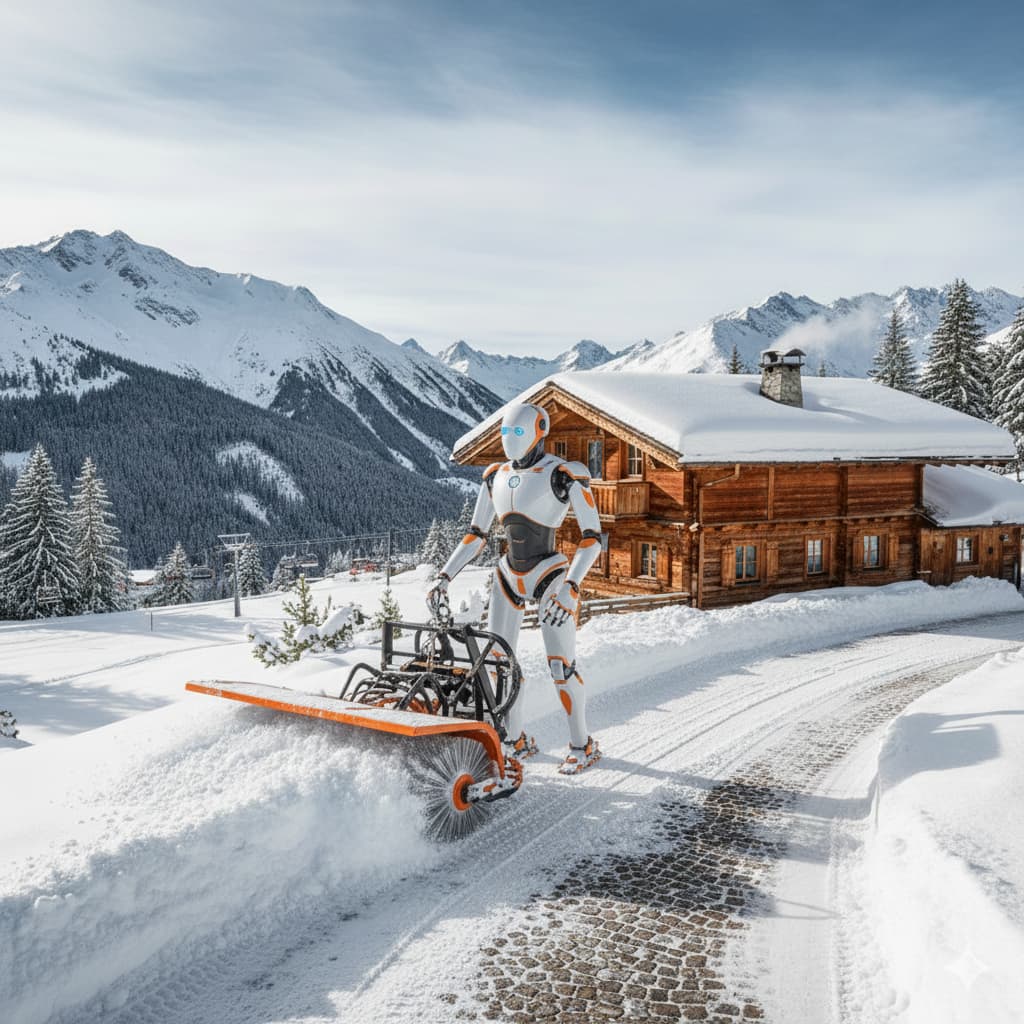
The mountains look traditional. Wooden chalets, stone villages, hand-carved signs, ski instructors in branded jackets, the rhythms of the seasons — the imagery is deeply human and deeply analogue. But the reality beneath the imagery is almost the exact opposite of traditional. Most operational work in the mountains — snow clearing, building maintenance, cleaning, monitoring, transport, guest services, security — is repetitive, predictable, seasonal and physically demanding. Those are the precise conditions where robots and AI systems outperform humans most dramatically, and over the next three-to-five years, automation is going to take over a dominant share of this operational work.
This is not a speculative forecast. It is already happening in visible form. SnowFactory weather-independent snow producers are replacing manual snow-gun operators. Autonomous grooming pilots are running at several Alpine resorts. AI snowmaking control systems are replacing night-shift operators at almost every major resort (covered in detail in our separate snowmaking article). Autonomous cleaning robots are being deployed at mountain hotels. Delivery drones are being tested for mountain logistics. Robot dogs and humanoid robots are being evaluated for building inspection and maintenance in conditions too dangerous or repetitive for humans. Each of these individual deployments is a data point in a much larger transition, and the aggregate effect will be profound.
This article works through the question systematically. What do humans actually do in the mountains, stripped of romantic imagery? Which of those tasks are genuinely suitable for automation, and which still require people? Why are mountain environments particularly well-suited to robots and AI? What is the realistic 2025-2030 deployment curve? And what does the transition mean for Alpine property owners, rental yields, resort operational quality and the long-term viability of different resort categories? The short answer on the headline question is that 80-90% of operational human tasks can realistically be automated inside five years, and much of this is already in motion.
The Setup
Why Mountain Environments Favour Machines
Mountain environments impose constraints that actually favour machines rather than disadvantage them. Fixed routes, seasonal rhythms, limited access points, predictable daily patterns, and the relative absence of complex urban stimuli make automation easier in mountains, not harder. A robot operating on a ski resort base area has a dramatically simpler operational problem than a robot operating in Paris or central London — fewer unpredictable pedestrian interactions, fewer random road events, fewer edge cases to handle. The mountain environment is semi-controlled, low-density, and operationally repetitive.
The second favourable factor is the harshness of the conditions. Cold, snow, night work, physical risk, and chronic labour shortages are exactly the conditions where robots deliver higher reliability, lower cost and better consistency than human workers. A human snow-clearing crew is expensive, fatigable, limited in shift duration, and subject to injury risk. An autonomous snow clearing machine runs through the night without complaint, does not take breaks, and delivers consistent output across a full season. The economics compound dramatically in favour of automation for any task that combines these characteristics.
The third factor is the labour market itself. Ski resort communes face structural labour shortages, particularly for seasonal operational roles. Housing affordability pressures, short seasonal contracts, and the rising cost of accommodating workers in expensive resort areas mean that many resorts cannot fully staff their operational teams even in normal conditions. Automation is not just a cost-saving option — in many cases it is the only realistic way to maintain operational quality given the labour constraints. This creates a positive feedback loop where resorts that automate first get a meaningful operational advantage over resorts that do not.
The fourth factor is the regulatory environment. Mountain resorts are typically subject to lighter regulatory oversight than urban environments for the kind of robotic and autonomous systems being deployed, partly because the operational envelope is narrower and partly because the political will to enable modernisation is stronger. This is not universal — heritage zones and environmentally sensitive areas do have regulatory constraints — but across the broad operational footprint of a typical ski resort, deployment of new automation technology is more straightforward than in equivalent urban settings.
80-90%
Realistic share of operational human tasks in mountain environments that can be automated by 2030 with current and emerging technology
30-50%
Typical reduction in snow operation labour footprint at French resorts furthest along the automation adoption curve
40-60%
Expected reduction in operational hotel staffing at fully-automated mountain properties by 2030 versus 2020 baseline
2028-2030
Most likely window for autonomous transfer vehicles to become a meaningful presence on main Alpine corridors
The Task Audit
What Humans Actually Do in the Mountains, Stripped of Romance
Strip away the imagery and most operational mountain jobs fall into a small number of categories. Moving things: snow from one place to another, luggage, supplies, rubbish, guests, equipment. Cleaning: buildings, paths, rooms, windows, equipment, vehicles. Monitoring: weather, slopes, lift infrastructure, buildings, security cameras, guests, wildlife, snowpack. Providing information: wayfinding, opening hours, ticket sales, restaurant orders, room service, basic guest questions. Driving short distances: within-resort transfers, delivery, operational logistics, emergency response. Repair and maintenance: routine mechanical work, predictable part replacements, scheduled inspections. These are not creative or emotional tasks. They are procedural, rule-based, repetitive and physically demanding.
Humans have been used for these tasks because they were the only realistic option — not because they are optimally suited to the work. Mountain operational staff have historically had high injury rates, high turnover, high absenteeism, and have cost substantial resort budgets to house, feed, train and manage. None of the underlying tasks require creativity or emotional intelligence; they require reliable execution of procedures in harsh physical conditions. That is exactly what well-designed robotics and AI systems deliver.
A good way to estimate the automation potential is to ask, for each task: ‘Could a well-trained operator with a printed checklist do this job?’ If the answer is yes, the task is almost certainly suitable for automation, because a well-trained operator with a printed checklist is exactly what a robot is — a procedural executor. A much smaller share of operational work requires real human judgement, social engagement, or creative problem-solving, and this is the share that will remain with humans well beyond 2030.
The remaining human share of mountain work — the 10-20% that does not automate well — is generally in three categories. First, high-end guest experience: personal interactions with premium guests, concierge-style services, personalised hospitality, ski instruction at the upper end of the market. Second, complex repair and problem-solving: diagnostic work on lift systems, unusual equipment failures, non-routine maintenance. Third, strategic and management work: resort planning, commercial strategy, guest experience design, marketing, community relations. These categories will remain human-led for the foreseeable future and will actually benefit from automation handling the routine work that used to dilute management attention.
Automation Readiness by Mountain Task Category
AI snowmaking control
Autonomous grooming
Hotel cleaning automation
Autonomous snow clearing
Autonomous transfer vehicles
Ski instruction
Snow and Pistes
Automation Across the Snow Operation Stack
Snow operations are the most visible and advanced area of mountain automation. AI-driven snowmaking control systems (covered in depth in our snowmaking articles) are already deployed at nearly every major French resort. Autonomous or semi-autonomous grooming is being piloted at multiple Alpine resorts with early deployments of self-driving Piste Bashers — the large tracked vehicles that groom the ski slopes overnight. SnowFactory and competing weather-independent snow production units provide automated snow supply even when wet-bulb temperatures are too warm for traditional snowmaking, managed by the same AI control platforms that run the rest of the snow operation.
The combined effect on snow operation staffing is substantial. A legacy snow operation required a dedicated team of snowmakers working through the night during cold windows, plus a grooming crew running multiple Piste Basher shifts across the resort, plus maintenance and dispatch staff coordinating the whole operation. An automated modern snow operation needs a smaller supervisory team running the control platform, with physical intervention limited to maintenance, audit and edge-case resolution. The labour footprint of snow operations has dropped by roughly 30-50% at the resorts furthest along the automation curve.
Autonomous snow clearing around base areas, car parks and resort building perimeters is the next wave. Several Alpine resorts are evaluating or deploying robot snow clearers that handle the repetitive work of keeping walkways, loading zones, lift access points and car parks clear of snow. Unitree’s robot dog that cleared 6,000 square feet overnight while humans slept (covered in a separate Domosno article) is one example; commercial autonomous snow blowers from multiple manufacturers are another. Buildings, roads and paths that previously required manual snow clearing can be handled by these systems, with humans intervening only for edge cases.
The final layer of snow operation automation is monitoring and decision support. AI systems now provide real-time piste condition monitoring, snow depth measurement, weather forecast integration, and automated alerts for operational decisions. Resort operations teams can run with significantly fewer dedicated weather and snowpack specialists because the AI platform delivers the relevant data directly to the decision makers, with automated recommendations on piste opening, closing, grooming priorities and snowmaking runs.
“The 80-90% number sounds extreme until you actually list the tasks. Move things, clean things, monitor things, drive short distances, answer routine questions — that is most of operational mountain work, and all of it is squarely in the automation sweet spot.”
Buildings and Services
Hotels, Chalets and Resort Building Operations
Building operations are the second major domain of mountain automation. Hotel and chalet cleaning has historically been one of the most labour-intensive parts of any ski resort operation, with rooms needing daily cleaning, public areas needing constant attention, and turnover cleaning between guest stays. Commercial cleaning robots — both floor-focused models from the major Chinese and European manufacturers and room-focused models from specialised hospitality vendors — are now being deployed at mountain hotels and can handle a substantial share of routine cleaning tasks. Human staff remain responsible for bed-making, high-touch surfaces and quality audits, but the labour requirement for cleaning has dropped significantly at the properties that have deployed the technology.
Building maintenance is a second area where automation is meaningful. Routine inspections of roofs, gutters, HVAC equipment, mechanical plant, and exterior envelopes can be handled by robot dogs (Unitree, Boston Dynamics) or autonomous drones, with the collected data fed into AI analysis platforms that flag issues for human attention. This is particularly valuable in Alpine settings because many building inspection tasks involve working at height, in cold conditions, on snow-covered surfaces where human access is dangerous or impossible. Robots can operate in these conditions with higher safety margins and lower cost.
Guest services in mountain hotels and chalets are being progressively automated through AI-driven platforms that handle booking, check-in, concierge requests, restaurant orders and room service coordination. Voice interfaces in rooms, mobile app integration and AI chat agents can handle a large share of routine guest interactions without requiring human reception staff. Human concierge and management remain important for premium guests and complex requests, but the baseline volume of routine guest interactions is being handled by software.
The combined effect on mountain hotel staffing is that a well-automated property in 2030 will run with 40-60% fewer operational staff than the equivalent property in 2020, while delivering higher service consistency and lower guest complaint rates. This has large implications for hospitality operator economics, and it will increasingly show up in which hotel operators are investing in which resorts. Resorts with strong hotel operators that are aggressive about automation will have operational advantages over resorts dependent on traditional labour-heavy hotel operations.
| Category | Automation Level 2025 | Automation Level 2030 (est.) | Who Remains |
|---|---|---|---|
| Snowmaking | AI control mature | Near-complete | Supervisors, edge cases |
| Grooming | Pilot deployments | Semi-autonomous default | Complex terrain operators |
| Snow clearing | Early robotics | Widely deployed | Edge cases, supervision |
| Cleaning | Commercial rollout | Standard infrastructure | Quality audit, high-touch |
| Guest services | AI-assisted | AI-dominated routine | Premium concierge |
| Ski instruction | Human | Still human | Professional instructors |
| Resort management | Human | Still human | Full management team |
Transport and Logistics
Autonomous Vehicles, Drones and Resort Logistics
Transport automation in mountain environments is less mature than snow or building automation but is developing quickly. Autonomous transfer vehicles covered in detail in our separate self-driving article will be the most visible change over the next 3-5 years — Waymo-style services on main Alpine transfer routes are plausible by 2028-2030, with earlier pilot operations at specific resorts. Within-resort autonomous shuttles are being piloted at several European ski resorts and handle predictable routes between car parks, lift stations and village centres with minimal human supervision.
Delivery drones are increasingly being used for mountain logistics — delivering supplies to high-altitude refuges, moving equipment between base and summit operations, handling last-mile delivery for resort logistics teams. Drone delivery of consumer goods to mountain chalets is being tested by several specialist logistics operators, with the natural advantage that mountain terrain is less congested than cities and regulatory airspace is simpler to clear. The technology is not yet at commodity scale, but the trajectory is clear.
Goods movement within resort boundaries is another automation frontier. Autonomous indoor logistics robots handle food and beverage delivery in large hotel kitchens, package movement in service corridors, and equipment delivery to specific locations. Robot waiters and food delivery robots are being deployed at some mountain restaurants for basic table service, handling drink and food delivery to tables while human staff focus on orders, guest interaction and quality control. This frees up human staff for the higher-value hospitality work that cannot easily be automated.
The transport and logistics automation story is somewhat slower than snow operations because of the regulatory complexity and the safety requirements for systems that move near people. But the direction is unambiguous, and by 2030 most large resort operations will have substantial automation across their transport and logistics layers. The effect on operational cost and reliability will be significant.
2015-2020
Early automation deployment
First wave of AI snowmaking control systems, early commercial cleaning robots and pilot grooming automation projects at European ski resorts.
2021-2023
Scale rollout begins
AI snowmaking becomes standard at major Alpine resorts, SnowFactory deploys widely for marginal-altitude operations, and commercial cleaning robots enter mainstream hotel use.
2024-2025
Robot hardware matures
Unitree robot dogs, autonomous snow clearers and commercial hospitality robots mature to commodity scale, making deployment economically viable for mid-sized resort operations.
2026-2027
Autonomous transport pilots
First European pilot deployments of autonomous transfer vehicles on main Alpine routes, and expansion of within-resort autonomous shuttle services.
2028-2029
Consolidation wave
Automation becomes a standard expectation at major resorts, with the gap between automated and non-automated operations visible in seasonal performance data.
2030
80-90% threshold reached
Well-automated mountain operations run with 80-90% of operational tasks handled by robots, AI and software — leaving humans focused on management, safety, premium hospitality and creative work.
Property Implications
What Automation Means for Alpine Property Owners
For Alpine property owners, the automation wave matters for three reasons. First, it directly affects resort operational cost and quality. Resorts that automate aggressively will deliver better guest experiences at lower operational cost, which supports rental yields, occupancy rates and long-term resort viability. Resorts that do not automate will progressively fall behind on cost and quality, with corresponding pressure on rental yields and property values. Over a 10-year ownership horizon, this is a real differentiator.
Second, automation affects the operational cost of owning and running individual properties. Chalets and apartments with managed rental operations will benefit from cheaper, more consistent cleaning, maintenance and guest services as automation arrives at the hotel and rental management level. Private chalets will benefit similarly from cheaper maintenance, remote monitoring, and automated property management. Owners who structure their operations around modern automation will have lower running costs and higher net yields than owners still dependent on traditional labour-heavy service providers.
Third, automation changes which resort categories look most attractive for property investment. Resorts with strong operational management, strong capital discipline, and aggressive technology adoption will outperform resorts without those qualities. This tends to favour larger, well-capitalised resort groups over smaller independent operations, and it favours resorts that have already invested in modern infrastructure over resorts that are still catching up. The ‘operational quality signal’ of automation adoption is increasingly showing up in resort-level performance metrics and will feed through into property values over the coming years.
For buyers, the practical implication is that resort selection should give meaningful weight to operational quality, technology adoption and capital management. The Domosno team tracks these factors across the main French Alpine resorts as part of our ongoing market coverage and can walk buyers through the full picture on specific resorts on their shortlist. Our resort guides cover operational profiles of each major market and our new-build ski apartments page lists current opportunities across the French Alps.
The Human Share
What Humans Will Still Do in 2030 — And Why
The 10-20% of mountain work that will not be automated by 2030 is concentrated in a few specific categories. Ski instruction remains a human-dominated activity because the coaching, social engagement and adaptive judgement involved in teaching skiing are beyond what current robots can plausibly deliver. Ski school at premium level is actually becoming more important as a guest experience differentiator, and premium resorts are investing in human instructor quality rather than attempting to automate it. This is one of the few mountain occupations that may actually grow in importance over the next decade.
Mountain guiding, avalanche rescue, and safety roles are the second category. These tasks involve real-time judgement calls under uncertainty, complex environmental interpretation, and high-stakes decision making where the cost of errors is extreme. Technology can support these roles (avalanche forecasting, GPS tracking, drone reconnaissance) but will not replace them in the foreseeable future. The safety professionals at any well-run Alpine resort are some of the most highly trained and best-compensated staff in the operation, and their roles will remain human-led.
Hospitality management, concierge work, and premium guest services are the third category. The social engagement, personalisation, and contextual judgement involved in handling demanding guests at premium properties cannot be fully automated, and in many cases the human element is precisely what the guest is paying for. Premium operators will invest in higher-quality human staff for these roles while aggressively automating the background operational work, creating a barbell structure where some roles grow while others disappear.
Finally, strategic and creative roles — resort management, marketing, brand development, community relations, long-term planning — will remain firmly human. These jobs are about setting the direction, interpreting the market, building relationships with stakeholders, and making non-routine decisions. AI and automation are tools that make these jobs more effective, not substitutes for them. A 2030 Alpine resort will have fewer operational staff but similar or slightly higher management and strategic staff relative to 2020.
Common Questions
Frequently Asked Questions
Is 80-90% automation by 2030 really realistic?
For the operational tasks that currently employ most mountain workers, yes. Snowmaking, grooming, cleaning, snow clearing, building monitoring, guest services and routine maintenance are all well-suited to automation, and the technology to handle them is either already commercial or close to it. What will not automate is premium hospitality, ski instruction, safety and strategic management — but these are a relatively small share of total operational staffing at most resorts.
What happens to mountain workers during this transition?
Mountain labour markets are chronically short of workers already, so the displacement effect is less severe than in fully-staffed urban environments. Many resorts are using automation specifically to cope with structural labour shortages rather than to reduce a fully-employed workforce. Over the transition, operational jobs will shrink while management, strategic, premium-hospitality and technology-operations roles will grow, and workers with transferable skills will find the overall labour landscape easier to navigate than in other automating industries.
How does this affect property rental yields?
Positively for owners at well-managed resorts. Lower operational costs feed through to higher net margins for rental operators, which supports the fees and yields paid to property owners. The effect is strongest at resorts with strong operational management and capital discipline — weak operators will not capture the benefits of automation as effectively as strong ones, which will show up in the rental performance gap between the two.
Should I factor automation readiness into my resort selection?
Yes, as one of several operational quality signals. Resorts that are investing in automation typically also invest in lift modernisation, climate adaptation and broader operational improvements — the automation signal is correlated with general operational strength. Combined with altitude, brand and infrastructure quality, it shapes the shortlist in favour of resorts with better long-term value preservation characteristics.
Will my chalet be cleaned by a robot by 2030?
Partially. Routine floor cleaning, window cleaning and some public-area cleaning may be handled by robots at managed chalets by 2030, but bed-making, personal touches and quality-audit passes will remain human. Most rental operators will use a blended model where automation handles the repetitive work and human staff focus on the high-touch elements that guests notice. The net effect is cheaper, more consistent cleaning rather than a fully robotic operation.
Are autonomous vehicles really coming to Alpine transfers?
The first meaningful deployments are most likely in the 2028-2030 window for main transfer corridors, with earlier pilot services possible at specific resorts under supervised operation. This is covered in more detail in our separate self-driving article, but the short version is that the technology is approaching readiness and the regulatory and insurance frameworks are developing in parallel. Mountain roads are actually easier for autonomous systems than complex urban environments in many ways.
What about humanoid robots — are they actually useful in the mountains?
Humanoid robots are still mostly in the research and pilot phase for mountain applications, though several specific deployments are being tested (building inspection, warehouse logistics, hotel back-of-house tasks). More specialised non-humanoid robots — cleaning robots, robot dogs for inspection, autonomous snow clearers — are actually more useful and more mature for most mountain work. The humanoid form factor is not the point; it is the automation of specific tasks that matters.
Where can I see how specific resorts are adopting automation?
The Domosno team tracks operational investment across French resorts as part of our ongoing market coverage, including automation adoption signals alongside more traditional quality metrics like lift modernisation and climate adaptation. We are happy to walk buyers through the full picture on specific resorts on their shortlist, and our resort guides cover operational profiles of each major French Alpine market.
Featured Properties
Popular Ski Resorts
Morzine
Megève
Chamonix
Les Gets
Alpe d’Huez
Les Deux Alpes
Les Arcs
La Plagne
Courchevel
Méribel
Saint-Martin-de-Belleville
Val Thorens
Val d’Isère
Tignes
Thollon-les-Mémises
Quick Links
All New-Build Ski Properties
All Ski Apartments
All Ski Chalets
New-Build Ski Apartments
New-Build Ski Chalets
Resale Ski Apartments
Resale Ski Chalets