Buyer Guide
New-Build vs. Resale Ski Properties in the French Alps: The Complete Buyer’s Guide
Customisation, cost savings and VAT reclaim on one side. Instant occupancy, prime locations and proven rental history on the other. Here’s how to choose.
27 Dec 2022
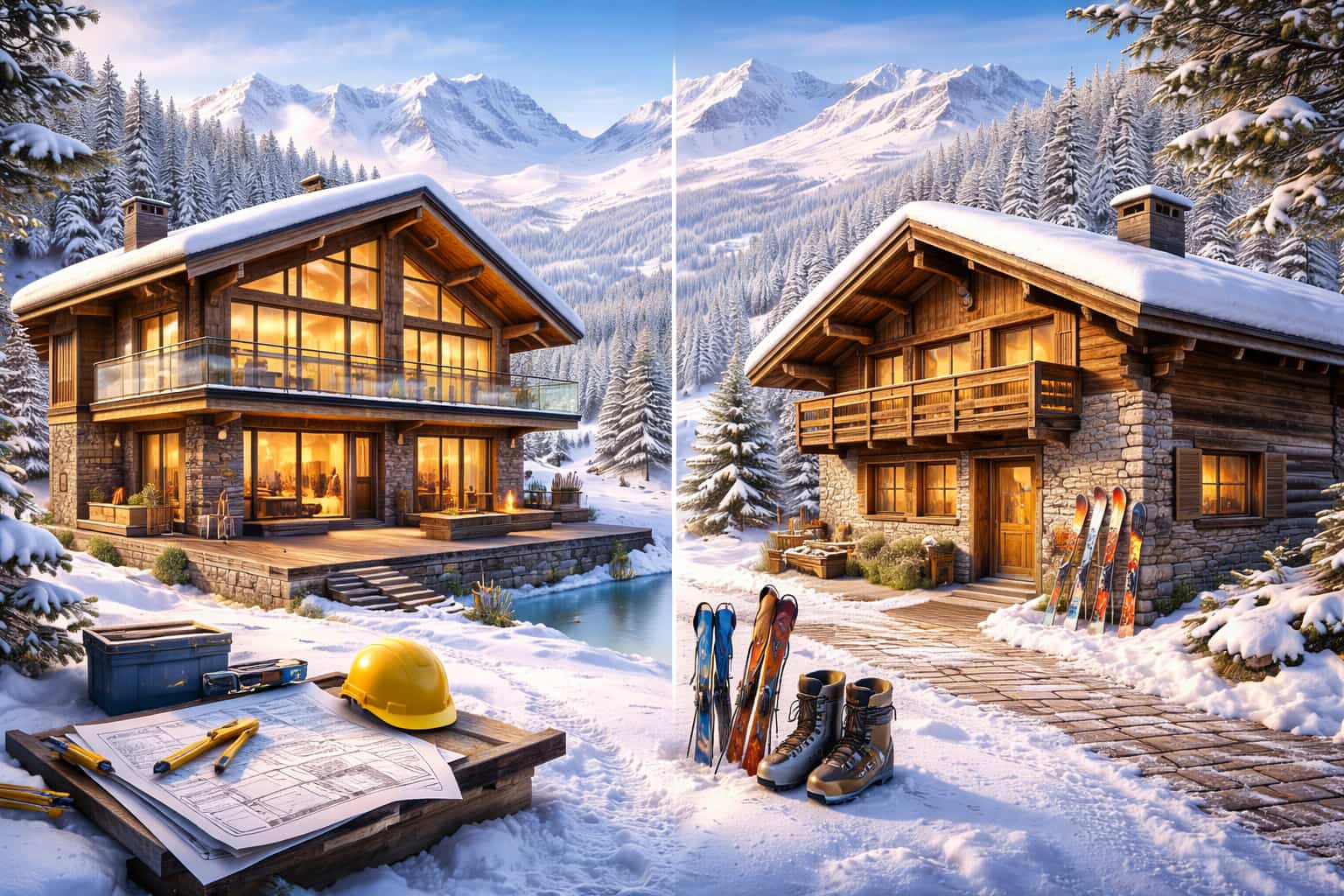
Choosing between a new-build and a resale ski property in the French Alps represents one of the most important decisions in your Alpine property journey. Both options offer distinct advantages, and the right choice depends entirely on your priorities — whether that’s customisation, immediate availability, financial incentives, or a proven rental history.
New-build (VEFA) apartments and chalets deliver modern amenities, lower transaction fees, a 10-year builder warranty and — for buyers willing to enter a managed rental programme — up to 20% VAT recovery on the purchase price. Resale properties, by contrast, offer zero wait time, established performance data and access to prime village-centre and ski-in/ski-out addresses that simply cannot be built anymore. This guide breaks down every angle of the decision with current 2025 market data, so you can choose with clarity.
Section 01
The New-Build Case: Customisation, Amenities & Modern Standards
One of the most compelling benefits of new-build or off-plan (VEFA) properties is complete customisation before construction. Unlike resale properties where you inherit someone else’s finishes, new builds allow you to select interior layouts, add premium features like saunas or chef’s kitchens, choose materials from developer-approved ranges, and configure bedroom arrangements to match your family. This flexibility is particularly valuable for buyers planning to generate rental income through a professionally-managed programme.
Contemporary ski developments also come equipped with amenities that dramatically enhance both personal enjoyment and rental appeal: swimming pools, saunas, steam rooms, hot tubs, wellness areas, concierge and ski storage, EV charging, and fibre internet throughout. These features command premium rental rates — properties with spa facilities typically achieve 15–25% higher occupancy and nightly rates than standard apartments in the same resort.
On the technical side, new-build properties deliver tangible advantages in comfort and operating costs. Enhanced insulation reduces heating bills by 30–40% compared to older properties; advanced soundproofing is critical for rental properties with high occupancy turnover; and the 10-year construction guarantee (garantie décennale) provides complete protection against structural defects. Modern builds meet strict RT 2012 or RE 2020 regulations, potentially qualifying for extended taxe foncière exemptions for highly efficient properties. The improved insulation alone can save €1,200–2,000 annually on heating costs for a typical 80m² apartment in a high-altitude resort.
2–4% vs 7–9%
Notary and stamp duty fees: new-build vs resale in France (Notaires de France)
20%
VAT potentially recoverable on new-build VEFA in classified managed rental use
€66,667
Effective VAT reclaim on a €400,000 new-build apartment under a 9-year rental commitment
30–40%
Heating cost reduction in RT 2012 / RE 2020 new-builds vs pre-2000 resale
Section 02
The Financial Advantage: Fees, Taxes & VAT Reclaim
This is where new builds shine financially. The cost difference between new and resale extends far beyond the purchase price itself. On a €500,000 property, notary fees and stamp duty run 2–4% on new-build (so €10,000–20,000) versus 7–9% on resale (€35,000–45,000). That’s an immediate €25,000–35,000 saving — effectively 5% additional equity from day one, a substantial advantage that compounds over time.
All new residential construction in France also benefits from a mandatory 2-year exemption from taxe foncière following completion. With average taxe foncière running €10–20 per m² per year in most Alpine communes, an 80m² apartment saves €1,600–3,200 and a 120m² chalet saves €2,400–4,800. Energy-efficient properties meeting stringent DPE standards may qualify for exemptions of up to 5 years. Data published by Notaires de France confirms that these incentives have been a major driver of new-build demand in the Alps since 2022.
Most powerful of all is the 20% VAT reclaim. New-build properties enrolled in managed rental programmes — leaseback or rental-pool arrangements — qualify to reclaim the 20% VAT on the purchase price. On a €400,000 apartment, that means €66,667 of VAT recoverable through the rental commitment, effectively reducing the net purchase to €333,333. The requirements are straightforward: a minimum 9-year rental commitment through an approved management company, the property must be fully furnished and professionally managed, and the VAT must be reclaimed within specific timeframes. For buyers comfortable with managed rental, this represents a genuine 20% discount from day one. Our buying process guide walks you through the full VEFA timeline.
Alpine Resorts: New-Build Premium Over Resale (2025)
Les Gets / Morzine
Les Deux Alpes
Alpe d’Huez
Méribel
Val d’Isère
Courchevel 1850
Section 03
2025 Pricing: What You Actually Pay per m²
Understanding the price premium — or discount — of new builds versus resale properties varies dramatically by resort, altitude, and ski-area access. In Val d’Isère, new-build three-bed apartments are trading at around €33,000/m² compared to €26,000/m² for renovated resale, a 27% new-build premium. Méribel follows a similar pattern at €23,500/m² new versus €19,000/m² resale (a 24% gap), and Courchevel spans an enormous €11,000–33,200/m² range depending on village.
Mid-market resorts show a much tighter spread. In Les Gets and Morzine, new-build trades at €7,000–9,000/m² against €6,500–8,000/m² for resale — a modest 10–15% premium. Les Deux Alpes sits at €7,000–8,000/m² new versus €6,000–7,500/m² resale, reflecting the dual-season appeal pulling buyer interest from both summer mountain-bikers and winter skiers. Alpe d’Huez in 2025 ranges €6,643–14,073/m² for new-build depending on development positioning, with entry one-beds at €375,000 and premium two-beds €430,000–660,000.
The underlying trend is unmistakable: over the past 5 years, new-build prices have increased 40–75% in major resorts (Les Deux Alpes moved from €4,000–5,000/m² to €7,000–8,000/m²). However, due to ongoing supply shortages, resale prices have often risen even faster — with stock levels 20% below historical averages in several resorts. Crucially, the effective price gap after accounting for 20% VAT reclaim can make new builds actually cheaper than equivalent resale properties for buyers using rental programmes.
“The effective price gap after 20% VAT reclaim can make a new-build cheaper than the equivalent resale — before you even factor in two years of taxe foncière exemption.”
Section 04
The Resale Case: Immediate Availability & Prime Locations
The primary advantage of resale properties is zero waiting time. Immediate occupancy means you ski this season. There’s no construction risk, no 12–24 month delay common with new-build VEFA, and rental income starts generating returns from day one. For buyers who have found their perfect resort and want to use the property this winter, resale offers unmatched speed to benefit.
Established properties also provide hard data on rental performance: historical occupancy rates demonstrating actual demand, verified seasonal rental income broken down between winter and summer, established guest reviews on booking platforms, and known maintenance costs and operational expenses. This transparency eliminates speculation about rental potential — you’re buying proven performance rather than projections. Many resale properties are even available for pre-purchase stays, a ‘try before you buy’ option that reduces uncertainty considerably, particularly for first-time Alpine property investors.
Perhaps most importantly, resale properties occupy prime historical locations that new construction simply cannot replicate: true ski-in/ski-out positions no longer available for new building, village-centre addresses at the foot of the slopes, mature gardens and landscaping for chalets, and an established rental reputation in booking systems. Many of the best locations in the most famous resorts — particularly Chamonix, Megève, and Saint-Martin-de-Belleville — are fully developed, making resale the only realistic option for specific sought-after positions.
| Resort | New-Build €/m² | Resale €/m² | New-Build Premium |
|---|---|---|---|
| Val d’Isère (3-bed) | €33,000 | €26,000 | +27% |
| Méribel | €23,500 | €19,000 | +24% |
| Courchevel (range) | €11,000–33,200 | €10,380–14,150 | Varies |
| Les Gets / Morzine | €7,000–9,000 | €6,500–8,000 | +10–15% |
| Les Deux Alpes | €7,000–8,000 | €6,000–7,500 | +15–18% |
| Alpe d’Huez | €6,643–14,073 | Development-dependent | Varies |
Section 05
Where Can You Actually Buy? Location Considerations
Major ski resorts face severe development restrictions: limited undeveloped land in top-tier locations, strict planning regulations protecting mountain environments, and local opposition to large-scale development. The result is that new-build developments in resorts like Courchevel, Val d’Isère and Megève are extremely rare, often selling out in pre-launch phases before any public marketing. Buyers who want prime-location new-build in those resorts typically need agent relationships to access pre-launch inventory.
New construction therefore concentrates in specific zones: resort peripheries with new lift access, former hotel conversions where older properties are transformed into luxury apartments, and up-and-coming resorts investing in infrastructure. Alpe d’Huez and Les Deux Alpes are currently seeing a surge of new-build activity backed by €153 million+ of resort investment, and Tignes has recorded an 85% increase in new-build prices over 5 years, now at a €10,336/m² median driven by strong altitude-driven demand.
In Chamonix Mont-Blanc, geographical constraints mean almost no new-build activity — average resale chalets run around €11,800/m² (€1.5M for a four-bedroom). Megève is dominated by architectural preservation rules, and Morzine offers a balanced mix of both new-build and resale at an average €9,299/m². In these protected villages, resale properties sell rapidly — often before official listing — making strong agent relationships essential.
Step 1
Scope & budget
Clarify budget, usage weeks, preferred resort style, and whether you’ll enter a managed rental programme. This decision alone narrows new-build vs resale for most buyers.
Step 2
Pre-launch access
For new-build in Courchevel, Val d’Isère or Megève, prime developments sell before public marketing. Agent relationships matter — pre-launch access is the difference between success and waiting lists.
Step 3
Offer & notaire
A formal offer is signed, notary fees paid (2–4% new vs 7–9% resale), and a 10% deposit goes into escrow. English-speaking notaire coordination is available through Domosno.
Step 4
Staged payments (VEFA) or completion (resale)
VEFA new-build is paid in stages tied to construction milestones. Resale completes quickly — typically 8–12 weeks from offer to keys.
Step 5
VAT reclaim setup
For new-build under managed rental, the VAT reclaim process begins post-delivery. A 9-year rental commitment unlocks the full 20% rebate.
Step 6
Handover & first winter
Snagging inspection on delivery, furniture package installation, rental-platform activation, and the first season begins — whether you used a new-build or resale route.
Section 06
Financing, DPE Ratings & the 2025 Regulatory Reality
Both property types qualify for French mortgages, but the requirements differ. For new builds, lenders require developer track-record verification, off-plan purchases may limit loan-to-value ratios to 70–80%, and staged payments align with construction milestones. For resale properties, immediate valuation is available, loan-to-value ratios can reach up to 85% for prime locations, and approval is typically faster because there’s no construction risk to assess. Non-resident buyers should add a 0.5–1.0% premium over the resident rate. Our French mortgage calculator models both scenarios with realistic rates and fees.
The critical new regulation to understand is DPE energy performance. Properties with poor ratings (F and G) now face rental restrictions, reduced financing availability and mandatory renovation requirements to remain on the rental market. Banks are increasingly reluctant to finance F/G-rated properties, rental rates and tenant eligibility are capped, and mandatory retrofits are required for continued rental activity. New builds with A or B ratings command a significant premium and finance more easily than older, inefficient resale properties — a consideration that has shifted market dynamics markedly since 2023.
Buyer preferences have shifted too. Minimum two-bedroom properties are now standard (three-bedrooms increasingly preferred), 80–100m² apartments are the ‘sweet spot’ for rental yields, and terraces of 25–40m² command premiums post-COVID. Many older resale properties are smaller studios and one-beds from 1970s–1990s construction, increasingly difficult to rent at premium rates. Resale properties built before 2000 often require €30,000–60,000 of comprehensive renovation to meet modern standards — a hidden cost that can erode the apparent purchase-price advantage over new-build.
Section 07
Making the Decision: Which One Is Right for You?
Choose new-build if you prioritise customisation and want to influence the design, value modern amenities like spas and pools, seek tax optimisation through VAT reclaim and property-tax exemptions, want a hassle-free rental management programme with guaranteed income, prefer lower transaction costs, can wait 12–24 months for completion, and care about long-term operating cost savings from energy efficiency. New-build is best for first-time buyers, investors seeking passive income, and buyers comfortable with 9-year rental commitments.
Choose resale if you need immediate occupancy for this ski season, want proven rental performance data before you buy, prefer established locations that are no longer available for new construction, seek specific unique properties (historical chalets, prime ski-in/ski-out), value the ‘try before buy’ opportunity, don’t want rental obligations or managed programmes, and prioritise flexible personal use without booking restrictions. Resale is best for experienced Alpine owners, buyers chasing specific locations, and those wanting immediate rental income.
In practice, many Domosno clients end up owning both types over time — starting with a resale in a prime village for immediate use, then adding a new-build VEFA purchase in a growing resort for tax-optimised investment returns. The two options aren’t mutually exclusive; they serve different roles in a thoughtfully constructed French Alps property portfolio. If you’d like to explore both sides of the market, the Domosno team can walk you through current inventory across all 40+ resorts we cover, from entry-level €200,000 resales to ultra-prime Courchevel chalets.
Common Questions
Frequently Asked Questions
Can I genuinely reclaim 20% VAT on a new-build?
Yes, on new-build (VEFA) properties enrolled in a classified managed rental programme. The property must be furnished, professionally managed, and committed to rental for at least 9 years. The VAT — effectively 16.67% of the gross purchase price — is refunded by the French tax authorities, typically within 6–12 months of completion. Domosno coordinates the process with specialist accountants.
What exactly are notary fees on a new-build versus resale?
New-build notary fees in France run 2–4% of the purchase price and include registration, disbursements and notary compensation. Resale fees run 7–9% because they include a higher stamp duty component. On a €500,000 property, that’s a concrete €25,000–35,000 saving for new-build — effectively 5% additional equity on day one.
Do non-residents get French mortgages for ski properties?
Yes. Non-resident buyers can access French mortgages at up to ~85% LTV for prime locations, with rates typically 0.5–1.0% above the resident base rate. Both new-build and resale qualify. Staged payments on VEFA new-build require a lender comfortable with construction finance; Domosno refers clients to brokers who specialise in non-resident mortgages for Alpine ski property.
How long does a new-build VEFA take to complete?
Typically 12–24 months from contract signature to key handover, depending on the development stage at the time of purchase. Pre-launch buyers waiting for a whole development may see longer timelines; later-stage buyers entering a partially-built programme may complete in 6–12 months.
Are there still new-build opportunities in Courchevel and Val d’Isère?
Yes, but they’re scarce and sell out rapidly. New-build in these top-tier resorts is almost always sold in pre-launch phases before public marketing, through agent relationships. If new-build in Courchevel or Val d’Isère is a priority, start conversations early and expect to move quickly when inventory appears.
What’s the hidden cost of buying a pre-2000 resale property?
Renovation. Pre-2000 resale properties often require €30,000–60,000 of comprehensive upgrades to meet modern buyer expectations — kitchen, bathrooms, insulation, DPE rating improvements, electrical and plumbing. That hidden cost can fully erode the apparent price advantage over new-build once accounted for.
What’s the ‘20% rental commitment’ actually like in practice?
The managed rental programme handles marketing, guest services, cleaning and maintenance. You get 4–8 weeks of personal use annually (depending on the programme), guaranteed gross yields typically 3–4%, and furniture packages worth €10,000–25,000 are included. The 9-year commitment can be extended or — in some programmes — exited early with penalty clauses.
Is now a good time to buy, given 2025 mortgage rates?
French mortgage rates in early 2025 average around 3.09% for residents, with non-residents paying +0.5–1.0%. Recent ECB rate cuts (deposit rate now at 2.50%) have meaningfully improved affordability. Combined with supply shortages that have kept resale prices firm, buyers who wait risk paying more for both the property and the financing.
Featured Properties
Popular Ski Resorts
Morzine
Megève
Chamonix
Les Gets
Alpe d’Huez
Les Deux Alpes
Les Arcs
La Plagne
Courchevel
Méribel
Saint-Martin-de-Belleville
Val Thorens
Val d’Isère
Tignes
Thollon-les-Mémises
Quick Links
All New-Build Ski Properties
All Ski Apartments
All Ski Chalets
New-Build Ski Apartments
New-Build Ski Chalets
Resale Ski Apartments
Resale Ski Chalets