Mountain Technology
Self-Driving Cars in the French Alps: Why Autonomy Is Closer Than You Think
Waymo’s 2025 deployment in Denver — explicitly designed as a cold-weather proving ground — is a direct read on when robotaxis will arrive on the winding roads to Courchevel, Val Thorens and Chamonix. Here is what the data says.
8 Jan 2026
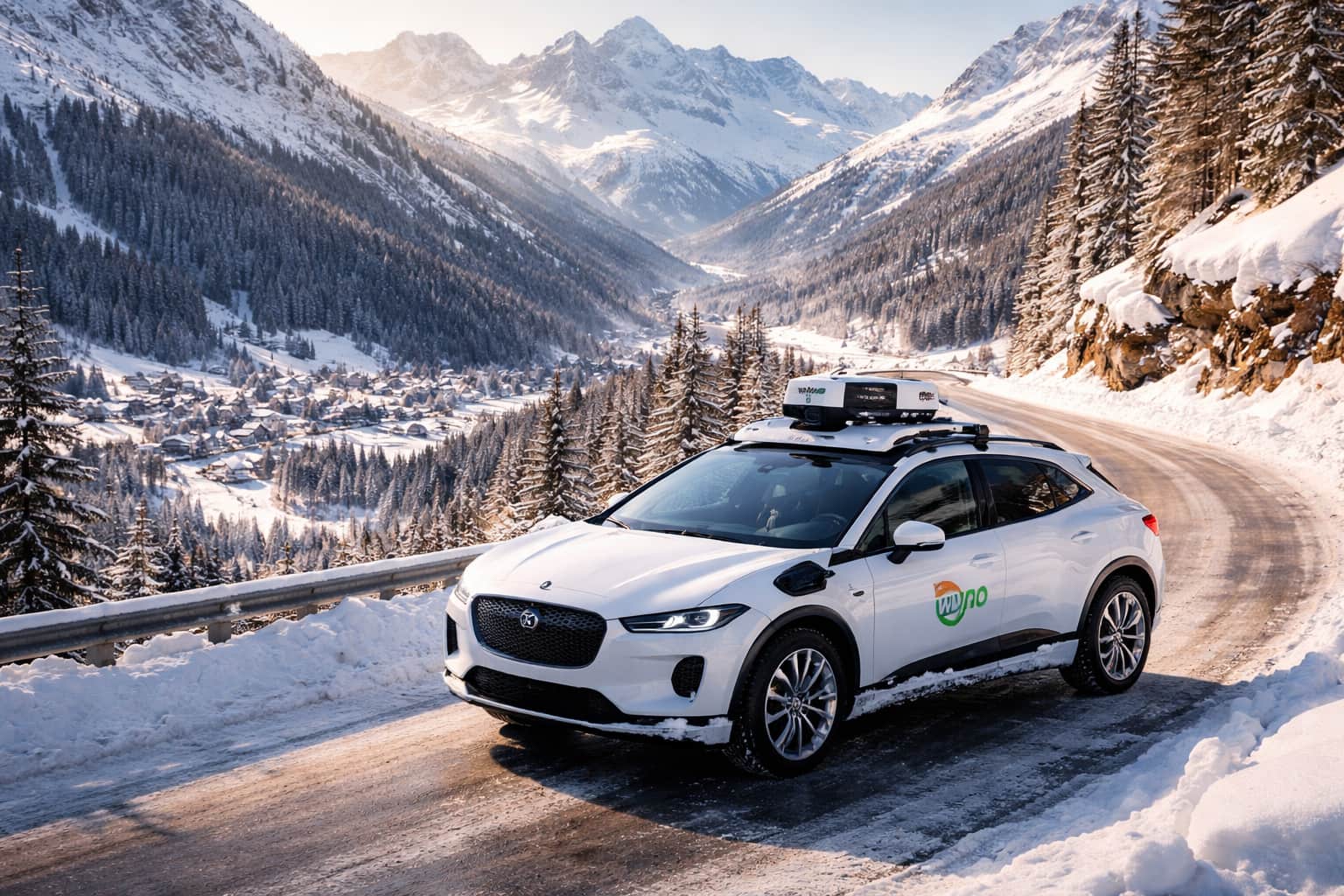
The idea of a self-driving car taking you from Geneva Airport to a chalet in Val d’Isère has for years been filed under ‘maybe in a decade or two’. That timeframe is now visibly wrong. Waymo’s deployment in Denver, which quietly began testing in late summer 2025 and is on track for public rides in 2026, is specifically designed as a cold-weather proving ground — snow, ice, steep grades, low visibility, variable traction — precisely the conditions you encounter on the N90 climbing toward Courchevel or the winding approach to Val Thorens. The industry is not testing for perfect weather any more. It is testing for Alps-adjacent conditions.
The scale of the underlying deployment makes this more than a tech-headline curiosity. By late 2025, Waymo had completed more than 14 million autonomous trips, was running around 450,000 paid rides per week in its operational US cities, and had accumulated well over 100 million autonomous miles on public roads. The safety data at that scale is striking: Waymo reports an 85% reduction in crashes involving any injury versus human drivers, a 96% reduction in injury crashes at intersections, and a 92% reduction in crashes involving pedestrian injuries. Human drivers are, by these numbers, roughly 6.8 times more crash-prone.
What this article addresses is not whether autonomous vehicles will arrive in the French Alps — they will — but when, how, and what the property and operational implications are for the Alpine resort market. The short version is that the first real deployments in French ski resort corridors are probably 3-5 years away, the first buyer-visible effects will arrive sooner than that through pilot partnerships, and the long-term implications for Alpine transfers, rental yields and resort accessibility are large enough to be worth taking seriously in any 10-year property decision framework.
The Denver Signal
Why Waymo’s Cold-Weather Proving Ground Matters for the Alps
Denver is not just another expansion city for Waymo. It is a deliberate, documented cold-weather proving ground. Testing began in late summer 2025 with Jaguar I-Pace electric vehicles equipped with Waymo’s latest sensor arrays, mapping Denver’s streets and learning the city’s traffic patterns under human supervision. The explicit goal is to launch fully autonomous public rides in Denver during 2026 — and to use that deployment as the validation case for cold-weather, high-altitude, variable-conditions operation more broadly.
The reason this matters for the Alps is that Denver’s winter driving conditions — snow, ice, steep grades, low visibility, and the kind of mixed precipitation that confuses older-generation sensor packages — are directly analogous to the conditions on French Alpine access roads. If Waymo’s stack can handle a December snowstorm on Colfax Avenue climbing out of Denver toward the Rockies, it can handle the same kinds of conditions on the approach roads to Tarentaise ski resorts. Waymo engineers and Colorado transportation officials have been explicit about this framing in public statements during 2025.
The second reason Denver is a key signal is regulatory. Colorado has been willing to give Waymo meaningful operational latitude for cold-weather testing, and the data generated there will feed into regulatory approval processes in Europe and specifically in France. French and EU autonomous vehicle regulation is tightly coupled to demonstrated safety performance in real-world conditions, and the Denver deployment is now the single most important ongoing cold-weather data set in the global autonomous vehicle industry. Every successful mile in Denver is evidence for the case that autonomous operation on French Alpine roads is viable.
The third reason is the operational economics. Denver’s deployment is teaching Waymo how to maintain a fleet in cold conditions — battery management, sensor cleaning, tyre strategy, charging infrastructure, snow-covered lane marking recognition. All of this operational knowledge is directly transferable to a hypothetical French Alpine deployment, and the current learning curve is the main constraint on how quickly that deployment can happen.
14M+
Autonomous trips completed by Waymo in the US by late 2025 — the largest documented commercial autonomous operation
85%
Reduction in injury-involving crashes for Waymo vehicles versus human drivers across 100 million autonomous miles
450k
Paid autonomous rides per week handled by Waymo across its operational US cities by December 2025
2028-2030
Most likely window for first meaningful autonomous vehicle deployments on French Alpine access corridors
The Safety Case
What 100 Million Autonomous Miles Tell Us
Waymo’s safety data at 100 million autonomous miles is strikingly favourable to the autonomous stack. The headline number is a 85% reduction in crashes involving any injury compared to human drivers, which translates to roughly 0.41 Waymo injury crashes per million miles versus 2.78 for human drivers — a 6.8x difference. The intersection safety improvement is 96% and the pedestrian injury reduction is 92%, with even larger gaps in cases involving protected road users like cyclists and scooter riders.
The relevance to Alpine driving is particularly high because the factors that autonomous systems handle best are exactly the factors that cause Alpine accidents. Driver fatigue contributes to around 10% of serious road crashes in France overall, and that share is higher on long-distance leisure routes like Saturday Geneva-to-Val-d’Isère transfers where drivers have often travelled from UK airports earlier in the day. Fatigue is not a factor for autonomous systems. Neither is distraction, impairment, frustration in traffic, or the kind of snap decision-making errors that contribute to head-on collisions on winding mountain roads.
There is also a critical secondary dimension: consistency. Human drivers vary enormously in skill, experience, local knowledge and mood. Autonomous systems are identical from one vehicle to the next, and their performance is bounded rather than variable. For a resort operator or a private transfer company, this consistency is valuable — it means guests experience the same level of service on every transfer, without the lottery of driver quality that characterises traditional taxi and minibus operations.
The safety numbers also support an insurance-side case for autonomous deployment that is already being developed by major European insurers. If the crash rate drops by 85%, insurance premiums for autonomous fleets should drop proportionally, and the economics of autonomous transfer services become significantly more favourable than traditional driver-based operations. This is one of the underlying reasons the autonomous deployment timeline is accelerating in 2025-2026 rather than slowing down.
Waymo vs Human Drivers: Crash Reduction by Category
All injury crashes
Intersection injury crashes
Pedestrian injury crashes
Cyclist injury crashes
Fatigue-related incidents
Distraction-related incidents
The Route Challenge
Why Alpine Roads Are Actually Easier Than People Assume
A common assumption is that Alpine roads — narrow, winding, often without clear lane markings, with steep gradients and tight hairpins — must be the worst-case scenario for autonomous driving. In reality, the opposite is often closer to the truth. Alpine access roads are highly structured: they have a small number of main routes, they are used repeatedly by the same vehicles making the same journeys, and they have a predictable seasonal rhythm. All of those factors make them ideal for the map-and-sensor-fusion approach that modern autonomous systems use.
The N90 from Albertville up to Moûtiers and on to Bourg-Saint-Maurice is an excellent example. It is a single main road, well-mapped, carrying a predictable flow of leisure traffic on Saturdays and a lower flow during the week. Autonomous systems thrive on this kind of predictability because their underlying HD map of the road can be refined over thousands of passes, and their object-detection systems can learn the typical behaviour of other vehicles on the route. A hairpin is no harder to navigate than a complex urban intersection — and in many ways easier, because the geometry is static and well-defined.
The genuine challenges are more specific: snow covering lane markings (the sensor system has to fall back to HD map localisation rather than visual lanes), wildlife on the road (more common in the Alps than in cities), and the interaction with winter-specific equipment like snow chains, road salt, and variable road closures. Waymo’s Denver testing is directly addressing all of these, and the initial indications are that the sensor stack can handle them — particularly the snow-covered lane marking case, which has been one of the most-tested scenarios during the Colorado rollout.
The second challenge is regulatory. French autonomous vehicle law is evolving, and specific deployment in mountain environments will require approval from national and regional transport authorities. The current trajectory is that general autonomous deployment on French highways will be permitted progressively through 2026-2028, with specific mountain and resort routes following at a 1-2 year lag. This implies first meaningful deployment in Alpine corridors somewhere in the 2028-2030 window, with limited pilot deployments possibly earlier at specific resorts that have strong operator relationships with autonomous vehicle companies.
“Denver is Alps-adjacent. Every successful Waymo mile through a Colorado snowstorm is evidence that the sensor stack can handle the N90 climbing toward Courchevel — and the regulatory calendar is moving in step.”
Alpine Transfer Economics
How Autonomous Vehicles Could Reshape the Transfer Market
The French Alpine transfer market is large, fragmented and expensive. Private transfers from Geneva Airport to major Tarentaise resorts typically cost €200-400 per car for a standard sedan and €400-800 for a premium SUV or minibus, with significantly higher prices on peak Saturdays during French school holidays. Shared transfers are cheaper at €50-100 per person but involve multi-stop routing and longer travel times. The aggregate market across all Alpine transfer routes runs into the hundreds of millions of euros per season, and it is entirely dependent on human drivers.
Autonomous vehicles change this economics structurally. If Waymo-style operations can handle Alpine routes by 2028-2030, the marginal cost of a transfer drops substantially because the largest single cost — driver labour — is replaced by a capital-cost-only operation. Insurance costs drop in line with the crash-rate reduction. Fleet utilisation improves because vehicles can run around the clock without driver hours-of-service constraints. The combined effect could be 30-50% reductions in transfer pricing, with significantly improved service availability during peak periods.
For property owners, this matters because transfer accessibility is a direct input to rental yields and guest satisfaction. Resorts that are perceived as ‘hard to reach’ or ‘expensive to reach’ see lower rental yields and lower capital values than resorts with convenient, affordable transfer options. Autonomous transfer services could flatten some of this difference by making remote resorts more accessible, which would benefit property owners at secondary resorts more than at the already-well-connected major destinations. This is a real 10-year tailwind for specific resort categories.
There is also a hospitality angle. Autonomous transfers enable consistent quality service — same vehicle standard, same arrival time reliability, same on-arrival experience — that rental managers can bundle into their guest packages. A chalet rental at a resort served by an autonomous transfer partnership could offer door-to-door service with greater consistency than any traditional chauffeur operation, creating a real product differentiator in the mid-to-premium rental segment.
| Provider | HQ | Cold-Weather Focus | Alps Relevance |
|---|---|---|---|
| Waymo | USA | Denver proving ground (2025-) | Direct — cold weather validation |
| Mobileye | Israel / EU | Scandinavia, German Alps testing | High — European deployment first |
| Zoox (Amazon) | USA | Urban autonomy, complex environments | Indirect — Alpine villages benefit |
| Baidu Apollo | China | Northern China cold-weather testing | Indirect via Chinese OEM partnerships |
| Tesla FSD | USA | Consumer vehicles, supervised | Indirect — EV owners bring autonomy |
| Stellantis / EU OEMs | Europe | Consumer vehicles, embedded autonomy | Direct — Alpine roads on native maps |
Competing Players
Beyond Waymo — Who Else Is Building Autonomous for Mountains
Waymo is the global leader but not the only player. Several European and Chinese autonomous vehicle companies are developing cold-weather capable stacks with specific interest in Alpine and mountain environments. Mobileye, headquartered in Israel but with significant European deployment, has been testing cold-weather operation in Scandinavia and the German Alps. Zoox, owned by Amazon, has a development programme focused on complex urban environments that translates directly to Alpine villages. Chinese players including Baidu Apollo and Pony.ai have cold-weather testing programmes in northern China and Inner Mongolia that mirror the Denver approach.
Within Europe specifically, Stellantis and the various German OEMs are developing autonomous driving capabilities in partnership with technology providers rather than as standalone efforts. These car-maker-led approaches are typically slower but deeply integrated into consumer vehicles that will be sold to private owners rather than operated as fleets. For the Alpine transfer market, fleet-based operations (Waymo, Zoox, etc.) are likely to arrive first, with private-vehicle autonomy following at a longer lag as the regulatory and insurance frameworks develop.
Tesla’s Full Self-Driving remains the most visible consumer-facing autonomous capability, though its deployment model is fundamentally different from Waymo’s — it runs on customer-owned vehicles, uses a camera-only sensor stack, and operates under a supervised-autonomy regulatory framework rather than true driverless operation. Tesla’s ability to offer meaningful autonomous capability on French Alpine roads is bounded by those architectural choices, but Tesla vehicles are already common in the Alps and the company has made progressive improvements to its cold-weather and mountain-road performance over the past two years.
The practical implication for Alpine residents and property owners is that the autonomous vehicle market is genuinely competitive, with multiple plausible providers racing toward commercially viable cold-weather deployment. This is positive for adoption speed and for eventual pricing. The first wave of deployments in the French Alps will probably involve operator partnerships (a fleet operator and a resort or transfer company), followed by more general commercial availability over the subsequent several years.
Late 2025
Waymo Denver testing begins
Waymo starts mapping Denver streets with Jaguar I-Pace test vehicles under human supervision, explicitly targeting cold-weather validation.
End 2025
14 million autonomous trips
Waymo crosses 14 million autonomous trips and 100 million miles, with 450,000 paid rides per week across US operational cities.
2026
Denver public launch
Waymo plans to launch fully autonomous public rides in Denver during 2026, the first commercial cold-weather deployment at this scale.
2026-2027
European pilot partnerships
First expected Alpine pilot partnerships between autonomous vehicle companies and European resort operators, likely under supervised operation initially.
2028-2030
First Alpine commercial service
Most likely window for first meaningful autonomous vehicle deployments on French Alpine access corridors — starting with main transfer routes rather than village streets.
Post-2030
Broad consumer autonomy in Alps
Mainstream consumer vehicles with Level 3-4 autonomy become common on French Alpine roads, reshaping the transfer market and resort accessibility patterns.
What It Means for Property
Why Alpine Buyers Should Factor Autonomy Into 10-Year Decisions
A 10-year property decision in the French Alps made in 2026 needs to account for an autonomous vehicle deployment that will almost certainly arrive inside that horizon. The arrival will be gradual rather than overnight, and the first buyer-visible effects will be indirect — smoother traffic flow, improved safety statistics, emerging pilot operator partnerships at selected resorts. By the second half of the decade, more direct effects will start to appear: better transfer availability, lower transfer costs, and improved accessibility for resorts that are currently perceived as remote or expensive to reach.
For buyers at secondary resorts — places like Sainte-Foy, Valmorel, Valloire, Samoëns or smaller valleys off the main transfer corridors — autonomous vehicles are a meaningful potential tailwind. Today, these resorts suffer from higher transfer costs and longer transit times versus the major flagship destinations, which depresses rental yields and capital values. As autonomous transfers flatten the cost difference, the gap between secondary resorts and majors narrows, which is a direct uplift to secondary-resort property economics.
For buyers at flagship resorts — Courchevel, Méribel, Val d’Isère, Tignes, Chamonix, Verbier — autonomous vehicles are more of a neutral-to-mildly-positive factor. These resorts already have strong transfer infrastructure and their values are bounded by factors other than accessibility. But even here, improved safety and consistency of transfers is a positive, and the emergence of premium autonomous transfer partnerships is likely to first appear at these destinations before diffusing into the wider market.
The Domosno team is watching the autonomous vehicle deployment timeline closely as part of our broader thinking on French Alpine property market dynamics. The Domosno team is happy to walk buyers through how accessibility, transfer economics and broader operational factors apply to specific resorts on their shortlist, and our resort guides cover the operational profile of each major Alpine destination.
The Near-Term View
What to Watch Over the Next 24 Months
The near-term signals to watch are all in the public domain. Waymo’s Denver public launch in 2026 is the most important single data point — if it proceeds on schedule with acceptable safety metrics, it validates the broader cold-weather deployment model and clears the path for European expansion. The European regulatory response to Waymo’s US operations is the second signal; French and EU transport authorities are in active dialogue with Waymo and competing providers about European deployment frameworks, and public statements from those authorities will telegraph the likely timeline.
Pilot partnerships between European resort operators and autonomous vehicle companies are the third signal. We would expect the first such pilots to be announced sometime in 2026-2027, probably involving a major Alpine resort, a premium transfer operator and a single autonomous vehicle provider. These pilots will typically begin with supervised operation (a safety driver in the vehicle) before moving to fully driverless operation as the operational data accumulates. Early adopters in this space will include resorts with strong technology identities and large premium guest bases.
The fourth signal is consumer autonomy — the arrival of Level 3 or Level 4 autonomous driving features in mainstream consumer vehicles sold in France. Mercedes, BMW, Audi, Tesla and the Chinese OEMs are all progressing toward this, and consumer-vehicle autonomy will diffuse into the Alps initially via privately-owned electric vehicles travelling from Geneva and other hub cities. This is a more gradual effect than fleet deployment but is equally significant in the long term.
Finally, insurance and regulation. Watch for French transport minister announcements on autonomous vehicle frameworks, European Union-level regulatory decisions on cross-border autonomous operation, and insurer-led pilot programmes that bundle autonomous vehicle operation with specific insurance products. These are the underlying plumbing for the commercial deployment wave, and their arrival is both a prerequisite and a leading indicator.
Common Questions
Frequently Asked Questions
When will I actually be able to take an autonomous transfer from Geneva to a French ski resort?
The most plausible window is 2028-2030 for the first meaningful deployments, starting with main transfer corridors like the Geneva-Chamonix and Geneva-Tarentaise routes. Earlier pilot services (2026-2027) may appear at specific resort partnerships under supervised operation. Fully commercial services across the whole Alpine region will probably take until the early 2030s, after which adoption should accelerate quickly once operational economics are proven.
Can current autonomous systems actually handle snowy mountain roads?
Increasingly yes, based on Waymo’s Denver testing and the published safety data from cold-weather deployments. Snow-covered lane markings, mixed precipitation and steep grades are solved problems for modern sensor-fusion stacks when supported by high-resolution maps and recent operational data. The remaining challenges are regulatory and operational rather than technical — the core driving capability is demonstrably there in 2025-2026 data.
Will autonomous vehicles make my remote Alpine chalet more valuable?
Probably yes, if you own at a secondary or harder-to-reach resort that currently suffers from transfer accessibility penalties. Autonomous transfers would flatten the cost-and-time gap between major and secondary resorts, which is a direct uplift to secondary-resort rental yields and capital values. For already well-connected flagship resorts, the effect is more neutral — they benefit less from an accessibility improvement they do not need.
How much cheaper could autonomous transfers be?
Potentially 30-50% cheaper than current human-driven transfers at the operator level, based on the removal of driver labour costs and the expected insurance savings from lower crash rates. Retail pricing to end customers will adjust more gradually than wholesale economics, so the first few years of service are likely to deliver somewhat smaller savings to customers while operators capture part of the margin. The long-run steady state is meaningfully cheaper than today.
Is Tesla’s Full Self-Driving relevant to the Alps?
Partially. Tesla vehicles are already common on French Alpine roads and the supervised FSD feature handles increasing fractions of the drive. But FSD operates under a supervised-autonomy model — a driver must remain engaged — which means it is not a direct replacement for traditional driving in the way a Waymo robotaxi is. It will improve the Alpine driving experience for Tesla owners rather than transforming the transfer market.
What regulatory hurdles need to clear for Alpine deployment?
Three main ones: French autonomous vehicle legislation (currently evolving), EU-level cross-border operation rules (important because many Alpine routes cross national boundaries), and insurer frameworks for autonomous fleet operation in mountain environments. All three are active work streams in 2026, with French transport ministry statements expected to telegraph the timeline over the coming year.
Will autonomous vehicles affect rental yields on my ski apartment?
Yes, over a 10-year horizon, though the direction depends on your specific resort. Resorts that currently suffer from accessibility penalties will benefit most, with rental yields potentially improving as autonomous transfers make them more attractive to a broader guest base. Already-accessible flagship resorts will see more modest effects. Our team tracks this alongside other operational factors when advising clients on resort selection.
Where can I follow developments on this?
Waymo, the French Ministry of Transport and the major European autonomous vehicle providers all publish regular updates on deployment progress. The Domosno team tracks these developments alongside our broader coverage of French Alpine operational quality signals, and is happy to walk clients through the specific implications for resorts on their shortlist. Our resort guides and buyer briefings incorporate emerging accessibility factors as they become relevant.
Featured Properties




Popular Ski Resorts
Morzine
Megève
Chamonix
Les Gets
Alpe d’Huez
Les Deux Alpes
Les Arcs
La Plagne
Courchevel
Méribel
Saint-Martin-de-Belleville
Val Thorens
Val d’Isère
Tignes
Thollon-les-Mémises
Quick Links
All New-Build Ski Properties
All Ski Apartments
All Ski Chalets
New-Build Ski Apartments
New-Build Ski Chalets
Resale Ski Apartments
Resale Ski Chalets