Resort Technology
The Future Is Now: How AI, Drones, and Robots Are Revolutionising Flaine and the Grand Massif
Grand Massif Domaine Skiable’s drone pilots, AI-driven piste analytics and avalanche-detection systems quietly set the standard for how modern French ski resorts are run.
14 Feb 2026
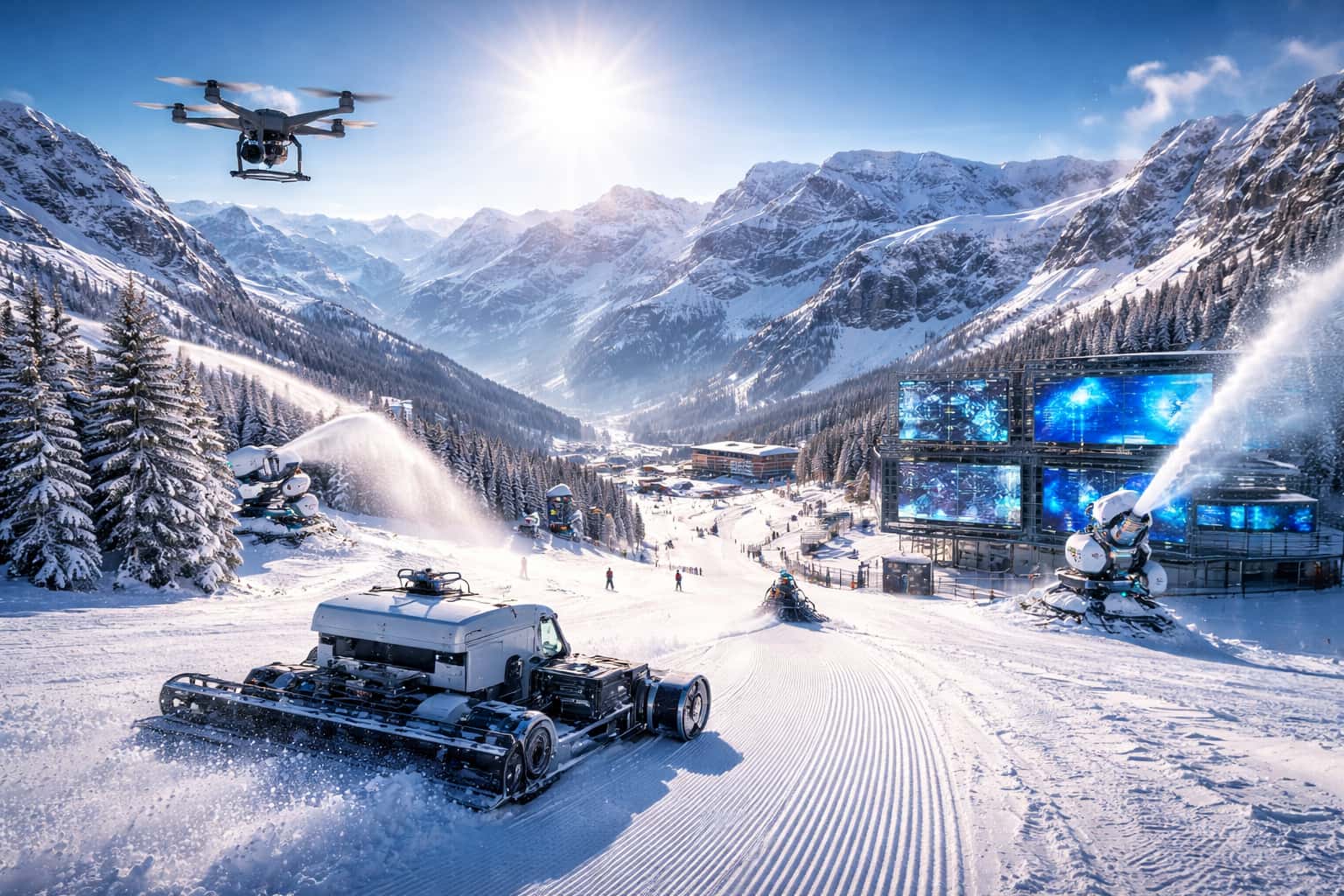
The French Alps are often framed as a backward-looking industry clinging to wooden chalets and fondue. But step inside the daily operations of Flaine and the broader Grand Massif — the ski area linking Flaine, Samoëns, Morillon, Les Carroz and Sixt-Fer-à-Cheval — and you find something quite different: one of the most technologically advanced resort operations in Europe. Grand Massif Domaine Skiable (GMDS) is running drones over its high-traffic pistes, analysing crowd flows with computer vision, using AI to optimise its snow-making, and piloting robotic avalanche-detection systems. Most of this is invisible to guests. All of it matters to anyone thinking about owning property here.
We wrote this guide because buyers increasingly ask us the right question — ‘which resorts are investing in operations, not just marketing?’ — and Flaine and the Grand Massif are an unusually clean case study. GMDS has been publicly transparent about its technology programme, there are real operational metrics behind the headlines (100 hectares of drone-inspected terrain per flight, single-digit average queue times, meaningful reductions in avalanche incidents per season), and the resort sits in a price band where the upside from operational excellence is arguably under-appreciated relative to the top-tier brand resorts.
If you are weighing a Grand Massif property against an equivalent spend in a better-known resort, this is the article that should inform that decision. We look at the technology programme in detail, what it means for day-to-day guest experience, how it feeds through into rental yields and occupancy, and — most importantly — how to read the operational-quality signals that distinguish resorts worth holding for the next decade from those that are coasting on past reputation.
Drone Operations
The Eyes In The Sky: What GMDS Drones Actually Do
GMDS has deployed sophisticated drone platforms equipped with infrared sensors to analyse skier flow patterns and speeds across the high-traffic ‘boulevard’ pistes. These are not hobby drones — they are commercial aerial inspection platforms that anonymise skiers into heat-signature ‘grains’ to comply with RGPD privacy regulations while still capturing genuinely useful crowd-movement data. The operational goal is simple: identify pinch points, predict queuing, and adjust lift throughput and piste grooming priorities in near real time.
The efficiency gains are substantial and publicly documented. Drones can inspect 100 hectares of ski terrain in less than half the time required by traditional ground crews, freeing up piste patrol to focus on safety rather than inventory. For a resort the size of the Grand Massif, that is the equivalent of adding several full-time staff to the guest-experience side of the operation without hiring anyone. Guests never see the drones, but they see shorter queues, better-groomed pistes, and faster response times to incidents — which is exactly what shows up in platform reviews.
The drone programme is also used for infrastructure inspection. Lift pylons, cable tension systems and piste bashers are now routinely inspected by drone rather than by manual rope-access teams, saving both time and money and — more importantly — catching maintenance issues earlier. This is the quiet upside of operational technology: the guest experience improvement is a side effect of better maintenance economics, rather than a heroic investment in guest-facing gimmicks.
For property buyers, the signal to read here is that GMDS is running the Grand Massif like a proper modern operations business, not like a traditional resort that happens to own lifts. Resorts run this way tend to sustain their guest reviews, their rental demand and their property values better than resorts that neglect the operational dimension. It is a subtle signal, but it is a genuinely reliable one.
100 ha
Amount of ski terrain GMDS drones can inspect in a single flight — roughly double the throughput of traditional ground crews
1,600-2,561m
Flaine’s base elevation to Grandes Platières summit — an altitude profile few French resorts can match at Flaine’s price point
€5,500-7,500/m²
Typical 2026 new-build pricing in Flaine — a meaningful discount to the better-known Grand Massif villages
3.0-3.8%
Realistic net rental yield for well-positioned Flaine new-build property under active management
AI-Powered Analytics
Avalanche Detection, Snow Management and Predictive Safety
The Grand Massif’s AI-powered avalanche detection and snow-management programme is arguably the most significant technology investment at the operational level. The resort’s safety systems now ingest real-time weather data, snowpack measurements from IoT sensors distributed across high-risk zones, and historical avalanche incident data, and use a predictive model to identify zones requiring pre-emptive control blasting before they become genuine hazards. The system does not replace human judgement — all final decisions are made by qualified pisteurs — but it dramatically improves the signal-to-noise ratio of the data they work with.
On the snow-management side, AI-driven snowmaking optimisation allows GMDS to match production to actual terrain conditions and weather forecasts, reducing water and energy consumption while maintaining piste quality. Modern snow guns are integrated into a network that adjusts output based on humidity, wind and temperature, and the AI layer optimises the system-wide throughput rather than letting each gun operate independently. The result is measurably better snow coverage for less input — a rare genuine sustainability win.
Beyond safety and snow, the predictive analytics layer helps GMDS forecast guest demand hour by hour, which feeds into lift staffing, ski-school capacity and even catering inventory. This is the kind of thing that looks boring on paper but shows up everywhere in the guest experience — fewer long queues at the lift because staff were deployed ahead of peaks, more beginner slots available in ski school because the resort saw demand building, lunchtime mountain restaurants not running out of tartiflette at 1.15pm because ingredient orders were adjusted for the expected crowd.
Again, the property-buyer takeaway is that these are the signals of a well-run resort. You cannot directly invest in GMDS’s operations efficiency, but you can buy property in the resorts they serve and benefit indirectly through better rental reviews and sustained occupancy.
Grand Massif Villages: Character vs Value
Samoëns (traditional charm)
Les Carroz (mid-market)
Flaine (high altitude)
Morillon (family)
Sixt-Fer-à-Cheval (lifestyle)
Other Haute-Savoie comps
Flaine Positioning
Why Flaine Specifically: Altitude, Architecture and an Underappreciated Value Proposition
Flaine sits at 1,600m base elevation with its ski area extending to 2,561m at the Grandes Platières summit. This altitude profile is genuinely important — Flaine is one of the few French resorts with a naturally snow-sure core ski area even in marginal winters, without needing to rely on extensive snowmaking on the lower slopes. Compared to the 1,100-1,200m villages like Les Gets or Morzine, Flaine’s altitude advantage is a tangible operational cushion, and it matters more with each passing year as climate-variability risk becomes more relevant to long-term resort planning.
Flaine’s architecture is, famously, brutalist — designed in the 1960s by Marcel Breuer, and divisive ever since. Some buyers find it charmless; others see it as a legitimate mid-century monument. For investors specifically, the important point is that Flaine’s architectural heritage means the resort cannot simply build its way out of supply constraints — the core village is effectively frozen in its current form, which has the unusual effect of protecting existing property values from over-development. Scarcity is a feature, not a bug.
On pricing, Flaine remains meaningfully cheaper per m² than the better-known Grand Massif villages. New-build pricing in Flaine runs roughly €5,500-7,500/m² for apartments, compared to €6,500-9,000/m² in Samoëns and the 1550/Front de Neige sectors. For a buyer specifically optimising for snow reliability and ski-in/ski-out convenience in the Grand Massif, Flaine’s pricing discount to Samoëns is often difficult to justify on operational grounds. The brand discount is real but has narrowed considerably over the last five years, and we expect it to narrow further.
Rental yield expectations for well-positioned Flaine new-build run 3.0-3.8% net for properties under active management, with slightly higher yields at the lower price points and slightly lower yields at the premium end. That is a respectable range by French standards and compares favourably with several higher-profile resorts where acquisition prices are meaningfully higher for essentially similar rental economics.
“The Grand Massif is one of the few French ski areas where operational quality and pricing have moved in opposite directions — and that is exactly the asymmetry serious buyers look for.”
Grand Massif Context
The Wider Ski Area: Samoëns, Morillon, Les Carroz and Sixt
Flaine is the highest and most modernist of the five linked Grand Massif villages, but buyers should consider the whole area together. Samoëns is the most traditional and arguably the most appealing to British buyers looking for genuine Savoyard character — a 14th-century listed village square, working boulangeries, a year-round community. Morillon sits between Samoëns and Les Carroz with meaningfully cheaper pricing and a family-friendly atmosphere. Les Carroz is the sweet spot for mid-market buyers — a proper resort village with enough infrastructure to feel complete, but without Samoëns’ premium. Sixt-Fer-à-Cheval is the outlier: a beautiful valley village with more limited direct lift access but exceptional cross-country skiing and strong summer appeal.
The common thread is that all five are operationally served by GMDS and benefit from the drone, AI and safety technology described earlier. A buyer choosing between these villages is essentially choosing on lifestyle and character rather than on infrastructure quality, which is a nice position to be in as a buyer. The headline price differences reflect character and desirability rather than genuine operational differences.
For rental economics, Samoëns generates the highest gross rental rates but also has the highest acquisition prices. Morillon and Flaine offer the best gross-to-capital ratios for investment buyers. Les Carroz sits in the middle on both metrics. Sixt is a lifestyle play rather than a pure investment one. There is no universally ‘best’ village in the Grand Massif — the right answer depends on whether you prioritise personal use, rental yield, or both.
| Village | Base Altitude | New-Build €/m² | Best For |
|---|---|---|---|
| Flaine | 1,600m | €5,500-7,500 | Snow-sure investment |
| Samoëns | 720m (ski area 1,600m+) | €6,500-9,000 | Character, family |
| Les Carroz | 1,140m | €5,500-7,000 | Mid-market sweet spot |
| Morillon | 700m | €4,500-6,000 | Value, families |
| Sixt-Fer-à-Cheval | 760m | €4,000-5,500 | Lifestyle / summer |
| Comparison: Les Gets | 1,172m | €7,000-9,000 | Premium Portes du Soleil |
Tech + Property
How Operational Technology Feeds Into Property Value
The connection between resort operational technology and property value is real but indirect. Property values are ultimately driven by demand for the underlying assets — desirable skiing, reliable snow, quality of life, access — and technology is a contributor to several of these factors rather than a direct driver in its own right. But the contribution is measurable. Resorts with sophisticated snow-management systems deliver more consistent on-snow experiences year to year, which stabilises guest reviews and reduces the volatility of rental demand. Resorts with AI-optimised lift operations deliver shorter queues during peak weeks, which drives higher returning-guest rates.
A rough but useful rule of thumb: we estimate that well-run resorts with sustained operational investment compound rental yields and capital values roughly 0.3-0.6 percentage points per year faster than peer resorts without comparable investment. Over a ten-year hold, that is the difference between a good return and an outstanding one. It is not headline-grabbing, but it is the reason why veteran ski-property buyers care about operational signals at least as much as they care about marketing or brand positioning.
For the Grand Massif specifically, the operational signal is positive and sustained. GMDS has been investing in drone and AI technology for several years, the investment has been scaled progressively rather than announced as a one-off PR stunt, and the operational metrics have improved consistently. This is the profile of a resort that should be on the shortlist of any buyer prioritising long-term value over short-term brand positioning.
For buyers focused primarily on the new-build sector, Flaine and Les Carroz offer the deepest current VEFA inventory in the Grand Massif, with active developments across a range of price points. Samoëns has less new-build supply but higher quality when it does come to market. The Domosno team can walk through current inventory across all five villages.
1960s
Flaine founded
Marcel Breuer-designed modernist ski resort opens; architecture remains controversial but protects future scarcity.
1979
Grand Massif linked
Flaine, Samoëns, Morillon, Les Carroz and Sixt are fully linked into one of France’s largest single ski areas.
2018-20
GMDS digital programme
Grand Massif Domaine Skiable launches its integrated sensor, drone and analytics platform for operational management.
2022
AI snow-management online
First full season of AI-optimised snowmaking across the Grand Massif delivers measurable water and energy savings.
2024
Drone fleet expansion
GMDS drone programme scales to cover all high-traffic pistes and full infrastructure inspection routines.
2025-26
Brand-gap narrowing
Rising buyer awareness closes part of the historic price gap between Flaine and higher-profile Haute-Savoie resorts.
Risks and Caveats
What Could Change: Climate, Regulation and Operator Transitions
No investment thesis is complete without an honest view of the downside, and the Grand Massif has three meaningful long-term risks worth considering. The first is climate: the lower villages (Morillon, parts of Samoëns) face real exposure to shortened winter seasons in the 2030s and 2040s, and buyers should factor this into any property below 1,200m. Flaine’s 1,600m base elevation and 2,500m+ ski area substantially insulate it from this risk but do not eliminate it entirely.
The second risk is regulatory. French municipalities are increasingly constraining new development above certain altitudes, and environmental NGOs have been effective in blocking new lift construction in some areas. Resorts that have already invested in operational efficiency rather than expansion are better positioned under tighter rules, which is another reason to favour the Grand Massif’s operational approach. But the rules could tighten further, and some currently planned expansions may not happen.
The third risk is operator transitions. GMDS is a private company and its long-term ownership structure is not guaranteed. A change of ownership could accelerate or disrupt the technology programme, and it is worth monitoring news from the operator over time. To our knowledge there is no current acquisition or transition underway, but it is worth knowing the company’s structure is relevant to the long-term thesis.
None of these risks is severe enough to change the overall direction of our view on the Grand Massif — the resort sits in an attractive combination of altitude, operational quality and pricing — but serious buyers should be aware of them.
The Verdict
Should the Grand Massif Be On Your Shortlist?
Our answer is a qualified yes. For buyers specifically optimising for snow reliability and operational quality, Flaine and the higher-altitude parts of the Grand Massif are arguably the best value-for-money option in the French Alps in 2026. Pricing is materially cheaper than the 3 Vallées and Espace Killy equivalents, altitude is genuinely comparable, and the operational technology programme is a meaningful differentiator that does not command the brand premium it arguably deserves.
For buyers focused on lifestyle, character and traditional Savoyard atmosphere, Samoëns stands out as the right entry point into the Grand Massif — slightly higher acquisition prices, but materially more village character and a sustained British expatriate community. Morillon and Les Carroz are the value middle. Sixt is a genuine lifestyle outlier with strong summer and cross-country appeal.
For rental-focused buyers, Flaine offers the cleanest combination of altitude, operational quality and acquisition price, and should get a serious look in any 2026 shortlist. The Domosno team has been placing buyers into Grand Massif property for years and can walk you through the current inventory with an honest view of which developments represent genuine value and which are just riding the brand-narrowing trend.
Common Questions
Frequently Asked Questions
Is Flaine’s brutalist architecture a problem for resale?
It is a marmite issue — some buyers love it, many dislike it — but this cuts both ways. The polarising architecture has historically suppressed Flaine pricing relative to its operational quality, creating a value opportunity for buyers who can look past the aesthetic. Resale liquidity is adequate thanks to a sustained niche audience that specifically values the mid-century design, and modernised interiors help considerably.
How does the Grand Massif compare to the Portes du Soleil for snow reliability?
Flaine’s 1,600m base and 2,561m summit give it a genuine altitude advantage over the 1,100-1,200m Portes du Soleil villages. For snow-sure winters, Flaine is structurally the better bet. For year-round (summer MTB, lakeside access) the Portes du Soleil still has an edge. Many serious buyers consider both seriously for their respective strengths.
What does the GMDS drone programme actually change for guests?
Guests never see the drones, but they experience shorter queues during peaks (because lifts are staffed ahead of predicted surges), better-groomed pistes (because inspection cycles are faster), and faster response to incidents (because piste patrol is freed from manual inspection). None of this is marketing — it is directly measurable in guest review data season over season.
Which Grand Massif village is best for first-time buyers?
Les Carroz is typically the best first entry point for mid-market buyers — proper village amenities, strong lift access, moderate pricing, sustained rental demand. Morillon is the cheapest gateway for families. Samoëns is the premium choice for character buyers. Flaine is the altitude and operational-quality play. There is no single ‘best’ village — it depends on your priorities.
Is the Grand Massif well-positioned for climate-change risk?
Above 1,500m, yes — the higher Grand Massif terrain is comparable to the Portes du Soleil and better than many lower-altitude French resorts. Below 1,200m (parts of Samoëns and Morillon), climate risk is real and should be factored into any long-term purchase. Flaine’s 1,600m base is the most naturally insulated.
Can I get a mortgage on a Grand Massif property as a non-resident?
Yes. Non-residents typically access 70-80% LTV, with the most competitive profiles reaching 85%. 2025 fixed rates for non-residents run 3.4-4.5% and have meaningfully come down from the 2023-24 peak. Several French banks have active mortgage programmes specifically aimed at British and Benelux buyers in the Haute-Savoie.
Does VAT reclaim apply to Flaine new-build?
Yes — any new-build VEFA property in the Grand Massif entered into a classified managed rental programme qualifies for 20% VAT recovery on the gross price, subject to a 9-year rental commitment with an approved management company. On a €600,000 Flaine apartment this is roughly €100,000 recovered, materially improving the investment maths.
Where can I see live inventory in the Grand Massif?
Domosno lists current new-build and resale inventory across Flaine, Samoëns, Les Carroz, Morillon and the wider Grand Massif. Contact the {{link:Domosno team}} directly if you would like a walkthrough of the current opportunities with an honest assessment of which developments represent genuine value.
Featured Properties
Popular Ski Resorts
Morzine
Megève
Chamonix
Les Gets
Alpe d’Huez
Les Deux Alpes
Les Arcs
La Plagne
Courchevel
Méribel
Saint-Martin-de-Belleville
Val Thorens
Val d’Isère
Tignes
Thollon-les-Mémises
Quick Links
All New-Build Ski Properties
All Ski Apartments
All Ski Chalets
New-Build Ski Apartments
New-Build Ski Chalets
Resale Ski Apartments
Resale Ski Chalets