When most people think about artificial snow, they picture the snow guns that line the lower slopes of every modern ski resort, spraying water into cold night air to build up a base for early season openings. That traditional approach has transformed skiing over the last 30 years — French resorts now have roughly 43% of their terrain covered by snowmaking systems, up from 20% in 2009 — but it has a fundamental limitation. Traditional snow guns need cold ambient air to work. No cold air, no snow. And as warming winters stretch the shoulder seasons at lower altitudes, the industry has been looking for a solution that does not depend on the weather cooperating.
TechnoAlpin's SnowFactory is that solution. It is one of the most impressive pieces of climate-adaptation engineering in the ski industry today — a self-contained system that produces real snow at any ambient temperature, from -10°C to +35°C, inside a shipping-container-sized refrigeration unit. No atmospheric conditions required. Flip the switch, and you get real snow on demand. It is the kind of technology that sounds almost too good to be true, and the technical details are genuinely impressive when you work through them.
This article walks through how the SnowFactory actually works, the specific models and their capabilities, where French resorts are deploying them, the operational economics, and — importantly for property buyers — what the broader adoption of this technology means for the long-term snow security of French ski resorts. Our view: the SnowFactory is not a silver bullet for climate change in the Alps, but it is an important tool that is quietly improving the snow reliability of a growing number of resorts, particularly at the shoulder-season edges where traditional snowmaking struggles.
The Core Concept
Why Traditional Snowmaking Hits a Limit
Traditional snowmaking uses atomised water droplets sprayed into cold ambient air. The water freezes as it travels through the cold air and lands as snow on the slopes. The process is elegant, cheap and energy-efficient when conditions cooperate — but it relies entirely on the ambient air being cold enough to freeze the water droplets before they hit the ground. In practice, that means wet-bulb temperatures need to be below roughly -2°C for conventional snowmaking to work effectively, with lower temperatures delivering better and more reliable production.
This constraint has been the binding limit on resort snowmaking for decades. Early-season openings in October and November depend on cold-enough nights at the right altitude; late-season survival in March and April depends on keeping snow on the ground longer than nature alone would manage. In lower-altitude resorts, or during warming winters, the cold windows for effective traditional snowmaking are getting shorter and less reliable. That is a direct threat to the operating seasons of resorts that depend on predictable early and late-season skiing for their business viability.
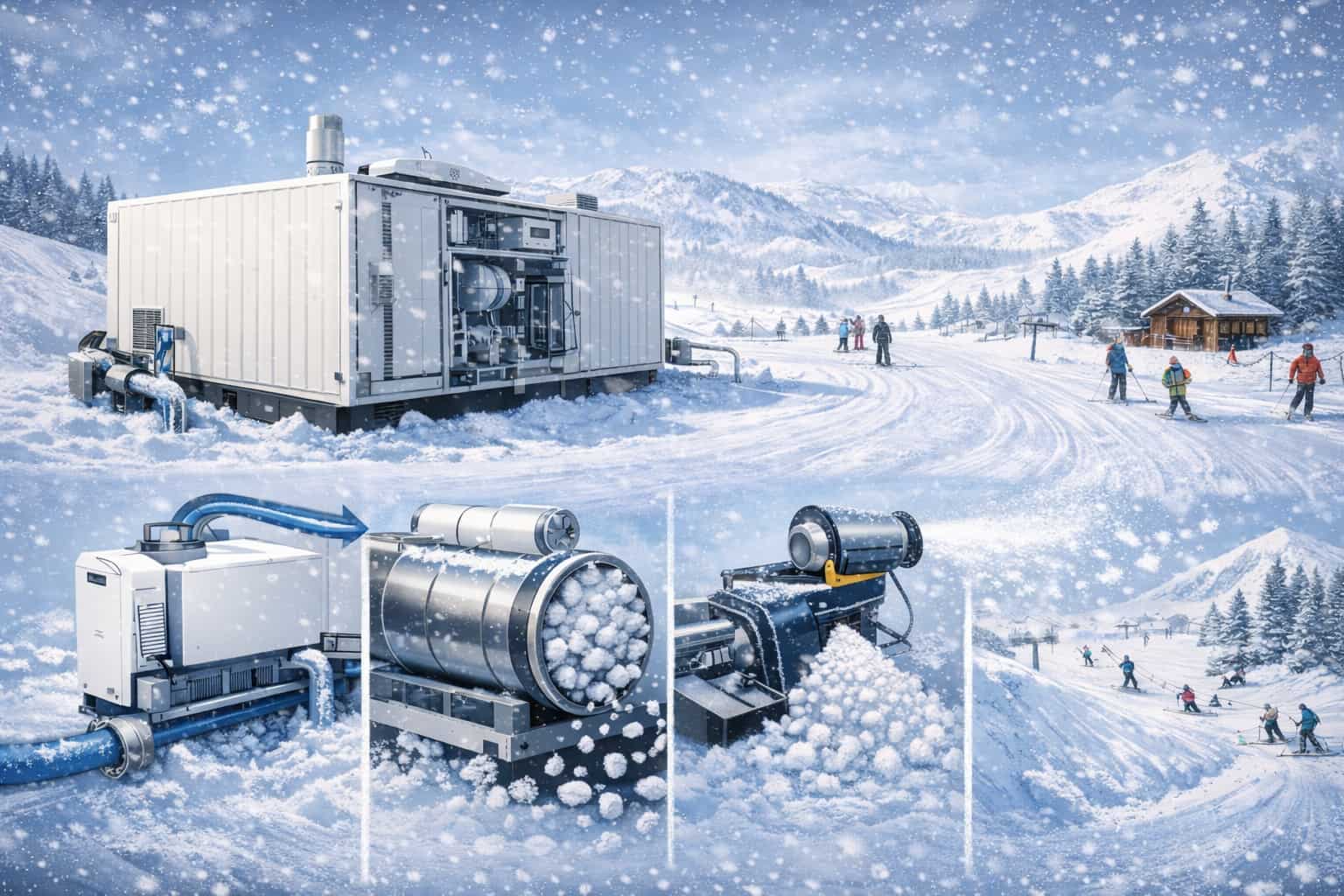
The SnowFactory flips this limitation entirely. Instead of depending on external temperatures, it creates its own cold environment inside a containerised refrigeration unit. Water enters the system, gets cooled to freezing point by an efficient heat exchanger, crystallises into snow inside the unit, and gets pumped out to the slopes regardless of whether it is -10°C or +30°C outside. The snow is made exclusively from water, with no chemical additives — it is real snow, just manufactured rather than fallen from the sky. That is a genuinely different operational proposition from traditional snowmaking.
The significance for the French ski industry is obvious. A resort with a SnowFactory can guarantee snow at specific high-value locations — the main pistes into the village, the critical learning areas, the race courses — regardless of what the weather is doing. That guarantees opening dates, supports late-season survival, and meaningfully reduces the business risk of running a ski resort in an era of warming winters. It is not cheap, but it is the most reliable insurance policy available against the climate risk that haunts the industry.
+35°C
Maximum ambient temperature at which the SnowFactory SF100 Plus 'Tropical' variant can produce real snow — true weather independence
207 m³/day
Maximum snow production of the SF210 variant per 24 hours (94 tonnes of snow)
43%
Share of French ski terrain covered by snowmaking systems in 2026, up from 20% in 2009
€4-8/m³
Typical operational cost of SnowFactory snow per cubic metre, including energy, water and amortised capital
Inside the Box
The Refrigeration Process, Step by Step
The SnowFactory fits inside a standard 40-foot shipping container — or multiple containers for the larger SF210 model — and the basic process follows four logical steps. Water intake: water enters the system at ambient temperatures between 5°C and 20°C for standard models, or up to 45°C for the 'tropical' SF100 Plus variant. Flow rates are approximately 1-2 litres per second depending on the unit, which is modest compared to traditional snow guns but adequate for continuous production of a meaningful snow volume over a 24-hour operating window.
Heat exchange: the refrigeration system extracts heat from the water, cooling it down to the freezing point. This is the energy-intensive part of the process — the compressors and heat exchangers doing the heavy lifting, with the SF100 Standard using roughly 21 kWh of electricity per cubic metre of snow produced. This energy intensity is the main operational cost, and it is why SnowFactory operations typically prioritise the highest-value snow placements (main pistes, learning areas, race courses) rather than general-coverage snow-building.
Ice formation: the cooled water crystallises into ice flakes or small ice particles inside the refrigeration unit. This is what distinguishes SnowFactory snow from conventional snow guns — the crystals form in a controlled interior environment rather than in variable outdoor air, which means the output is consistent regardless of ambient conditions. The ice particles are slightly denser and more uniform than natural snow, which actually makes them more durable on the slope surface (an operational advantage that reduces the total volume of snow required to maintain a ski-quality surface).
Snow delivery: the finished snow gets pumped out through pipes to the intended slope location — up to 150-200 metres horizontally and 20-50 metres vertically, depending on the model. This means a single SF100 unit can service multiple slope sections without trucking snow around, making installation and operation genuinely practical at typical French resort layouts. The refrigerants used are typically R717 (ammonia) for stationary installations or R449a for mobile units, with natural refrigerants increasingly preferred for environmental reasons.
SnowFactory Models: Capacity & Energy Comparison
SF100 Standard (100 m³/day)
SF100 Mobile (100 m³/day)
SF100 Plus Tropical (92 m³/day)
SF210 (207 m³/day)
Traditional snow guns (avg)
Natural snow
The Model Range
Which SnowFactory Variant Does What
TechnoAlpin offers several SnowFactory configurations to match different operational requirements. The SF100 Standard is the workhorse model: 100 cubic metres per day (approximately 45 tonnes of snow), 87 kW of power draw, 20.9 kWh per cubic metre of snow energy intensity, and operating windows from -10°C to +25°C ambient. It fits inside a single 40-foot container and can be installed in a few days with appropriate electrical, water and drainage connections. It is the typical starting point for a resort considering SnowFactory deployment.
The SF100 Mobile variant (100 m³ per day, 130 kW, 31.2 kWh/m³) is designed for short-term events and temporary installations — film productions, special events, one-off marketing activations. The mobile version sacrifices some efficiency for portability, but it makes the technology practical for use cases that do not justify a permanent installation. Several French resorts use mobile units for specific peak-demand weeks or special events rather than continuous operation.
The SF100 Plus 'Tropical' variant (92 m³, 210 kW, 48 kWh/m³, operates to +35°C ambient) is the extreme-heat version designed for indoor skiing facilities in hot climates and emergency use cases. It is substantially more energy-intensive than the standard variant, but it proves that the SnowFactory technology has no hard temperature limit — it is the same snow, at any ambient condition, with only the energy cost changing as the ambient gets hotter. This matters for the long-term climate-adaptation story: SnowFactory technology is genuinely future-proof against further warming.
The SF210 is the large-capacity version: 207 cubic metres per day (94 tonnes), 184 kW of power draw, 21.2 kWh/m³, in a double-container configuration. This is the model deployed at larger resort installations where continuous high-volume production is needed. It is roughly twice as energy-efficient per unit of snow as the mobile models and comparable to the SF100 Standard, making it the practical choice for any resort using SnowFactory as a core operational asset rather than a niche tool.
“SnowFactory is not a replacement for traditional snowmaking — it is a weather-independent insurance policy for the critical pistes, and that is exactly how the best French resorts are now deploying it.”
French Alpine Deployment
Where SnowFactories Are Actually Being Used
Several French resorts have deployed SnowFactory units for specific high-value use cases, typically around early-season opening, late-season survival, and critical race courses. Serre Chevalier, Le Grand Bornand, Le Corbier, Villard-de-Lans and a number of smaller resorts have integrated SnowFactory technology into their operational snowmaking strategy, alongside the much larger traditional snow-gun networks that remain the primary snow production tool for the bulk of piste coverage. SnowFactory is a specialist complement, not a replacement for conventional snowmaking.
The typical use case is the 'critical piste' — the main blue run from the lift down to the village, the learning area for ski schools, or the race course for an FIS event. These specific slopes generate the bulk of the resort's guest-experience and commercial value, and guaranteeing their snow coverage through SnowFactory deployment is a cost-effective way of protecting the resort's critical commercial assets. Full-domain SnowFactory coverage is not economically viable today and would not be the efficient use of the technology even if it were — the value comes from targeted high-impact deployment.
For resorts at the low-altitude end of the French Alps — notably several resorts in the Pyrenees and the Jura, and some low-altitude Haute-Savoie resorts where base-area snow is increasingly uncertain — SnowFactory represents a genuine operational lifeline. These resorts face the sharpest climate risk in the French ski industry, and their ability to guarantee at least the main pistes via SnowFactory investment is the difference between remaining a viable ski operation and gradually transitioning to a different business model. For buyers in those resorts, the local operator's commitment to SnowFactory investment is a very material signal about long-term viability.
| Model | Daily Output | Power | Energy/m³ | Max Ambient |
|---|---|---|---|---|
| SF100 Standard | 100 m³ (45 t) | 87 kW | 20.9 kWh | +25°C |
| SF100 Mobile | 100 m³ | 130 kW | 31.2 kWh | +25°C |
| SF100 Plus Tropical | 92 m³ | 210 kW | 48 kWh | +35°C |
| SF210 | 207 m³ (94 t) | 184 kW | 21.2 kWh | +25°C |
| Traditional snow gun | Variable | Low | Weather-dependent | -2°C wet-bulb |
| Natural snowfall | Weather-dependent | Zero | Zero | Any |
Economics
The Cost-Benefit of SnowFactory Deployment
A SnowFactory SF100 Standard unit costs roughly €400,000-€600,000 in capital terms, plus installation costs for water, power and drainage connections that can add another €100,000-€200,000 depending on the site. Operational costs are dominated by electricity — at typical French industrial rates and the SF100's 20.9 kWh/m³ energy intensity, producing 100 cubic metres of snow per day costs approximately €250-€400 in electricity alone, plus water supply, maintenance and labour. Total operational cost per cubic metre of SnowFactory snow typically lands in the €4-€8 range including amortised capital.
Compared to traditional snow guns, SnowFactory snow is considerably more expensive per unit volume — traditional snowmaking typically runs €1-€3 per cubic metre operationally, although with much higher capital footprint across an entire piste network. The cost differential is the price of weather independence: SnowFactory snow costs 2-4x as much as traditional snow, but it can be produced when traditional snow cannot. For critical-use-case applications where weather-dependent snowmaking fails, the extra cost is easily justified by the commercial value of the protected operation.
The broader economic logic is that SnowFactory is a targeted insurance policy, not a general-purpose snowmaking solution. Resorts deploy it to cover the specific high-value operational risks — opening-week snow security, closing-week survival, critical race courses, learning areas for ski schools — where failing to have snow would create disproportionate commercial damage. For the bulk of the piste network, traditional snowmaking combined with natural snow remains the economically correct choice. The two approaches are complementary, not substitutes, and the most sophisticated French resort operators are deploying both in parallel.
2009
TechnoAlpin begins SnowFactory R&D
TechnoAlpin begins developing the SnowFactory concept as a response to early evidence of climate risk in European ski resorts.
2013
First commercial SnowFactory installation
The first SnowFactory installation enters commercial operation at a European resort, proving the container-scale refrigeration concept.
2017-20
French resort adoption begins
Several French resorts, starting with mid-altitude operations most exposed to climate risk, begin deploying SnowFactory units as complementary operational tools.
2020-24
Tropical variant launched
TechnoAlpin launches the SnowFactory Tropical variant capable of producing snow at up to +35°C ambient, extending the operational envelope and proving genuine climate resilience.
2024
SF210 large-capacity deployment
The large-capacity SF210 variant enters wider deployment at larger French resorts needing continuous high-volume production for critical operational assets.
2025-26
Standard part of resort toolkit
SnowFactory technology becomes a standard part of the French ski industry's climate-adaptation toolkit, complementing rather than replacing traditional snowmaking in comprehensive operational strategies.
Climate Adaptation
What This Means for French Alpine Property Buyers
For property buyers looking at French Alpine investment with a 10-year horizon, SnowFactory deployment is one of several operational factors worth considering when assessing a resort's long-term climate adaptation posture. Resorts that have invested in SnowFactory technology are signalling that they take the climate risk seriously, that they have the capital to deploy sophisticated solutions, and that they are actively protecting their most commercially valuable operations against weather dependence. All of these are positive signals for long-term property buyers.
The resorts that benefit most from SnowFactory deployment are paradoxically not the highest-altitude giants (Tignes, Val Thorens, Val d'Isère, Les Deux Alpes) where snow is already reliable because of altitude. The biggest beneficiaries are the mid-altitude resorts in the 1,000-1,800m range where climate risk is real but operational viability remains strong — including several Portes du Soleil resorts, some Chablais and Beaufortain valleys, and lower-altitude Trois Vallées and Tarentaise villages. For buyers looking at these altitudes, SnowFactory investment by the local operator should be one of the factors on your due-diligence checklist.
For buyers at the highest-altitude end of the French market, SnowFactory is less relevant because the underlying snow security is already exceptional. But it still matters at the margins: even 2,200m resorts use SnowFactory technology for specific critical pistes, race courses and early-season preparation, and the broader commitment to climate-adaptation technology is a positive signal about the resort operator's capital discipline and long-term thinking. Our new-build ski apartments page covers inventory across the full altitude range, and the Domosno team can discuss how SnowFactory and other climate-adaptation tools apply to specific resorts on your shortlist.
The Limits
What SnowFactory Cannot Solve
SnowFactory is an impressive tool, but it is not a magic bullet for the climate challenges facing the French ski industry. It cannot economically cover the entire piste network of a major resort — the energy costs would be prohibitive, and the production capacity of even the largest SF210 units is small relative to total resort snow consumption. It cannot substitute for natural snow in terms of atmosphere, visual appeal, or off-piste terrain — SnowFactory snow sits on the groomed piste, not across the whole mountain. And it does nothing to solve the fundamental warming of winter ambient temperatures, which has broader impacts on operating windows, lift availability and guest experience beyond simple snow coverage.
What SnowFactory does solve is the specific operational risk of weather-dependent snowmaking failing at commercially critical moments. That is a real, measurable and valuable outcome — it is just one piece of a broader climate-adaptation strategy that also needs to include high-altitude terrain expansion, efficient traditional snowmaking, piste grooming optimisation, summer revenue diversification and long-term brand positioning. Resorts that treat SnowFactory as a single-point solution will be disappointed. Resorts that integrate it into a holistic adaptation strategy will be genuinely more resilient.
For property buyers, the takeaway is that SnowFactory adoption is a useful but not sufficient signal of climate adaptation. Look for resorts that are investing across multiple adaptation dimensions — new high-altitude lift infrastructure, expanding snowmaking coverage, summer revenue growth, energy efficiency, brand investment — rather than resorts making single-point bets on any one technology. The Domosno team tracks operational investment across French resorts as part of our ongoing market coverage, and we are happy to walk buyers through the full picture for specific resorts on their shortlist.
FAQs
Frequently Asked Questions
Is SnowFactory snow the same as natural snow?
It is real snow made from water with no chemical additives, but the crystal structure is slightly different from natural snowfall — denser, more uniform, and slightly more durable on the piste surface. Skiers cannot typically tell the difference once it is groomed onto the slope. SnowFactory snow performs similarly to well-conditioned traditional snow-gun snow from a skier's perspective, and it skis normally under all typical conditions.
Can SnowFactory replace traditional snowmaking entirely?
No, and it is not designed to. SnowFactory is a weather-independent tool for critical high-value snow production, but it is much more energy-intensive and has lower production volume than traditional snow-gun networks when cold weather allows them to operate. The economically correct strategy is to use both — traditional snow-guns for bulk coverage when weather allows, SnowFactory for guaranteed critical-use-case production regardless of weather.
Is SnowFactory climate-friendly?
It is more energy-intensive than traditional snowmaking per unit volume, but the environmental footprint depends heavily on the electricity source. French ski resorts drawing from the low-carbon French grid have meaningfully lower carbon-per-snow-cube than equivalent operations in higher-carbon grids. The use of natural refrigerants (R717 ammonia) in stationary installations also reduces the climate impact compared to older refrigerant technologies.
Which French resorts actually use SnowFactory?
Several resorts have deployed SnowFactory units, including installations at Serre Chevalier, Le Grand Bornand, Le Corbier, Villard-de-Lans and a growing number of mid-altitude operations. Large Tarentaise resorts also deploy SnowFactory for specific race courses and critical pistes alongside their traditional snowmaking networks. The technology is particularly important for resorts at 1,000-1,800m base altitudes most exposed to climate risk.
Should property buyers care about SnowFactory deployment?
Yes, particularly for mid-altitude resorts (1,000-1,800m) where climate risk is a material long-term consideration. Local operators' commitment to SnowFactory investment is a useful signal about climate adaptation and operational seriousness. For high-altitude resorts (1,800m+) the signal is less important because the underlying snow reliability is already excellent, but the operational investment is still a positive data point for long-term property confidence.
How much does a SnowFactory unit cost to deploy?
Capital cost for the SF100 Standard is roughly €400,000-€600,000 plus €100,000-€200,000 of installation for power, water and drainage connections. Operational costs are dominated by electricity — producing 100 m³ of snow per day costs approximately €250-€400 in electricity alone. Total cost per cubic metre of SnowFactory snow typically lands in the €4-€8 range including amortised capital.
Does SnowFactory use lots of water?
Water consumption is modest — approximately 1-2 litres per second flow rate for the standard models, which translates to around 100 cubic metres of water per day at full SF100 Standard operation. That is meaningfully less than traditional snowmaking because SnowFactory snow is slightly denser. Water supply is typically tapped from the same resort water infrastructure as traditional snowmaking operations, with minimal additional load on local water resources.
Where can I learn more about climate-adapted French resorts?
The Domosno team tracks operational technology investment across French resorts as part of our ongoing market coverage, including SnowFactory deployment, high-altitude lift expansion, snowmaking upgrades and summer revenue growth. We are happy to discuss how specific resorts on your shortlist are positioned for long-term climate resilience. Our resort guides cover the operational profile of each major French Alpine market in detail.