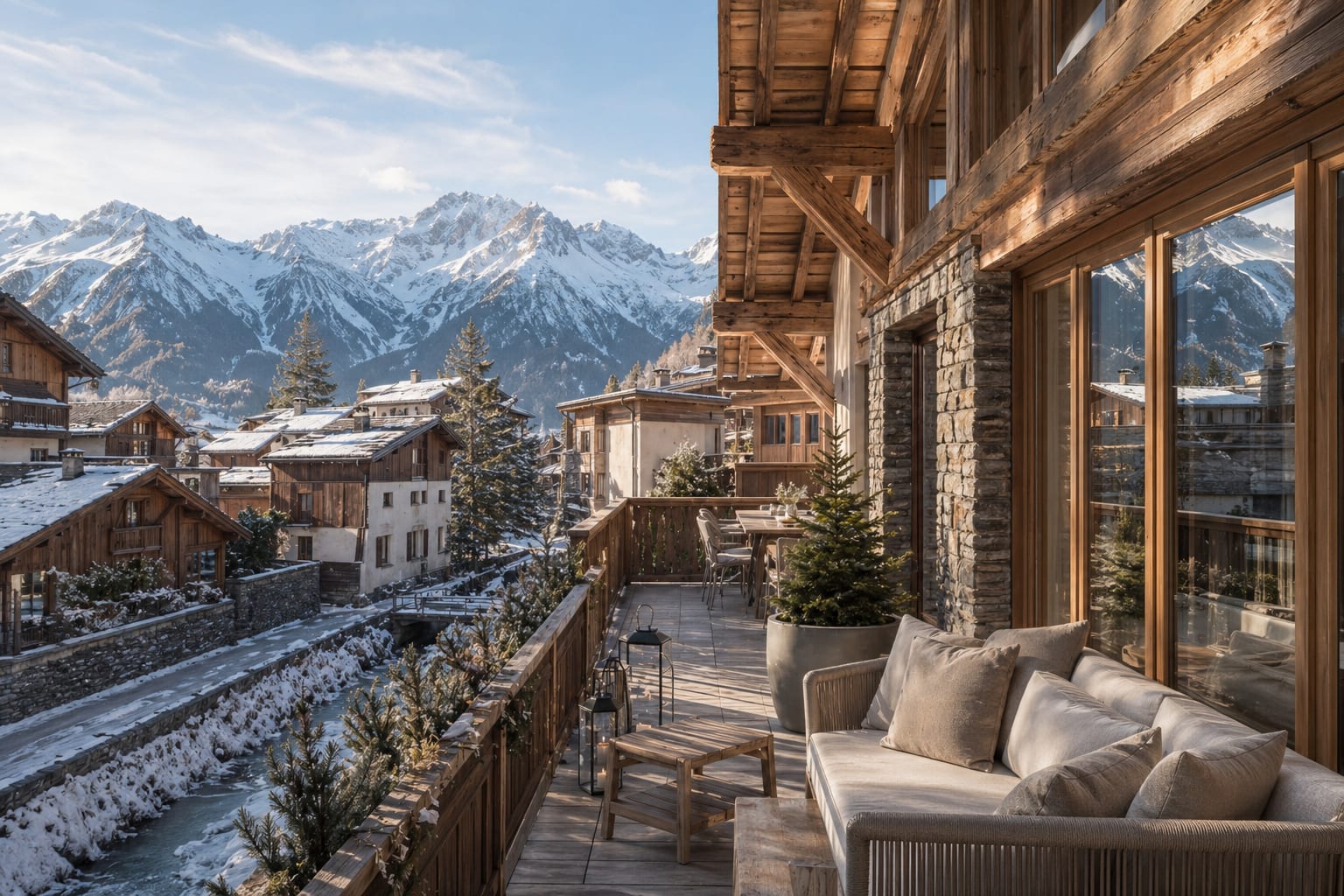
It is a Wednesday in early May, and a London-based fund manager who closed on a four-bedroom apartment in Courchevel 1850 the previous July is sitting in front of his laptop trying to make sense of a French tax form he had never heard of when he signed the compromis de vente. His notaire mentioned it in passing on completion day. His mortgage broker referenced it in an email a fortnight ago. His accountant — based in Mayfair, no French tax practice — has just sent a polite note saying it falls outside her remit. The form is the 2042-IFI. The deadline is sixteen days away. And the question he is now urgently typing into a French government search bar is whether the €2.4 million apartment he bought to ski with his children for one week a year has just inadvertently put him into the French wealth tax system.
This is the moment most international ski property buyers first discover the Impôt sur la Fortune Immobilière. Almost nobody hears about IFI when they begin a property search. It rarely features in the early conversations about frais de notaire, capital gains, or whether to buy through an SCI. It almost never appears in agent marketing or developer brochures. And yet, in the resorts where international demand is concentrated — Courchevel, Val d'Isère, Méribel, parts of Megève and Chamonix — the threshold at which IFI begins to bite is a number that single ski apartments routinely cross.
This guide explains how IFI works in 2026, which assets count, what you can legitimately deduct, how ownership structure changes the calculation, and which legal strategies meaningfully reduce the bill. It is written for non-residents holding, or considering, French ski property. The 2026 declaration window is already open: it opened on 9 April 2026 and closes on 21 May 2026 for online filings by non-residents.
What IFI Is — And What It Is Not
France replaced the old Impôt de Solidarité sur la Fortune (ISF) in 2018 with a property-specific successor, the IFI. The change was politically deliberate. The previous wealth tax had captured everything — equities, business stakes, art, jewellery, savings — and was widely blamed for capital flight. The IFI narrowed the base sharply. IFI applies only to real estate. Financial portfolios, life assurance contracts backed by financial units, business assets, cash, and movable goods all sit outside the calculation entirely.
The practical consequence is striking. A non-resident with a €3 million share portfolio and a €1.5 million chalet in Megève is assessed on the chalet alone. The portfolio is invisible to the French tax authority. By contrast, a non-resident holding €1.5 million directly in French real estate and nothing else is squarely inside the system. The asset class matters more than the headline wealth.
Assets that count include directly owned residential and commercial property in France, bare land, property held through SCIs (sociétés civiles immobilières) and other predominantly real-estate companies, the French property component of foreign corporate vehicles, usufruct rights over French property, and certain real-estate-backed unit-linked insurance contracts. According to service-public.fr, the perimeter is broad and includes effectively all real-estate rights, not just freehold ownership.
The Non-Resident Advantage: French Property Only
For buyers domiciled outside France, the IFI perimeter is limited strictly to real estate physically located in France. Global property wealth does not enter the calculation. A British buyer holding a ski apartment in Les Arcs, a villa in the Algarve, and a buy-to-let in Manchester is assessed on the French ski property alone. The Algarve and Manchester assets are simply outside the French tax authority's perimeter.
This is a meaningful structural advantage over French residents, who must declare their worldwide property estate. Even new arrivals establishing French tax residency benefit from a five-year transitional exclusion on foreign property holdings — but non-residents never face that exposure at all. For an international buyer treating French property as one part of a globally diversified estate, the geographic ring-fence is one of the most underappreciated features of the regime.
A nuance worth flagging: if you hold your French property through a company — a French SCI, a Luxembourg société à participation financière, an offshore vehicle — the French real-estate component still counts towards your IFI base. The form of ownership does not conceal the underlying asset. What it can do is alter how liabilities are calculated and how exposure is shared between owners, which is the point of the structuring section below.
The 2026 Threshold and Rate Schedule
You enter the IFI system only if your net French property estate on 1 January 2026 exceeds €1.3 million. Two points matter here. First, the tax does not apply only to the excess above €1.3 million — once you cross the threshold, the rate schedule applies starting from €800,001. Second, the relevant figure is net value: qualifying debts are deducted from gross property values before the rate schedule is applied. A décote smooths the entry-point cliff for net estates between €1.3 million and €1.4 million, calculated as €17,500 minus 1.25% of net taxable value.
The 2026 progressive rate bands, confirmed unchanged by the Loi de Finances 2026:
- Up to €800,000: 0%
- €800,001 to €1,300,000: 0.5%
- €1,300,001 to €2,570,000: 0.7%
- €2,570,001 to €5,000,000: 1%
- €5,000,001 to €10,000,000: 1.25%
- Above €10,000,000: 1.5%
A worked example makes this concrete. A non-resident owns a ski apartment in Méribel with a net taxable value of €1.8 million after deducting an outstanding French mortgage. The IFI bill flows through three bands: 0% on the first €800,000, 0.5% on the next €500,000 (€2,500), and 0.7% on the remaining €500,000 (€3,500). Total annual liability: approximately €6,000. At a €4 million net portfolio the liability rises to roughly €22,500 per year. At €6 million it crosses €37,000. These are recurring annual costs that materially affect the long-run economics of holding French ski property at the prime tier.
One important 2026 development to flag: the Loi de Finances 2026 introduced new anti-abuse rules around passive holding structures (holdings patrimoniales passives) and tightened the framework around the contribution différentielle sur les hauts revenus for very high earners. Neither directly changes the IFI rate schedule, but both tighten the environment in which structures designed to suppress taxable bases will be reviewed by the administration fiscale. Aggressive optimisation has always carried risk; in 2026 it carries more.
Equally significant is what the Loi de Finances 2026 chose not to do. There was substantive political debate in late 2025 about broadening IFI into a wider tax on idle or unproductive capital — a proposal sometimes labelled the impôt sur la fortune improductive, which would have pulled luxury vehicles, yachts, valuable art and certain financial assets back into the wealth tax base. The bill passed in February 2026 explicitly rejected this widening. The perimeter of IFI remains confined to real estate, no new rate brackets were introduced, and the €1.3 million threshold was left unchanged. Buyers planning over a five-to-ten-year horizon can work from the current framework with reasonable confidence; any future budget pressure would require fresh legislation before touching these rules.
How Each Property Is Valued
The starting point for each property is its market value on 1 January — the price at which it would change hands between willing parties on that date. There is no prescribed formula. Owners are expected to use comparable sales, recent valuations, or professional assessments. The administration fiscale has three years to challenge an understatement and can apply surcharges of 10% to 40% for negligent or deliberate undervaluation.
For directly owned property, you declare the gross market value, then deduct any outstanding French mortgage capital and other qualifying debts to arrive at the net taxable value. Properties held through an SCI are not exempt from the regime — you declare the proportional value of the underlying real estate corresponding to your shareholding. If an SCI holds a chalet worth €2.5 million and you own 50% of the company, €1.25 million enters your IFI base, subject to any qualifying SCI-level debt being deducted at the same proportion.
Holiday-let properties, including those operated under LMNP (Loueur en Meublé Non Professionnel) status, are taxable in full. The professional asset exclusion that can shelter certain genuine business assets from IFI does not extend to rental property, even where the activity is structured under a parahôtelier regime. This is a regular point of confusion for buyers who assume LMNP status delivers comprehensive tax protection — it materially helps with income tax and VAT recovery, but it does not remove the property from the IFI base.
Deductible Debts: Reducing the Taxable Base
French tax law permits a defined set of liabilities to be netted against gross property values. The most significant lever is the outstanding capital on a French acquisition mortgage on 1 January. Every euro of remaining mortgage principal reduces the taxable estate one for one. This is one of several reasons why carrying some French leverage on a ski property can make sense from an IFI perspective, even for buyers who could comfortably purchase outright.
Other deductible items include loans taken to fund renovation, construction or improvement work on the taxable property; the proportional share of company-level debt where property is held through an SCI; and certain outstanding property taxes due but unpaid on 1 January. Non-deductible items include personal consumption loans, family loans lacking genuine repayment terms, and any debt that cannot be directly linked to the taxable asset.
One important restriction applies at scale. Where net taxable assets exceed €5 million and deductible debts exceed 60% of that value, only 50% of the excess debt above the 60% ceiling is deductible. This anti-abuse provision targets structures where borrowing has been engineered primarily to suppress the taxable base rather than to finance genuine acquisition or works. For portfolios well below €5 million the cap has no effect, but it shapes planning at the very top of the market.
How to Declare: Form, Deadline and Process
IFI is declared alongside the annual income tax return, using annex form 2042-IFI, with the supplementary 2042-IFI-COV identification form for non-residents filing on paper. The 2026 online declaration service opened on 9 April 2026. The online deadline for non-residents is 21 May 2026 at 23h59. Non-residents filing on paper must post the completed declaration to the Service des Impôts des Particuliers Non-Résidents in Noisy-le-Grand by 19 May 2026, with the postmark date being the binding evidence of timely filing.
Online filing requires a French numéro fiscal and a registered account on the impots.gouv.fr portal. If you do not yet have one, see our guide to getting your French fiscal number as a non-resident property owner — without it, meeting the May deadline through the digital channel is impossible, and the paper deadline is two days earlier.
Late or missing declarations attract penalties: a 10% surcharge if you file within thirty days of a formal demand from the tax authority, rising to 40% for prolonged failure. Interest on late payment accrues at 0.20% per month. None of these penalties are extraordinary by international standards, but they make passive non-compliance a poor strategy. The French tax authority has good visibility on foreign-owned French real estate through the cadastre, the conservation des hypothèques, and an increasingly active programme of automatic exchange of information with major partner jurisdictions.
Three Legal Strategies to Reduce Your IFI Bill
1. Carry a French Mortgage
An outstanding French acquisition loan reduces the net IFI base directly, euro for euro. A property bought at €1.6 million with a €400,000 mortgage outstanding on 1 January produces a net IFI base of €1.2 million — comfortably below the €1.3 million threshold. The carrying cost of the loan must be weighed against the IFI saving, and against the broader portfolio question of whether French Euro-denominated debt makes sense relative to your home-currency cost of capital. But in many scenarios the arithmetic favours modest leverage — particularly given current French taux fixe mortgage rates and the fact that the deductibility runs across the entire holding period, not just at acquisition. This is one reason why thinking carefully about acquisition structure has consequences that extend well beyond completion day.
2. Structure SCI Debt at Company Level
Where property is held through an SCI, the company's liabilities reduce each shareholder's IFI base in proportion to their stake. By ensuring that any acquisition or renovation loan is carried at SCI level rather than in individual partners' names, the debt is shared between all shareholders proportionally. In a family SCI holding a €2 million chalet between four shareholders with a €600,000 SCI-level loan, each shareholder's net taxable share drops to €350,000 — well below the IFI threshold. The same loan held in a single individual's name would deliver a net base of €1.4 million for that one person, with the others taking the unmitigated €500,000 each.
SCI structuring also integrates naturally with succession planning, since shares can be transferred progressively over time, each transfer benefiting from the standard French parent-to-child allowance of €100,000 every fifteen years. For an explanation of how SCIs work in practice for international ski property buyers, see our guide to owning French property through an SCI.
3. Charitable Donations: 75% Direct Tax Reduction
Approved charitable donations generate a direct reduction of 75% of the donated amount against IFI due, capped at €50,000 of reduction per year (so a maximum donation of approximately €66,667). This is a credit against the tax itself, not a deduction from the taxable base. A taxpayer with an IFI liability of €10,000 who donates €13,340 to an approved foundation reduces their IFI bill to zero. Eligible recipients are tightly defined under article 978 du Code Général des Impôts: fondations reconnues d'utilité publique, certain higher-education establishments, social-insertion enterprises, and approved research organisations.
The mechanism is popular among property owners who carry both a meaningful IFI liability and philanthropic objectives. The donation must be made between the 2025 declaration deadline and the 2026 declaration deadline to count against the 2026 IFI bill. The receipt does not need to be attached to the declaration but must be retained in case of audit.
What This Means for Ski Property Buyers in 2026
For most non-residents acquiring a single sub-€1.3 million ski apartment in a mid-tier resort, IFI is irrelevant. The threshold genuinely is meant to capture wealth, and a one-bedroom apartment in La Rosière, La Plagne or Châtel bought outright with no other French exposure simply does not engage the regime. The conversation begins to matter at the prime tier — Courchevel 1850, Val d'Isère's Vieux Village, Méribel-Centre, the most desirable Megève addresses, the high-end Chamonix valley — and at the new-build chalet end of the market where €3 million plus is now the entry point in several flagship developments.
For buyers in that range, the planning is straightforward in principle and consequential in practice. Decide on ownership structure before signing the compromis de vente, not afterwards. Consider whether a French mortgage makes sense at the acquisition stage, even if you could buy outright. If the budget is at family-portfolio scale, evaluate an SCI architecture early. And budget for IFI as a recurring annual cost in the same way you would budget for taxe foncière, taxe d'habitation, syndic fees and maintenance — because it is one.
If you are weighing up the right ownership structure for a French Alps ski property purchase, the Domosno team works closely with French notaires and tax counsel and can help you understand the implications before you commit. Get in touch to start the conversation, or browse current inventory to see what is currently on the market across the major resorts.


