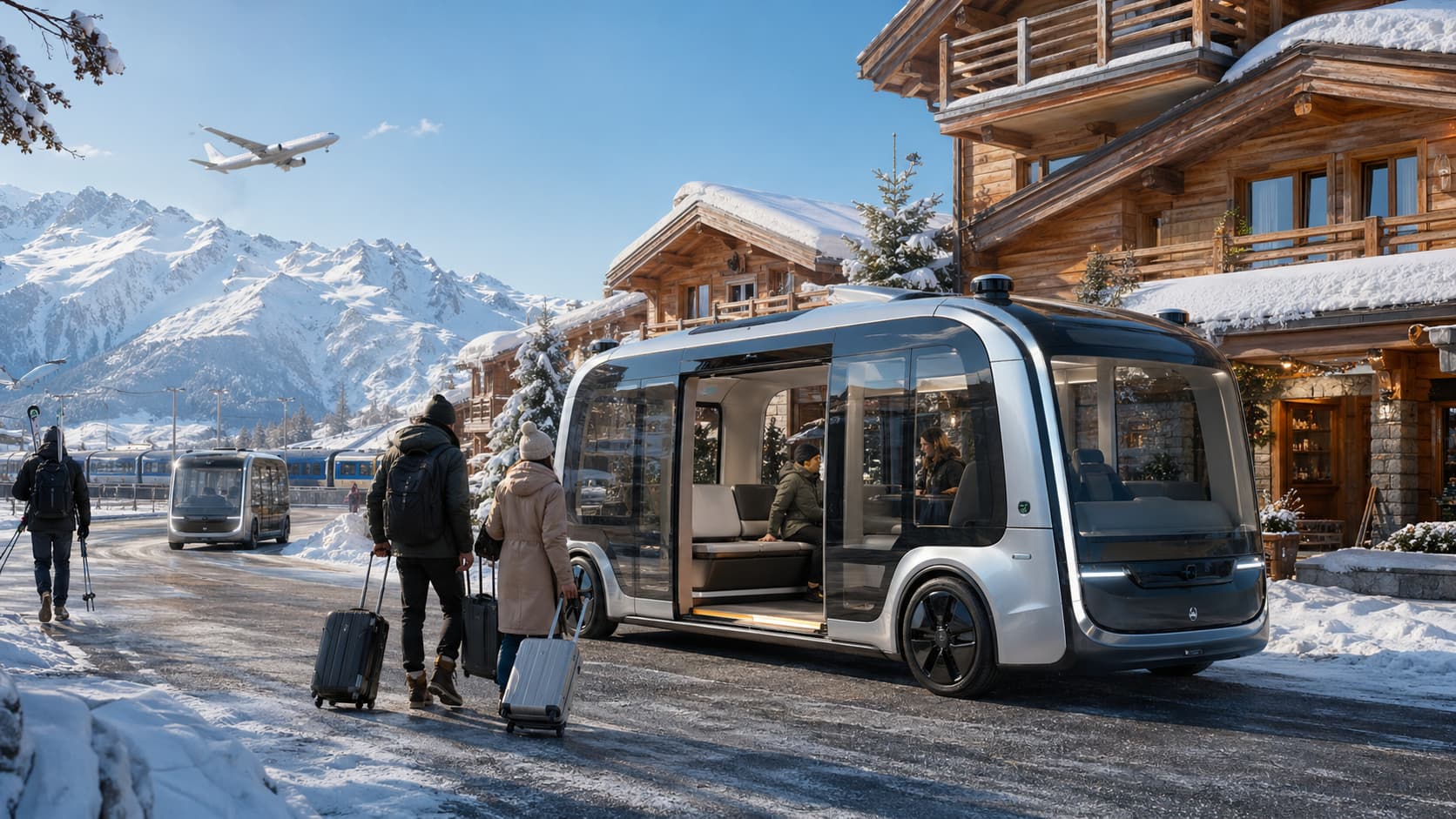
Something extraordinary is happening at the intersection of transport technology and real estate — and for buyers considering property in the French Alps, the consequences are far from abstract. Autonomous vehicle (AV) fleets are advancing from pilot programmes to mass deployment across Europe, with the World Economic Forum projecting that shared fleets could reduce private car ownership by up to 80 per cent within two decades. That is not a rounding error. It is a structural shift that will reprice land, reshape city planning, and fundamentally alter the meaning of 'well-connected' as a property attribute.
For investors in French Alps ski property, the AV revolution intersects with a trend that has long defined Alpine valuations: the so-called accessibility premium. For decades, the price of a ski property has been closely tied to transfer time from Geneva Airport. Properties within 90 minutes command a demonstrable premium; those at 2-plus hours face a discount. As autonomous shuttles, electric last-mile vehicles and AI-optimised routing begin to smooth out these differentials, the traditional pricing gradient across the Alps may compress — creating both risks and opportunities depending on where you buy.
This article examines the mechanics of the AV-driven real estate reshuffle, with particular attention to what it means for buyers considering new-build ski apartments and ski chalets for sale in the French Alps. We draw on the latest Geneva autonomous shuttle pilot data, European EV uptake figures, the 2026 Investropa French Alps market analysis, and Notaires de France transaction data to build a grounded, evidence-based picture of how the transport revolution will affect Alpine property values across the next decade.
The Big Picture
Why Autonomous Fleets Will Trigger a Global Real Estate Repricing
Property pricing, at its core, is a function of accessibility. We pay premiums for central locations because transport is scarce, fixed, and unpredictable. The train runs on a timetable. The car requires a driver. Parking is finite and expensive. Autonomous fleets disrupt all three constraints simultaneously — offering unlimited on-demand mobility without driver stress or parking costs, running 24 hours a day at consistent speeds via AI-optimised routing. When every address becomes equally accessible, the pricing differentials that reflect today's transport limitations begin to erode. Urban economists at Stanford and the National Bureau of Economic Research estimate that full autonomous vehicle deployment could reduce the urban-to-suburban price gap by 15-30 per cent in major cities — a redistribution of value on a scale not seen since the post-war motorway era.
The impact on urban land use is equally dramatic. In most major European and US cities, between 30 and 60 per cent of urban land is currently dedicated to roads, surface parking, and automotive infrastructure. When shared fleets eliminate the need for cars to park near their owners — because vehicles are in constant circulation — parking demand could drop by up to 90 per cent in dense urban centres. Multi-storey car parks become obsolete. Surface lots become developable land. The economic value of this reclamation is staggering: in cities like London or Paris, a single downtown car park occupies land worth tens of millions of euros. Multiplied across thousands of structures, the redevelopment opportunity is measured in the trillions globally.
For European buyers with investment portfolios spanning both urban and mountain properties, understanding which segments of the market are exposed to AV disruption — and which stand to benefit — is increasingly important due diligence. The French Alps sit in a particularly interesting position: a market that has always been defined by the logistics of getting there, and where improvements in transport connectivity have historically correlated directly with uplift in property values. The arrival of autonomous and electric transport technology is best understood not as a threat to Alpine values, but as the next chapter in a long history of infrastructure-driven repricing.
80%
Projected reduction in private vehicle numbers on urban roads within two decades as shared autonomous fleets scale (World Economic Forum)
€55M
Budget of the ULTIMO autonomous shuttle programme operating in Geneva — the gateway city for 60%+ of French Alps foreign property buyers
3.3%
Year-on-year growth in the 26-resort European Alpine Property Index in 2025, with French prime resorts posting up to 7.1%
3.2%
Approximate fixed-rate mortgage cost for non-resident buyers in early 2026, down from 4%+ in 2024, following ECB rate cuts
Geneva Corridor
The Alps Access Revolution: Geneva's Autonomous Shuttle Pilots and What They Signal
Geneva is already deploying autonomous electric shuttle technology. The ULTIMO project — an EU and Swiss government-funded initiative with a total budget of €55 million running from 2022 to 2026 — has been operating autonomous demand-responsive shuttles in the Geneva metropolitan area since 2024. Simultaneously, 45 driverless electric minibuses are programmed to run for a full year across three European cities including Geneva, in a programme with a budget approaching $60 million. These are not laboratory experiments. They are live, passenger-carrying deployments in one of Europe's most prosperous and property-sensitive urban environments.
Why does Geneva matter to Alpine buyers? Because roughly 60-65 per cent of foreign buyers in the French Alps route through Geneva Airport. The transfer experience — quality of road, traffic unpredictability, availability of professional transfer operators — is a direct input into both buyer decisions and rental guest satisfaction. As autonomous and electric shuttle services extend their range from central Geneva towards the Haute-Savoie border, they create a new type of resort access: pre-booked, door-to-door, without the stress of driving unfamiliar Alpine roads in variable weather. For rental guests in particular, the removal of the driving burden is a meaningful differentiator that could sustain or increase demand for properties in resorts with good A40 motorway connectivity.
Looking further ahead, the Estonian firm AuVe Tech's MiCa autonomous shuttle — now deployed in 17 countries — is specifically designed for the 'last-mile' problem that currently makes remote Alpine properties less attractive to rental guests: the gap between the nearest bus stop or train station and the property itself. As last-mile autonomous vehicles proliferate, properties that are currently penalised for being 5-10 minutes walk from the main lift or a 20-minute taxi from the train station could see that discount compress. For buyers considering Morzine properties or Les Gets properties where intra-resort distances are modest, this trend reinforces existing appeal; for more dispersed resorts, it opens up a wider range of viable locations for rental investment.
Geneva Transfer Time vs. 2025 Property Price Premium
Morzine / Les Gets (60–75 min)
Chamonix (80 min)
Méribel / Courchevel (90 min)
Les Arcs / Bourg-St-Maurice (110 min)
Les Deux Alpes / Alpe d'Huez (120+ min)
Isola / Serre Chevalier (150+ min)
Market Data
2025-26 French Alps Property Market: What the Numbers Say Now
Before mapping AV-driven repricing scenarios, it's essential to understand the current baseline. According to the Investropa 2026 French Alps Real Estate Market Analysis and Notaires de France transaction data, the market is performing solidly across most tiers. Savoie apartment prices average €6,350/m² at ski stations — up 46.5% over the past five years. Haute-Savoie sits at approximately €4,900/m² for apartments on average, with premier resorts pushing well above this. Morzine, one of the most in-demand Portes du Soleil resorts for British buyers, averages around €9,300/m², with apartments rising roughly 28% year-on-year in asking price terms — though notaire data shows actual selling prices more nuanced, with mid-range chalets lagging behind asking prices in some segments.
Alpine property benchmarks across a 26-resort European study show France's top performers outperforming the broader market: Méribel recorded 7.1% year-on-year growth, Alpe d'Huez posted 5.7%. Meanwhile the broader Alpine Property Index grew 3.3% year-on-year and 23% over five years. French resort appeal continues to centre on three factors: proximity to Geneva Airport, short-term rental demand, and the favourable new-build VAT reclaim structure available to buyers who enter managed rental programmes. Current ECB-linked mortgage rates for non-resident buyers have fallen to approximately 3.2% in early 2026, down from 4%+ in 2024, accelerating buyer activity after a period of relative caution.
Against this backdrop, the most useful lens through which to assess AV-driven value shifts in the French Alps is the accessibility gradient: the pricing differential between resorts at different distances from Geneva Airport. Currently, this gradient is steep — properties at 60-75 minutes from Geneva (Morzine, Les Gets, Megève, Chamonix) command a meaningful premium over equally well-equipped resorts at 90-120 minutes (Bourg-Saint-Maurice, Les Arcs, Val d'Isère). As autonomous and optimised-routing transport compresses effective travel times — and eliminates the stress cost of driving Alpine roads — this gradient is likely to flatten over the coming decade, benefiting buyers in currently undervalued resorts that sit just beyond the traditional 90-minute threshold.
“As shared autonomous fleets compress the effective travel time from Geneva to the Alps, properties currently penalised for distance may be the quiet winners of the next decade's transport revolution.”
The Death of the Garage Premium
How AV Technology Reshapes Urban Home Values — and What It Means for Second Homes
In urban markets, one of the most immediate value shifts driven by AV adoption is the collapse of the garage premium and the rise of conversion value. In cities where car ownership is declining fastest — London, Paris, Amsterdam — the garage has already shifted from a feature buyers pay for to a space buyers are quietly converting into living area. A typical double garage conversion adds 35-50 sq m of usable space; at London or Paris prices of €8,000-15,000/m², that represents €280,000-750,000 of value creation for a conversion costing €40,000-80,000. As autonomous ride-hailing eliminates the functional need for private garages, this trend will accelerate across European cities.
The second-home Alpine market has its own version of this dynamic. Many legacy ski properties — particularly pre-2000 builds — include substantial ski locker and boot room space, underground parking, and garage facilities that were designed for an era when owning a dedicated ski vehicle was assumed. As electric vehicle charging networks expand rapidly across the French Alps (Haute-Savoie now has over 1,200 public charging points, with major expansion underway ahead of the 2030 Olympics) and as autonomous rental vehicles make car ownership optional for resort visitors, some of this parking and storage infrastructure will become available for repurposing. For buyers assessing older chalets with large garages, this optionality is worth factoring into renovation budgets.
More broadly, the AV transition reinforces the investment case for new-build ski apartments over older resale stock in one key respect: new-builds are designed for the energy and connectivity standards of the coming decade rather than the assumptions of the past one. They include EV charging points, fibre connectivity, DPE-efficient envelopes, and flexible layouts. The buildings being delivered today in Morzine, Méribel and Alpe d'Huez are designed for the world in which a tenant or guest arrives by shared autonomous electric transfer, not by private petrol car. That alignment with the direction of travel is, in our view, the strongest structural argument for new-build premium in the current market.
| Resort Tier | Avg Price/m² (2025) | Geneva Transfer | AV/EV Connectivity Outlook | Investment Thesis |
|---|---|---|---|---|
| Haute-Savoie Premier (Morzine, Les Gets) | €9,000–9,900 | 60–80 min | Already strong (Geneva pilots) | Hold / premium maintained |
| Chamonix Valley | €9,900–14,000 | 75–90 min | EV infrastructure expanding | Strong long-term hold |
| 3 Vallées (Méribel, Courchevel, Val Thorens) | €12,000–40,000+ | 90 min | Grenoble EV corridor benefit | Prime / limited supply |
| Savoie (Les Arcs, Bourg-St-Maurice) | €5,500–7,500 | 105–115 min | 2030 Olympics investment active | Potential discount compression |
| Isère (Alpe d'Huez, Les Deux Alpes) | €5,000–6,500 | 110–130 min | Grenoble AV pilot proximity | Emerging value play |
New Investment Corridors
The 'Virtual Subway' Effect: Resorts That Benefit Most From Improved Connectivity
Urban economists use the phrase 'virtual subway' to describe how autonomous vehicle fleets, by providing on-demand mobility at consistent speeds via optimised routing, effectively extend the radius of convenient access around any given hub — flattening the distance-to-price gradient in the same way that a new metro line historically created a corridor of value appreciation. In the French Alps, the hub is Geneva Airport, and the 'virtual subway' effect of improving road-based transport technology will compress the effective travel time from the airport to resorts currently sitting in the 90-120 minute range.
Resorts most likely to benefit from this connectivity upgrade include those served by the A41/A43 motorway corridors to Savoie: Bourg-Saint-Maurice and Les Arcs, currently at approximately 110 minutes from Geneva, where property prices average significantly below the Haute-Savoie comparables. Les Deux Alpes and Alpe d'Huez, accessed via Grenoble (already a major tech-sector city where autonomous mobility pilot projects are active), similarly sit on the edge of the traditional accessibility premium zone. As electric and autonomous transport makes these journeys more consistent, more comfortable, and less stressful — particularly for non-EU buyers unfamiliar with Alpine driving conditions — the buyer pool for these resorts will expand.
For investors with a 5-10 year horizon, this compression of the accessibility gradient argues for selective consideration of second-tier resort pricing that has not yet priced in improving transport. This is not a call to buy speculatively in remote locations; rather, it is an argument that well-connected, well-invested resorts like Les Arcs and Les Deux Alpes, which currently trade at a 30-40% discount to comparables in Morzine or Les Gets despite offering equivalent or superior skiing, may see that discount narrow as road-based transport technology advances over the next decade. Our buying process guide outlines how to assess this kind of longer-duration investment case.
2023
Geneva autonomous bus pilots begin
The Belle-Idée demand-responsive autonomous shuttle project launches in Geneva, providing the first live proof-of-concept for AV public transport within the Alps gateway city.
2024
ULTIMO project goes live
EU and Swiss government-funded ULTIMO project (€55M budget) begins operating autonomous on-demand shuttles in the Geneva area, with a four-year programme running through 2026.
2025
French Alps EV network expands
Haute-Savoie surpasses 1,200 public charging points as France accelerates EV infrastructure investment in advance of the 2030 Winter Olympics, improving practicality for electric vehicle travel to Alpine resorts.
2026
Mortgage rates fall; buyer activity rebounds
ECB rate cuts push non-resident mortgage rates below 3.2%, re-energising the Alpine buyer market after a 2023-24 period of caution. French Alps prices forecast to rise 3-7% through 2026.
2028–29
Pre-Olympics infrastructure surge
Lyon-Turin rail improvements, expanded clean mobility networks and resort access upgrades go live as France prepares for the 2030 Winter Olympics — independently improving connectivity to second-tier Savoie and Isère resorts.
2030+
AV gradient compression accelerates
As private and commercial AV fleets reach critical mass in the Geneva-Alps corridor, the 90-minute rule of thumb for premium pricing begins to erode — with well-positioned second-tier resort properties the likely beneficiaries.
2030 Olympics Factor
Infrastructure Convergence: How the 2030 Winter Olympics Amplifies the Transport Story
The autonomous vehicle story does not exist in isolation for the French Alps. It intersects with a parallel infrastructure investment programme driven by the 2030 Winter Olympics, awarded jointly to the French Alps and the Pyrenees. France has committed to major transport infrastructure upgrades as part of its Olympics preparation — including improvements to the Lyon-Turin rail link, expansion of Grenoble's transport network, and significant investment in clean mobility infrastructure across Savoie and Haute-Savoie. This represents a public investment programme that will independently improve accessibility for the same resorts that stand to benefit from private-sector autonomous transport technology.
Historically, Olympic host city properties outperform in the years preceding the Games as infrastructure investment creates genuine accessibility improvements and global media coverage raises resort profile among international buyers. The 2030 Games announcement has already catalysed increased inquiry volumes for Les Deux Alpes, Alpe d'Huez, Serre Chevalier, and Isola 2000 — resorts that appear in the 2030 programme. For buyers who understand the transport thesis, the 2030 infrastructure story provides a near-term catalyst for the longer-term AV-driven accessibility repricing argument: public investment accelerates what private technology will eventually deliver regardless.
The convergence of AV technology, electrification, 2030 Olympic investment, and the ECB rate-cutting cycle creates what may be one of the most favourable structural alignments the French Alps property market has seen in a generation. Buyers who understand the transport thesis — and who position themselves in resorts that sit on the right side of the improving accessibility curve — have the opportunity to acquire property in what may, in retrospect, prove to be the last years before the current distance-based pricing discount is fully eroded. Our ski property investment guide explores these dynamics in detail for investors ready to act.
Buyer Takeaways
What the AV Revolution Means in Practice for French Alps Property Buyers Today
For buyers actively considering a purchase in the French Alps in 2025-26, the autonomous vehicle revolution is a horizon risk and opportunity rather than an immediate market force. No French Alpine resort has yet seen property values move visibly in response to AV deployment. But the groundwork is being laid: Geneva's ULTIMO autonomous shuttle project runs through 2026, Grenoble is an active EV transport pilot city, the French government has committed to phase out new petrol car sales by 2035, and the 2030 Olympics preparation is accelerating clean mobility investment across the region.
The practical implications for buyers are threefold. First, new-build properties with EV charging, fibre connectivity, and flexible floor plans are better positioned for the 2030-2040 rental market than pre-2000 buildings without these features — reinforcing the existing case for buying off-plan in VEFA schemes where you control the specification. Second, the 90-minute rule of thumb for Geneva transfer time is likely to become less rigid as a pricing driver over the coming decade — meaning buyers who anchor their search to the traditional Haute-Savoie cluster may be over-paying for a premium that will partially compress. Third, resorts currently sitting just beyond the traditional premium threshold — Les Arcs, Les Deux Alpes, Bourg-Saint-Maurice — deserve a closer look from investors with a 7-10 year horizon, particularly where infrastructure investment is active.
None of these observations should distort the fundamentals of a well-considered Alpine property purchase: buy in a resort you enjoy visiting, target a building with strong rental credentials, ensure your mortgage and tax structure is correctly set up from the outset, and work with advisors who understand both the French legal framework and the rental management landscape. The AV revolution is a tailwind for the market broadly, and a differentiator between individual positions within it. The Domosno team has been advising buyers across the full French Alps market since 2005 and can help you identify the assets best placed to benefit from the transport transition.
FAQs
Frequently Asked Questions
How quickly will autonomous vehicles actually affect Alpine property prices?
AV-driven repricing is a 5-15 year story rather than an immediate event. Geneva's autonomous shuttle pilots are real but limited in scale. The most likely near-term impact is on rental guest experience — smoother, less stressful transfers — rather than on capital values. For buyers with a 10+ year horizon, the 'virtual subway' compression of the Geneva-to-Alps distance premium is a genuine structural consideration when choosing between resort tiers.
Which French Alps resorts are most exposed to improving transport connectivity?
Resorts currently sitting just beyond the traditional 90-minute Geneva premium threshold stand to benefit most: Les Arcs and Bourg-Saint-Maurice in Savoie, and Alpe d'Huez and Les Deux Alpes in Isère. These currently trade at meaningful discounts to Haute-Savoie comparables. As AV and EV transport improves the Geneva-to-Savoie and Geneva-to-Grenoble corridors, and as 2030 Olympics investment adds infrastructure, that discount may compress over the coming decade.
Are Morzine and Les Gets at risk from the accessibility repricing thesis?
No — these resorts benefit from the AV story rather than being threatened by it. At 60-75 minutes from Geneva, they will remain among the most accessible French Alps resorts regardless of transport improvements elsewhere. The risk for buyers in these markets is different: overpaying for an accessibility premium that becomes partially commoditised. But given the quality of skiing, family appeal, and rental demand fundamentals in Morzine and Les Gets, valuations appear well-supported on multiple grounds beyond pure transfer time.
Does the 2030 Winter Olympics materially change the investment case?
Yes, particularly for Savoie and Isère resorts featuring in the 2030 programme. Historically, Alpine host cities see above-average price growth in the 5-7 years preceding the Games as infrastructure investment delivers genuine accessibility improvements and global media profile raises buyer awareness. Resorts like Les Deux Alpes, Alpe d'Huez and Serre Chevalier have already seen increased enquiry volumes following the 2030 announcement, and the parallel Olympic infrastructure investment directly accelerates the transport improvement thesis.
How does the electric vehicle charging infrastructure affect ski property rental appeal?
Increasingly directly. Many rental guests now arrive by electric vehicle, and properties without charging facilities score lower in guest satisfaction surveys and on booking platforms that filter by EV charging. Haute-Savoie surpassed 1,200 public charging points in 2025, and the network is expanding. New-build properties with dedicated EV charging bays are materially better positioned for the 2026-2030 rental market than older buildings without this infrastructure.
What's the best structure for a French Alps investment property given the AV and transport outlook?
New-build VEFA in a resort with good motorway access, EV infrastructure, and year-round appeal remains the strongest structure. The VEFA regime provides 20% VAT reclaim (typically €80,000–120,000 on a standard apartment), reduced notaire fees of 2-4% versus 7-9% on resale, and modern DPE-efficient builds designed for the transport landscape of the coming decade. Our French mortgage calculator and buying process guide on domosno.com walk through the financial mechanics in detail.
Are autonomous vehicles already operating in ski resort areas?
In limited form, yes. An autonomous ski vehicle concept has been demonstrated for use on mountain terrain, and last-mile autonomous shuttles from firms like AuVe Tech (deployed in 17 countries) are specifically designed for the final-mile connectivity gap that affects resort guests. Commercial resort deployment is still several years away, but the technology is proven and the economics are improving rapidly as manufacturing volumes grow.
How should I factor transport technology trends into my budget and timeframe?
For most buyers, transport technology is a background tailwind rather than a primary investment driver. Buy in a resort you enjoy, at a price sustainable on realistic rental yields, with a mortgage and tax structure set up correctly. The AV and transport improvement thesis is most useful for buyers comparing two equally attractive options in different resort tiers — it provides additional conviction for the one with better future connectivity. The Domosno team can help frame these comparisons clearly as part of a structured buying consultation.


